+91 9312966129
 sparc.enquiry01@gmail.com


SQL vs Python for Analytics Career
Confused about SQL vs. Python for analytics? Compare real use cases, career paths, and skills needed to pick the best language for data analytics.

Table of Contents
- What is SQL and Why Analysts Use It
- What is Python and Where It Fits In
- SQL vs Python for Analytics: A Side-by-Side Comparison
- Which One Should You Learn First?
- Real Career Scenarios: What You Actually Need
- If you're targeting a Business Analyst or MIS role
- If you're targeting a Data Analyst role
- If you're targeting a Data Scientist or ML role
- If you're a business owner trying to make data-driven decisions
- Common Mistakes People Make When Choosing Between SQL and Python
- So, What's the Best Language for Data Analytics?
- SQL vs Python for Analytics: A Quick Decision Guide
- Local Context: Analytics Careers in Delhi NCR
- Final Thoughts
If you're trying to break into data analytics, you've probably run into the same debate everywhere — SQL vs. Python for analytics, and which one actually gets you hired faster. The honest answer isn't as simple as picking a side. It depends on the role you're targeting, how much time you have, and what kind of problems you'll be solving day-to-day.
This guide breaks down what SQL and Python actually do in an analytics job, where each one wins, and how to decide what to learn first — without the hype. If you're new to the field, start with this beginner guide to data analytics before deciding which technical skills to learn first.
What is SQL and Why Analysts Use It
SQL (Structured Query Language) is how you talk to databases. Almost every company — from a Delhi NCR startup tracking user sign-ups to a bank managing transaction records — stores its data in some form of relational database. SQL is the language you use to pull, filter, and summarize that data. Students who are new to SQL can start with this SQL basics tutorial for students to understand queries, filtering, and other core concepts.
A typical analyst's day might involve writing a query to find last month's top-performing product categories, or checking how many customers dropped off after a specific step in a sign-up flow. SQL handles this kind of structured, table-based work directly and efficiently.
Where SQL is used in analytics roles:
- Extracting data from company databases (MySQL, PostgreSQL, SQL Server, BigQuery)
- Building reports for sales, marketing, or operations teams
- Joining multiple tables to answer business questions
- Aggregating data — totals, averages, counts, trends over time
- Powering dashboards in tools like Power BI or Tableau
What is Python and Where It Fits In
Python is a general-purpose programming language that, in analytics, is mainly used for tasks SQL isn't built for — cleaning messy data, automating repetitive work, statistical analysis, and building predictive models. If you're new to Python, this Python basics for data analytics guide can help you build the fundamentals before moving into pandas and advanced analysis.
Where SQL asks "what does the data show," Python often asks "what can I do with this data beyond reporting it." If you're merging data from five different Excel files, scraping information from a website, or building a forecasting model, Python is usually the better tool. For data manipulation and analysis with Python, you can also explore the official pandas documentation.
To understand how these technologies fit into an analytics workflow, explore these data analytics tools you should know.
Where Python is used in analytics roles:
- Cleaning and reshaping messy or inconsistent datasets (via pandas)
- Statistical testing and deeper exploratory analysis
- Data visualization (matplotlib, seaborn, plotly)
- Automating recurring reports instead of doing them manually
- Machine learning and predictive modeling, when the role calls for it
SQL vs Python for Analytics: A Side-by-Side Comparison
When you actually sit down and compare the two feature by feature, the differences become a lot clearer than they sound in forum debates.
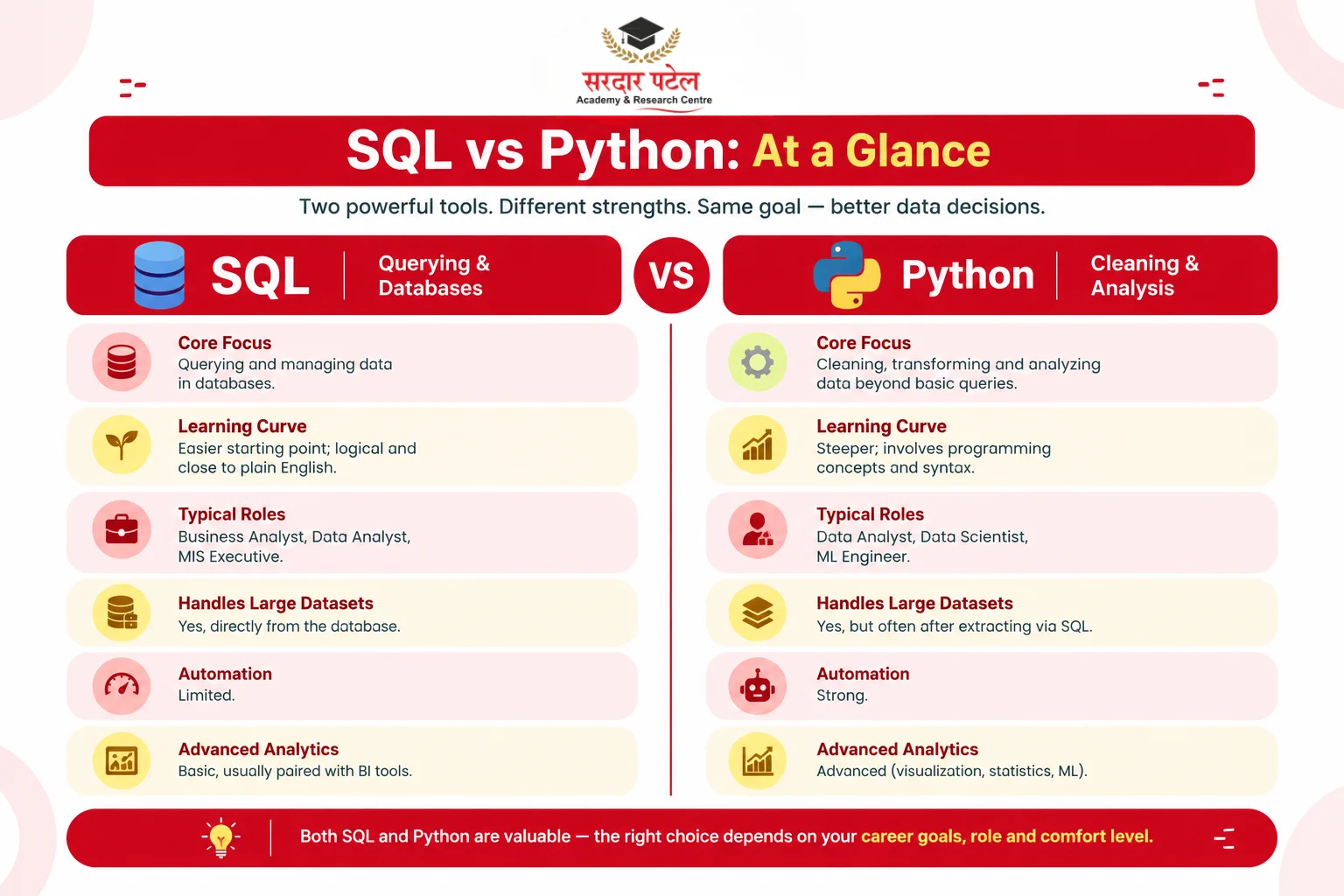
| Factor |
SQL |
Python |
| Primary use |
Querying and managing structured data in databases |
Data cleaning, analysis, automation, modeling |
| Learning curve |
Easier for beginners; logical, close to plain English |
Steeper; involves programming concepts |
| Typical roles |
Business Analyst, Data Analyst, MIS Executive |
Data Analyst, Data Scientist, Analytics Engineer |
| Handles large datasets |
Yes, directly from the database |
Yes, but often after extracting via SQL |
| Automation capability |
Limited |
Strong |
| Visualization |
Basic, usually paired with BI tools |
Advanced, highly customizable |
| Statistical/ML work |
Not designed for this |
Well-suited for this |
This table is a good starting point for weighing your options based on your target job role rather than just personal interest.
Which One Should You Learn First?
For most beginners and students, SQL is the more practical starting point. Here's the reasoning:
- Job listings ask for it first. Even entry-level analyst roles across Delhi NCR's IT and BFSI-heavy job market routinely list SQL as a baseline requirement — often before Python.
- The learning curve is gentler. SQL syntax reads close to plain English (SELECT, WHERE, GROUP BY), so you can get productive within weeks, not months.
- It builds your data intuition. Understanding how data is structured in tables and how to join and filter it makes learning Python's data libraries (like pandas) much easier later.
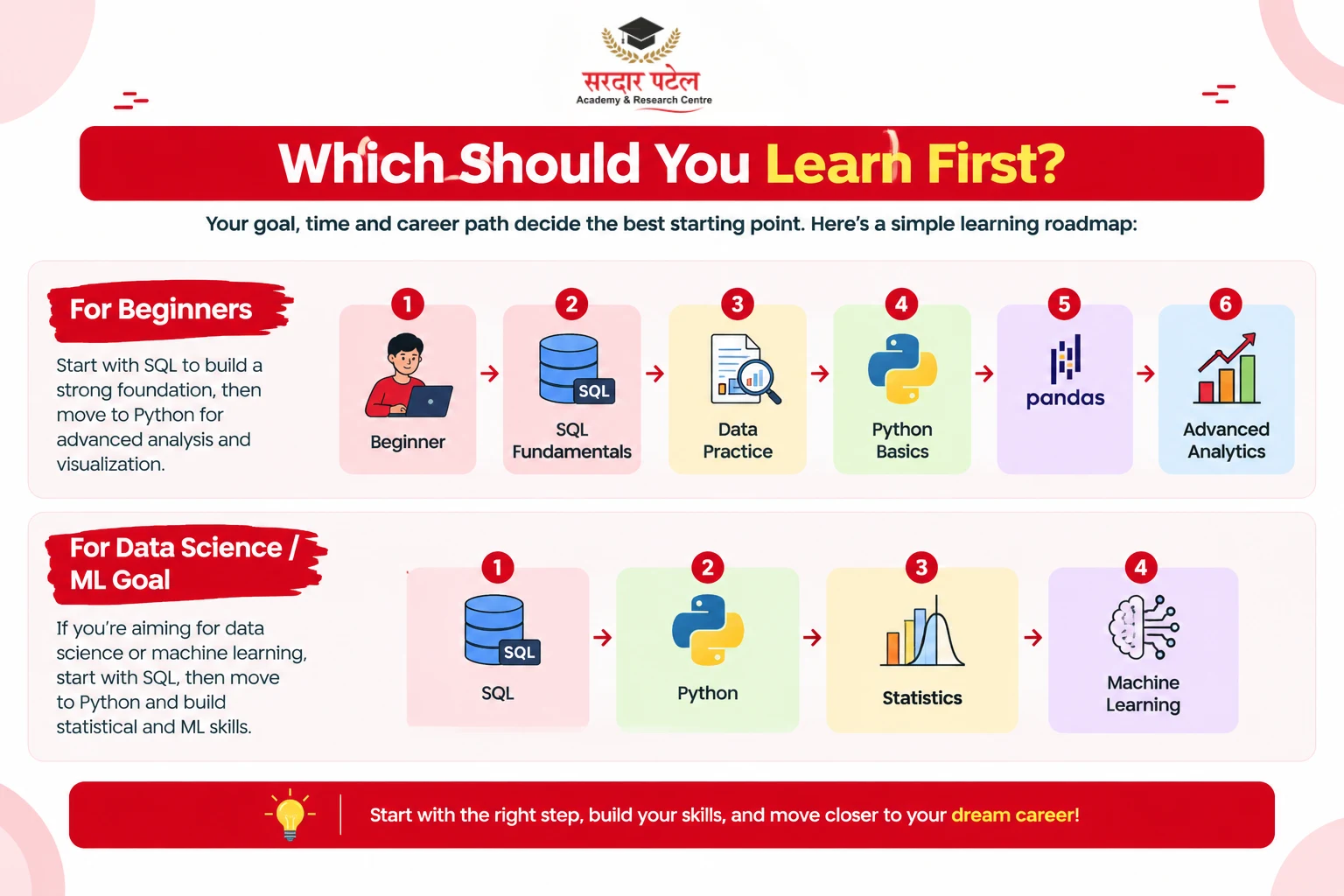
That said, if your goal is a data science or machine learning career specifically, you can't stop at SQL. If you're unsure how to build these skills step by step, follow this structured data analytics learning path
Python becomes essential once you're building models or doing anything beyond descriptive reporting. This is really the core of the decision — it's less about which language is "better" and more about which stage of your career you're in.
Real Career Scenarios: What You Actually Need
Rather than treating this as an abstract debate, it helps to map it to actual job titles. If you're also exploring formal training, this guide explains data analytics skills and career options in more detail.
If you're targeting a Business Analyst or MIS role
SQL typically covers the large majority of your daily tasks in these roles — pulling reports, filtering data, and running recurring queries. Some roles may never require Python at all, especially in operations-heavy or reporting-focused positions.
If you're targeting a Data Analyst role
You'll need both. SQL to pull and shape the data, Python (or Excel, depending on the company) to clean it further, analyze patterns, and sometimes build visualizations beyond what BI tools offer.
If you're targeting a Data Scientist or ML role
SQL is still necessary — you can't build a model on data you can't retrieve — but Python becomes your primary working language for the actual analysis and modeling.
If you're a business owner trying to make data-driven decisions
You may not need to code at all. Understanding what SQL- and Python-based analytics can tell you — and knowing what questions to ask your analytics team — often matters more than writing the queries yourself.
Understanding the broader data analytics career skills and scope can also help you decide which technical skills to prioritize.
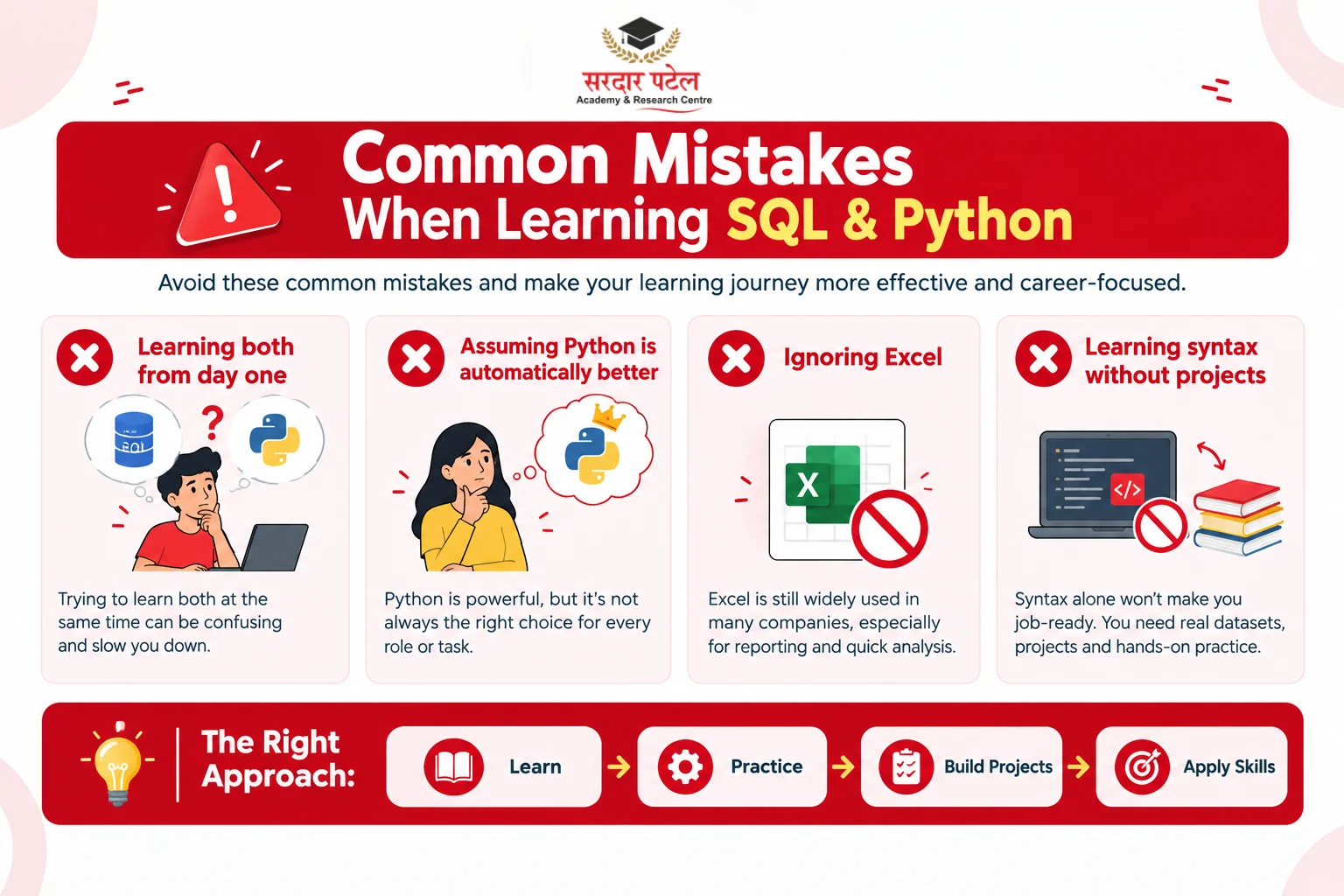
Common Mistakes People Make When Choosing Between SQL and Python
- Trying to learn both at once from day one. This usually leads to shallow knowledge of both instead of real competency in either.
- Assuming Python is "more advanced" so it's automatically better to learn. Advanced doesn't mean more useful for your specific role — a Business Analyst fluent in SQL is often more employable than one with surface-level Python knowledge.
- Ignoring Excel entirely. Many entry-level analytics roles in India still lean on Excel alongside SQL, especially in smaller organizations.
- Learning syntax without solving real problems. Watching tutorials without practicing on actual datasets is one of the biggest reasons beginners stall out.
So, What's the Best Language for Data Analytics?
If you're searching for the single best language for data analytics, the honest answer is that it isn't a single-language decision — it's a sequencing decision. Most working analysts use SQL for extraction and Python (or R) for deeper analysis. They're complementary tools, not competitors. Framing this as a head-to-head contest misses the point a little — in practice, most analysts end up using both.
A practical learning path looks like this:
- Start with SQL fundamentals — SELECT statements, filtering, joins, aggregations
- Practice on real, messy datasets rather than only clean sample data
- Move to Python basics — variables, loops, functions
- Learn pandas for data manipulation once your Python fundamentals are solid
- Add visualization libraries and basic statistics as your projects demand them
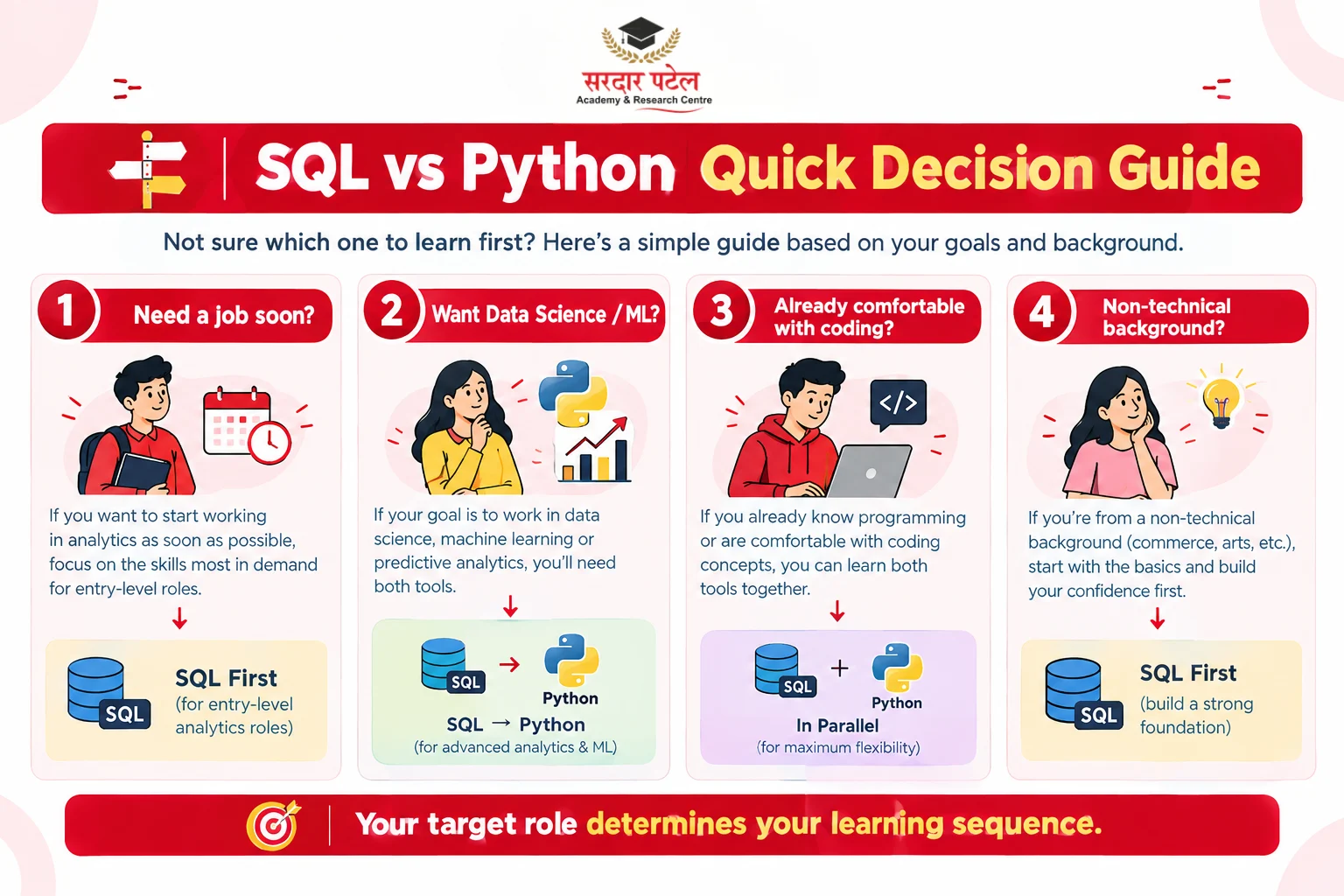
SQL vs Python for Analytics: A Quick Decision Guide
Still stuck deciding between SQL and Python for analytics? Use this quick filter:
- Short on time, need a job soon? Start with SQL — it has a faster path to job-readiness.
- Aiming for data science or ML long-term? Learn SQL first, then move to Python seriously within a few months.
- Already comfortable with logic/coding? You can run SQL and Python learning in parallel, but keep SQL slightly ahead.
- Non-technical background? SQL first, without exception. It builds confidence before you tackle programming concepts.
Whichever path you pick, the question tends to answer itself once you know the specific job title you're aiming for.
Local Context: Analytics Careers in Delhi NCR
The Delhi NCR job market spans a wide mix of sectors — IT services, BFSI, e-commerce, consulting, and a growing number of startups — and each tends to weight SQL and Python differently. IT services and BFSI firms often prioritize strong SQL skills for reporting-heavy roles, while product-based companies and startups are more likely to expect working Python knowledge alongside SQL, even at junior levels.
For students and working professionals based in or around Delhi NCR, this makes it worth checking actual job postings in your target sector before deciding how much time to invest in each language — the "right" skill mix genuinely varies by industry here, and the split you'll need often comes down to which sector you're applying to.
Final Thoughts
The SQL vs Python for analytics question isn't really about picking a winner — it's about sequencing your learning around the role you actually want. SQL gets you job-ready faster and is non-negotiable for almost every analytics role. Python extends what you can do once you're ready to go beyond reporting into deeper analysis or modeling.
Weighing your options on your own can feel overwhelming without a clear sense of where your current skills already stand. For students and parents exploring structured analytics training, you can also read what parents say about data analytics training before choosing a learning path.
If you're still figuring out your path, it's worth getting a structured view of your strengths before committing months to either one. At SPARC, you can compare your analytics skills and map out a learning sequence that actually matches the roles you're targeting. Explore the SPARC Data Analytics course for a structured, mentor-guided path through SQL, Python, and the tools covered in this guide.
FAQs
Both are typically needed, but SQL is usually the first requirement listed in data analyst job postings, since most data lives in databases that SQL is built to query.
Yes, particularly for business analyst, reporting analyst, or MIS-type roles. Data science and advanced analytics roles, however, will require Python or R as well.
With consistent, hands-on practice, most beginners can become comfortable with core SQL concepts (SELECT, WHERE, JOIN, GROUP BY) within a few weeks — the exact timeline depends on prior experience and time invested. Mastery of advanced query optimization takes longer.
Python isn't strictly necessary for every analytics role, but it's increasingly expected for analysts who need to clean large datasets, automate reports, or go beyond what BI tools can do.
One at a time is generally more effective. Learning SQL first gives you a foundation in how data is structured, which makes Python's data libraries easier to pick up later.
Compensation depends more on role seniority, industry, and company than on the specific language. for any current salary figures, since these vary significantly by city, company size, and experience level.
No. SQL knowledge transfers directly — most Python data work (via pandas) still involves filtering, grouping, and joining data, just with different syntax.
SQL, for most entry-level and business-facing analytics roles — it's the more universally required skill. But treat it as a starting point, not a final destination, if you want long-term flexibility.