+91 9312966129
 sparc.enquiry01@gmail.com


How Chat-GPT is Changing Analytics Careers
Discover how Chat-GPT is transforming data analytics careers, changing analyst roles, and the key AI, technical and business skills professionals need to stay ahead.
Table of Contents
- Why ChatGPT Is Transforming Data Analytics
- The Growing Role of ChatGPT in Data Analytics
- Key Trends Changing Analytics Careers
- AI-Assisted Analytics
- Natural Language Analytics
- Smarter Data Visualisation
- Automated Documentation
- Data Storytelling Is Becoming Essential
- Human + AI Collaboration Is the Future
- What's Driving AI Adoption in Analytics?
- Impact on Analytics Roles
- Data Analyst
- Business Analyst
- Business Intelligence (BI) Developer
- Data Scientist
- SQL Developer
- Analytics Consultant
- Skills Shift and How to Prepare
- Strengthen Your Technical Foundation
- Learn AI Tools Responsibly
- Build Business Knowledge
- Improve Communication Skills
- Develop Critical Thinking
- Create a Practical Portfolio
- Commit to Continuous Learning
- Sardar Patel Academy & Research Centre (SPARC)
- Case Examples and Real-World Scenarios
- Scenario 1: A Fresher Starting a Data Analytics Career
- Scenario 2: A Data Analyst Managing Daily Reports
- Scenario 3: A Business Analyst Handling Client Requirements
- Scenario 4: A BI Developer Building Executive Dashboards
- Scenario 5: A Data Science Team Working on Predictive Models
- Learn Future-Ready Analytics
- Conclusion
AI has stopped being a futuristic idea and turned into everyday infrastructure.” Future of Jobs research” — it now shapes how businesses decide, operate, and read their own data. Among the AI tools professionals have picked up fastest,
ChatGPT stands out for how directly it plugs into analytics work: writing SQL, explaining a messy dataset, drafting a report. ChatGPT in data analytics isn't a side trend anymore — it's changed how the daily work actually gets done.
Analysts used to burn hours on cleaning data, writing repetitive code, documenting projects, and formatting reports. None of that work has disappeared, but AI now clears it faster, freeing analysts to spend more time on the parts that actually require judgment — strategic thinking, framing business problems, and turning numbers into decisions.
That shift raises an obvious question: will ChatGPT replace data analysts? The situation is more complex than simply asking whether AI will replace analysts. What's happening instead is a change in how analysts work, not whether they're needed. Analysts who treat AI as a collaborator rather than a threat tend to get more done, faster, with less friction.
There's also a broader AI impact on analytics jobs playing out — employers now want more than technical skill; they want people who can use AI responsibly to actually move the business forward. That's reshaping the profession faster than most other tech shifts have.
This article covers what's changing, the trends behind it, the skills worth building, and how to prepare for an analytics career that assumes AI is part of the toolkit. As the profession evolves, understanding Delhi’s current analytics job market can help aspiring analysts see what employers are actually looking for.
Why ChatGPT Is Transforming Data Analytics
At its core, analytics has always meant turning raw data into something a business can act on. The problem was never the goal — it was the repetitive work standing between an analyst and that goal:
- Cleaning and formatting datasets
- Writing SQL queries
- Debugging Python scripts
- Creating business reports
- Documenting analytics projects
- Explaining technical findings to stakeholders
ChatGPT now takes a real bite out of that list. Instead of digging through documentation or forums for an hour, an analyst can get an instant explanation, a code suggestion, or a sanity check on an approach. That doesn't remove the need for technical skill “ChatGPT for data analysis” — it just removes the friction around using it.
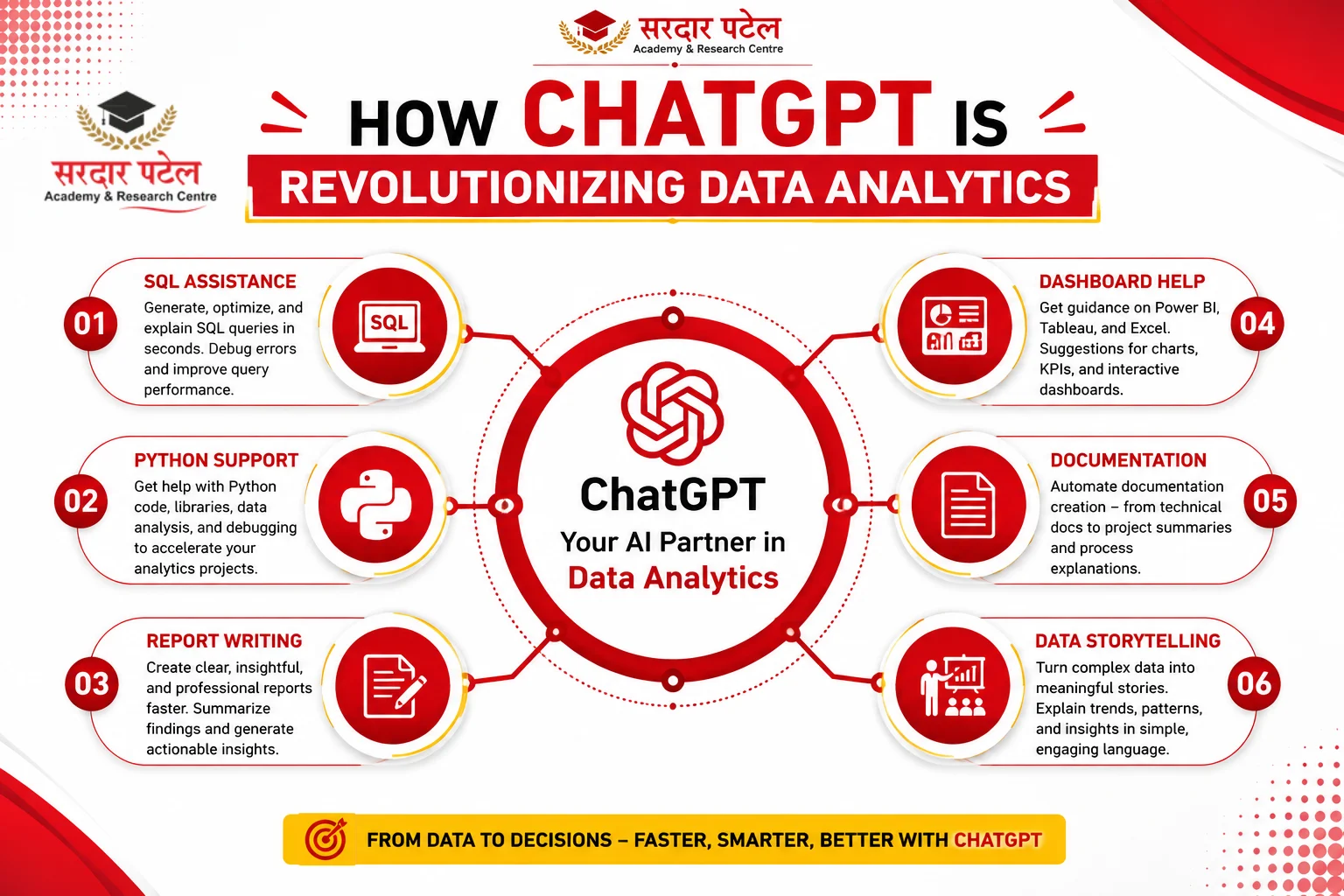
A junior data analyst can use ChatGPT to practice SQL query building, understand how commands work, and identify errors while writing code. A senior analyst can use it to draft a report summary or brainstorm which chart actually tells the story best. Either way, the job is drifting from task execution toward judgment and strategy. To understand the wider toolkit behind this work, it's useful to explore tools that support modern analytics work.
The Growing Role of ChatGPT in Data Analytics
As more teams build AI into daily workflows, ChatGPT's footprint in analytics keeps widening. It's now commonly used for:
- SQL query generation and optimisation
- Python programming assistance
- Excel formula explanations
- Power BI and Tableau guidance
- Data visualisation recommendations
- Business report writing
- Developing project documentation
- Dashboard interpretation
- Turning data into clear insights
- Learning new analytics concepts
Its real value is speed without taking over judgment. It might suggest a query or explain a statistical idea, but the analyst still owns the outcome — validating the result, checking it against business context, and deciding what to recommend. That division of labour is what makes the human-AI combination work.
Read More : AI Tools Every Data Analyst Should Know
Key Trends Changing Analytics Careers
The profession is moving fast right now. A handful of trends are quietly redefining what the job looks like, what skills matter, and what employers expect.
AI-Assisted Analytics
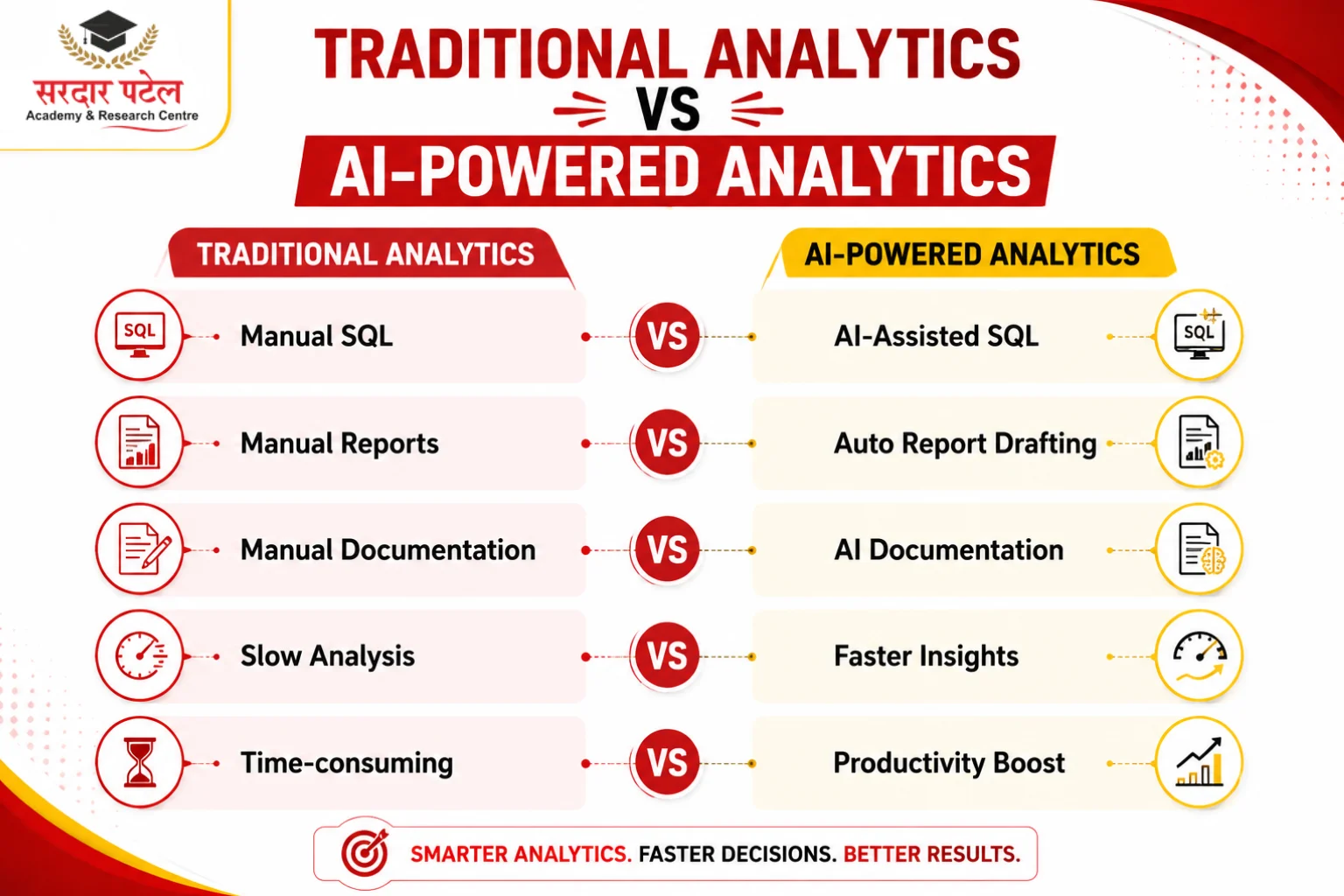
Teams are leaning on AI to speed up analysis and reporting — faster report generation, automated summaries, AI-assisted dashboards, and a general productivity lift. None of this replaces the analyst; it just clears out the repetitive work so more time goes toward decisions that actually need a person.
Natural Language Analytics
One of the bigger shifts: you can now query data in plain English instead of writing SQL from scratch. Ask something like "which sales channel drove the most revenue last quarter" and AI tools translate that into a technical query “natural language data analysis” — opening analytics up to people who aren't SQL-fluent.
Smarter Data Visualisation
BI platforms are increasingly building in AI suggestions — the right chart type, an unusual pattern worth flagging, an anomaly worth investigating. The result is reports that communicate faster and land better with business audiences.
Automated Documentation
Documentation used to eat huge chunks of project time. ChatGPT now helps draft project summaries, technical docs, reports, meeting notes, user guides, and process documentation — leaving more time for the actual problem-solving.
Data Storytelling Is Becoming Essential
A dashboard alone doesn't move a decision-maker anymore — they want the story behind it. Analysts are expected to explain trends, flag opportunities, and translate technical findings into plain business language. AI helps organise that narrative, but the judgment behind it is still the analyst's.
Human + AI Collaboration Is the Future
This isn't a competition between analysts and AI — it's a partnership. Professionals who blend technical skill with AI fluency tend to deliver insights faster, work more efficiently, and move into leadership roles sooner. Employers increasingly value people who know exactly when to lean on AI and when a human call is required.
What's Driving AI Adoption in Analytics?
A few forces are pushing AI adoption in analytics teams faster than almost anywhere else:
- Businesses are generating more data than ever
- Decisions need to happen faster
- Companies want less time spent on repetitive manual work
- Cloud analytics platforms now ship with built-in AI features
- AI tools shrink project turnaround time
- Data-driven decision-making keeps expanding across every industry
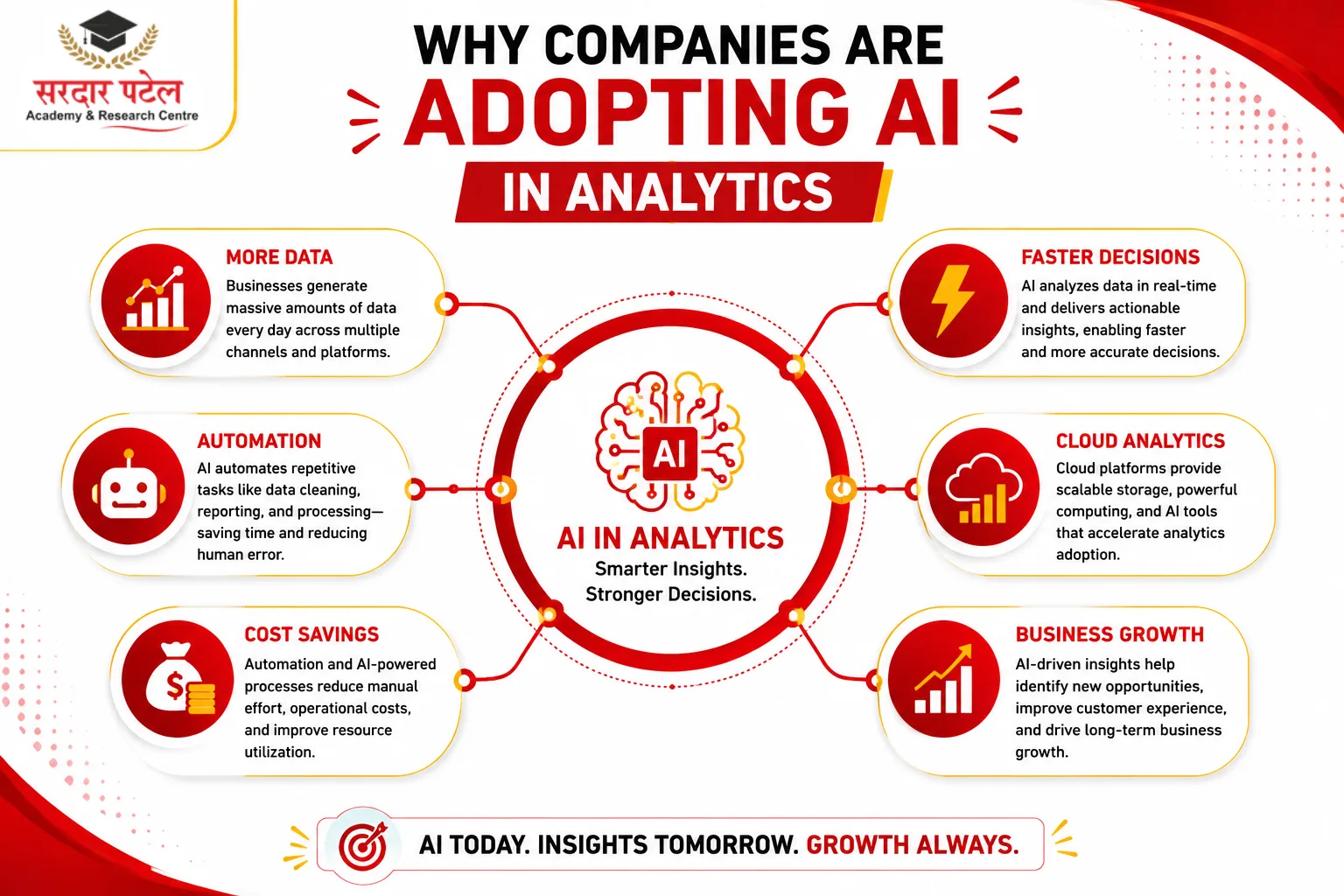
Put together, these forces are making AI-assisted analytics skills one of the more sought-after combinations in today's job market. This shift is also connected to the growing importance of using data to support smarter business decisions across different industries.
Impact on Analytics Roles
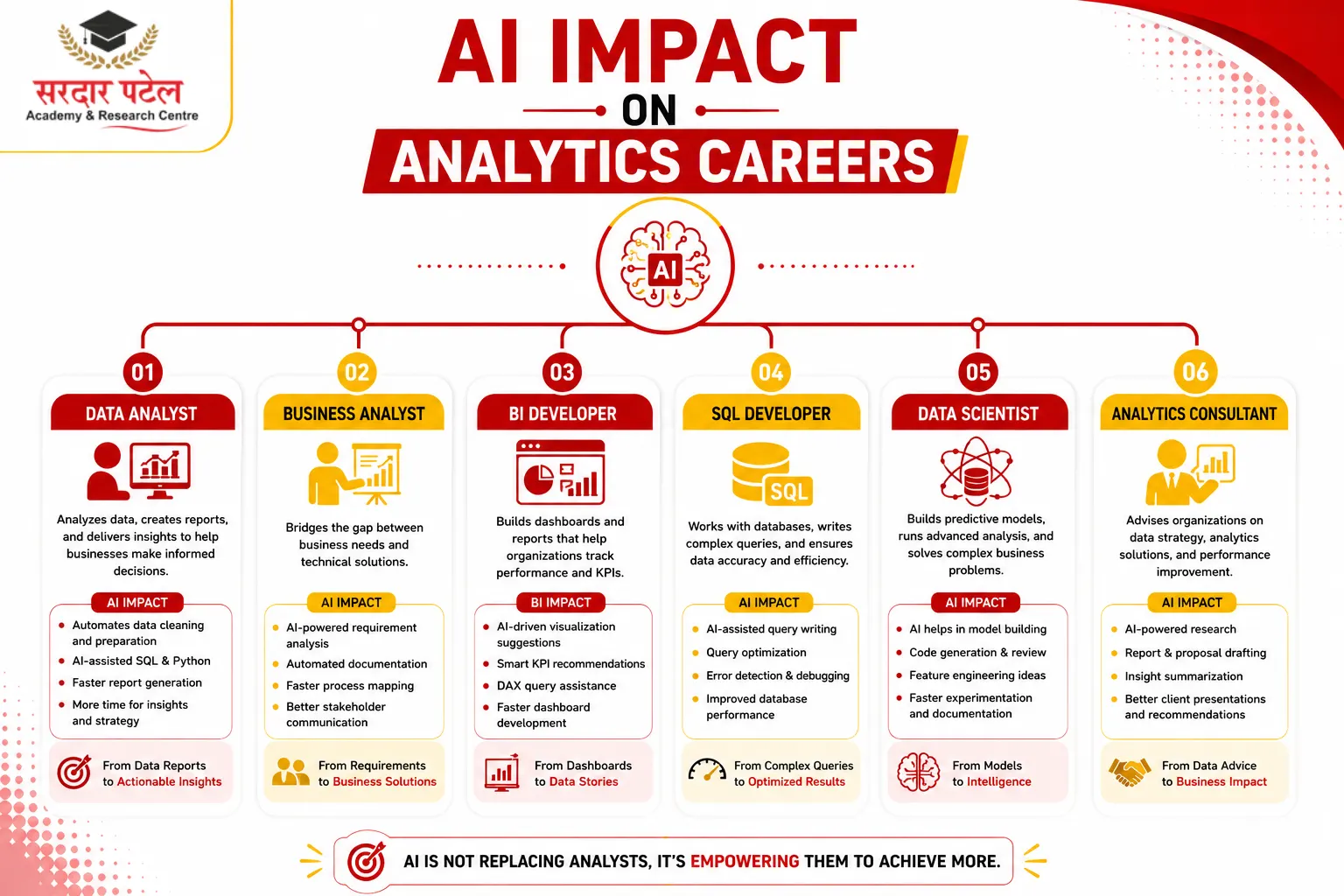
AI isn't erasing analytics careers — it's reshaping them. Routine work is getting automated, which pushes the job toward business problem-solving, insight interpretation, and strategic support. Here's how that's playing out across specific roles.
Data Analyst
The role has stretched well past building reports and dashboards — analysts are now expected to validate AI-generated output and communicate insight clearly, not just produce it.
it.
- How ChatGPT helps: writing and optimising SQL, explaining complex datasets in plain terms, drafting report summaries, suggesting visualisations, and supporting documentation.
- Where the role is heading: business problem-solving, data quality validation, insight generation, decision support, and managing AI-assisted workflows.
Business Analyst
Business Analysts sit between stakeholders and technical teams, and a lot of that job is communication-heavy — exactly where ChatGPT saves time.
- How it helps: requirement documentation, meeting summaries, business case drafts, process documentation, and workflow recommendations.
- Growing responsibilities: strategic planning, digital transformation work, AI-enabled business optimisation, and stakeholder communication.
Business Intelligence (BI) Developer
BI Developers build the dashboards leadership relies on, and AI is making that build process faster and more approachable.
- How it helps: explaining DAX formulas, suggesting KPIs, recommending dashboard layouts, troubleshooting Power BI, and improving how a report tells its story.
- What's ahead: interactive dashboards, AI-powered reporting, self-service analytics, and executive-level visualisation.
Data Scientist
Data Scientists are still the ones building and validating predictive models — AI speeds up the coding and documentation, but the judgment calls stay human.
- How it helps: explaining ML concepts, generating sample Python code, supporting feature-engineering ideas, reviewing logic, and drafting documentation.
- Skills that stay firmly human: statistical reasoning, model evaluation, experiment design, business context, and ethical AI judgment.
SQL Developer
SQL isn't going anywhere, and ChatGPT has become a genuinely useful learning companion for both beginners and experienced developers — writing queries, explaining joins, optimising performance, debugging syntax, and clarifying database concepts. That said, AI-generated queries still need a human check before they touch production.
Analytics Consultant
Consultants solve business problems with data, and AI helps them do it faster — drafting client reports, presentation outlines, research summaries, concept explanations, and executive summaries. The strategy, the client relationship, and the final call still rest with the consultant. These evolving responsibilities also show where analytics skills can lead professionally, especially as organisations increasingly rely on data-driven decision-making.
Skills Shift and How to Prepare
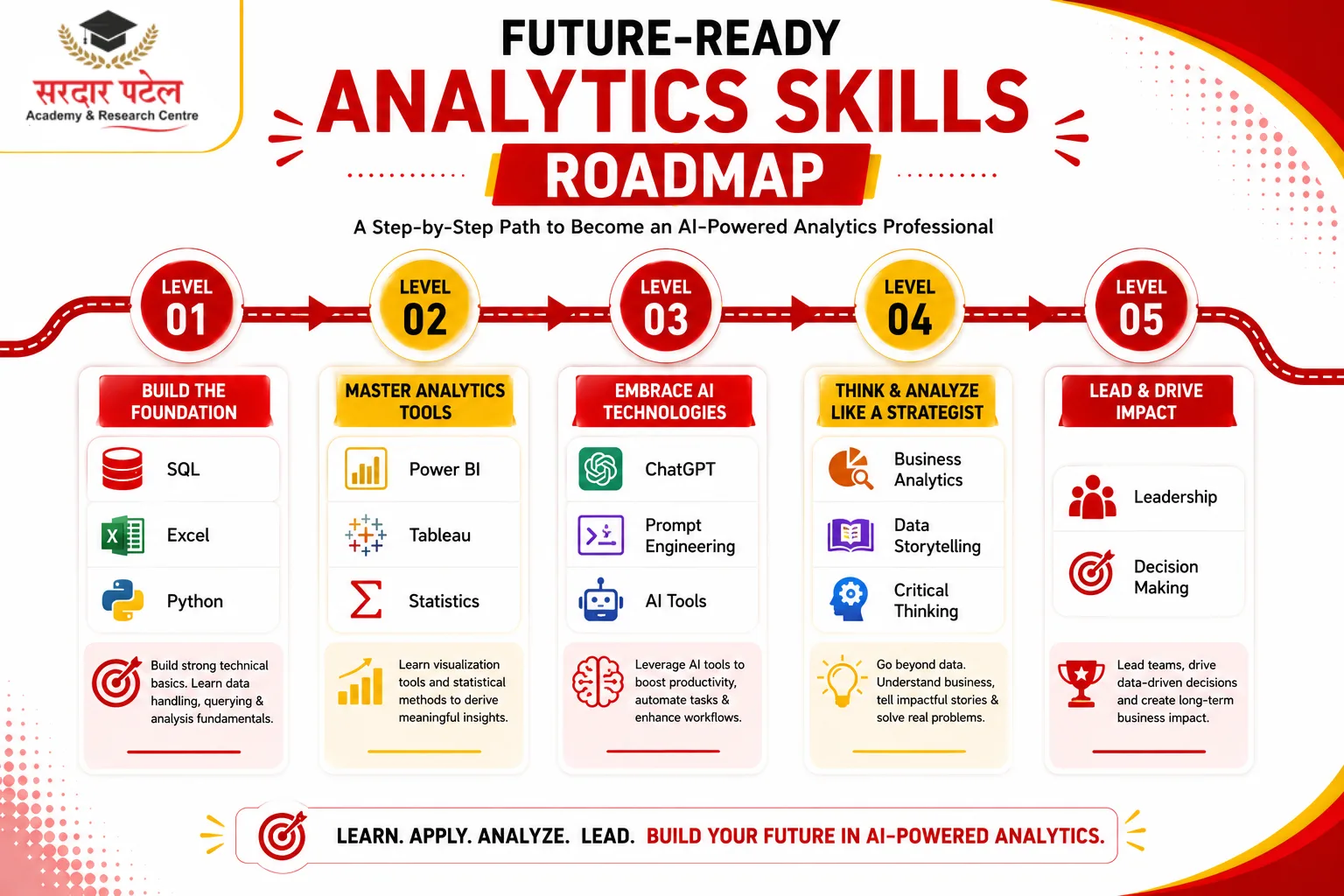
As AI becomes a standard part of the analytics toolkit, technical skill on its own isn't enough anymore. The professionals pulling ahead combine technical depth with AI literacy, communication, and business sense.
Strengthen Your Technical Foundation
This still matters more than anything else. Build depth in:
- SQL
- Python
- Excel
- Power BI
- Tableau
- Statistics
- Data Cleaning
- Data Visualisation
- Data Modelling
- Database Management
Solid fundamentals mean you can understand data on your own, not just trust whatever AI hands you. For learners considering this field, understanding starting your journey in the analytics field can make it easier to choose the right skills and learning path.
Learn AI Tools Responsibly
Knowing how to use ChatGPT well is quietly becoming a real advantage. Worth building:
- Prompt engineering
- AI-assisted coding
- AI-supported documentation
- AI-based report generation
- Output validation
- Responsible AI usage
Treat AI as support for your thinking, not a replacement for it.
Build Business Knowledge
Companies hire analysts to solve business problems, not just build charts. Build fluency in:
- Business metrics
- Customer behavior
- Sales analytics
- Marketing analytics
- Financial reporting
- Operational efficiency
Improve Communication Skills
Explaining technical work in plain language is becoming a career differentiator. Sharpen:
- Presentation skills
- Report writing
- Data storytelling
- Client communication
- Team collaboration
Analysts who explain themselves clearly tend to move into leadership faster.
Develop Critical Thinking
ChatGPT is fast, not infallible. Keep asking:
- Is this output actually accurate?
- Does it align with the business objective?
- Is the dataset complete?
- Could there be bias in this analysis?
- What assumptions is this resting on?
That habit is what keeps AI-assisted work reliable instead of just fast.
Create a Practical Portfolio
Real projects beat theory every time. Build things like:
- Sales dashboards
- HR analytics reports
- Customer segmentation analysis
- Financial performance dashboards
- Marketing campaign analysis
- Supply chain analytics
Put it on GitHub or a portfolio site where a hiring manager can actually see it. Once you have a few strong projects to showcase, exploring freelancing opportunities for data analysts can be another way to gain practical experience and build a professional portfolio.
Commit to Continuous Learning
The field moves fast. Stay current by:
- Reading industry blogs
- Practising on real datasets
- Exploring new AI-powered analytics tools
- Joining online challenges
- Earning relevant certifications
- Tracking industry trends
Sardar Patel Academy & Research Centre (SPARC)
Where you learn matters almost as much as what you learn. Sardar Patel Academy & Research Centre (SPARC) takes a practical, career-first approach to Data Analytics training rather than leaning on theory alone.
Students build hands-on skills in Excel, SQL, Power BI, data visualisation, and business reporting, while also learning how AI tools fit into a modern analytics workflow. The focus stays on real projects and problem-solving that mirror what employers actually expect.
As more organisations lean into AI-powered analytics, the professionals best positioned for long-term growth will be the ones who understand both the traditional fundamentals and the emerging AI layer on top. Training that combines both is what builds real, lasting confidence.
Case Examples and Real-World Scenarios
A few practical scenarios make the impact of ChatGPT in data analytics easier to picture — across skill levels and roles.
Scenario 1: A Fresher Starting a Data Analytics Career
A recent graduate wants to break into analytics but is still new to SQL, Python, and reporting.
- How ChatGPT helps: explains SQL concepts with examples, suggests beginner-friendly Python code, recommends practice datasets and projects, helps build a portfolio, and supports interview preparation.
- Outcome: faster skill-building and a stronger shot at entry-level roles.
Scenario 2: A Data Analyst Managing Daily Reports
An analyst spends hours every week on repetitive management reporting.
- How ChatGPT helps: drafts report summaries, assists with SQL optimisation, explains unusual trends, drafts presentation content, and suggests better visualisations.
- Outcome: hours saved, more time for actual strategic analysis.
Scenario 3: A Business Analyst Handling Client Requirements
A Business Analyst juggles stakeholder meetings and requirement documentation.
- How ChatGPT helps: summarises meetings, organises requirements, drafts user stories, and builds documentation templates.
- Outcome: cleaner documentation and better collaboration between business and technical teams.
Scenario 4: A BI Developer Building Executive Dashboards
A BI Developer is designing dashboards for senior leadership.
- How ChatGPT helps: suggests relevant KPIs, recommends layouts, explains DAX formulas, and improves chart selection and storytelling.
- Outcome: dashboards that are more interactive and easier for executives to read at a glance.
Scenario 5: A Data Science Team Working on Predictive Models
A data science team is building a demand-forecasting model.
- How ChatGPT helps: explains ML concepts, generates sample code, suggests feature-engineering ideas, and drafts documentation.
- Outcome: less time on documentation, more time improving model accuracy.
Learn Future-Ready Analytics
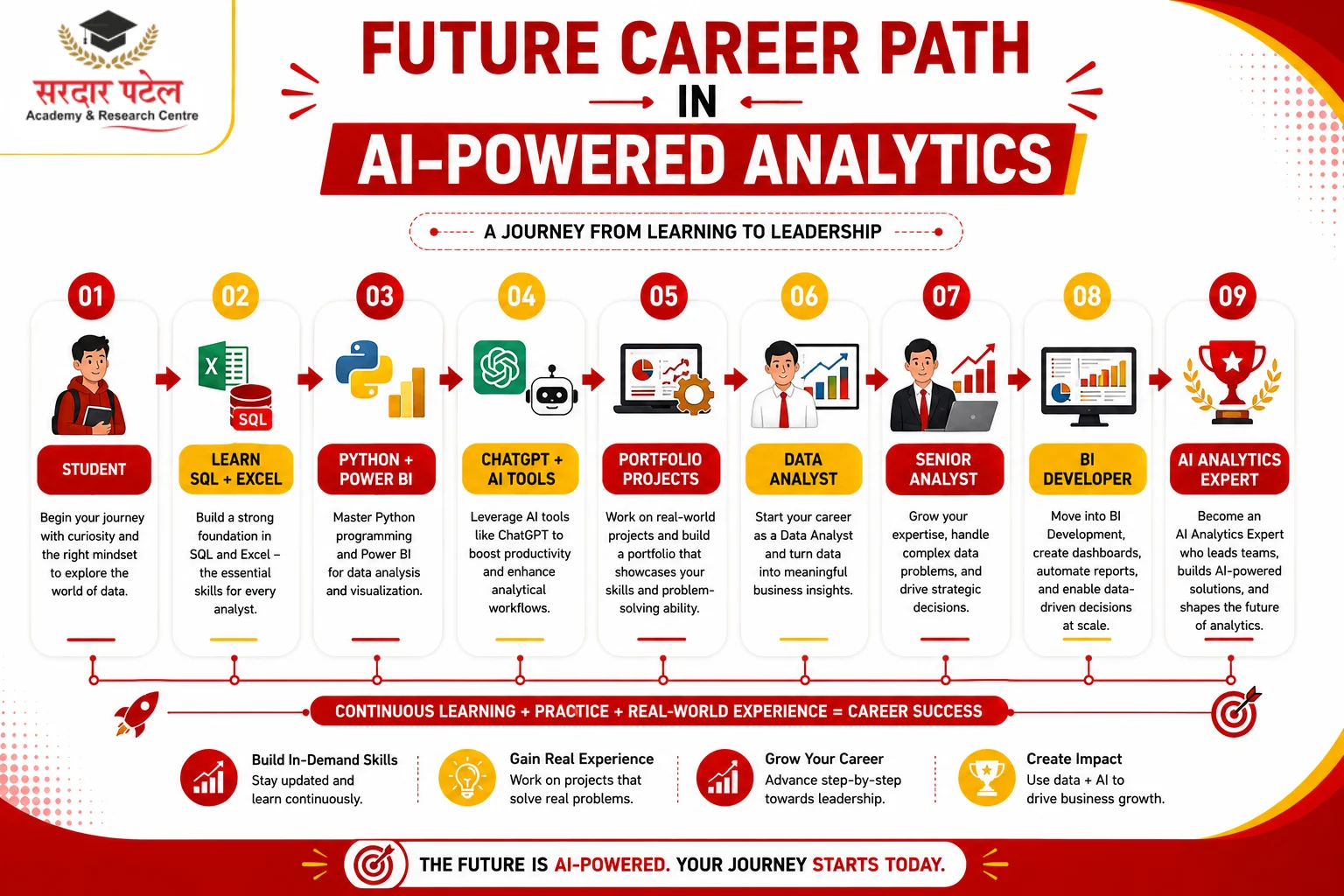
The future belongs to professionals who can work with both data and AI to solve real business problems. Build expertise in Data Analytics, SQL, Python, Power BI, data visualisation, and AI tools like ChatGPT to stay ahead in the job market.
Start your learning journey today and become a future-ready analytics professional.
Learn Future-Ready Analytics →
Sardar Patel Academy & Research Centre (SPARC) +91 93129-66129 | +91 93129-77129
Conclusion
AI is reshaping analytics, and ChatGPT in data analytics has become one of the more genuinely useful tools in a modern professional's kit — simplifying SQL, automating documentation, and sharpening reporting and storytelling so analysts can spend more time on decisions that matter.
The AI impact on analytics jobs is opening doors, not closing them, for professionals willing to adapt. Instead of replacing human expertise, AI is pushing analysts toward stronger technical skills, better business understanding, and sharper critical thinking.
As organisations keep investing in AI-powered analytics, demand will keep growing for people who can combine human judgment with AI tools. Whether you're a student, a fresher, or already deep into your career, this is a good time to build future-ready analytics skills and treat AI as a career accelerator, not a threat.
FAQs
It refers to using AI language models to support analytics work — SQL generation, data-cleaning guidance, report writing, dashboard explanations, documentation, and data storytelling — freeing analysts to focus on deeper analysis and decisions.
No. It automates repetitive work like drafting reports or suggesting code, but interpreting data, validating AI output, solving business problems, and making strategic calls still need a human.
It's changing what the job involves, not eliminating it. Employers want people who pair analytical thinking with AI fluency, and new opportunities are opening up in AI-assisted analytics, BI, data strategy, and automation.
-SQL
-Python
-Excel
-Power BI
-Tableau
-Statistics
-Data Visualization
-Prompt Engineering
-Business Analytics
-Communication Skills
-Critical Thinking
-Data Storytelling
Yes — for understanding SQL, practicing Python, learning Excel formulas, exploring Power BI, building projects, prepping for interviews, and grasping statistics. Just verify AI output and keep practicing independently.
Yes. AI is becoming standard in analytics workflows, and professionals who use it responsibly alongside strong technical and business skills will have a real edge.
-Banking and Financial Services
-Healthcare
-Retail and E-commerce
-Manufacturing
-Information Technology
-Telecommunications
-Education
-Marketing and Advertising
-Logistics and Supply Chain
-Build a strong foundation in core analytics concepts
-Learn SQL, Python, Excel, and Power BI
-Use AI tools like ChatGPT responsibly
-Work on real-world analytics projects
-Stay current with industry trends
-Keep improving business and communication skills