+91 9312966129
 sparc.enquiry01@gmail.com



Local SEO for Small Businesses: A Step-by-Step Tutorial
Learn how to improve your local search visibility with this step-by-step Local SEO tutorial for small businesses, covering Google Business Profile, citations, reviews, and more.
Table of Contents
- Why Local SEO Matters for Small Businesses in 2026
- How Local Search Ranking Actually Works
- Step-by-Step Local SEO Strategy for Small Businesses
- Step 1: Claim and Fully Optimize Your Google Business Profile
- Step 2: Run a Local SEO Audit
- Step 3: Optimize On-Page Local SEO
- Step 4: Build Consistent Local Citations
- Step 5: Earn and Manage Reviews Actively
- Step 6: Create Local Content and Earn Local Links
- Step 7: Track, Measure, and Adjust
- Google Business Profile Optimization Checklist
- Conclusion
If your business serves customers in a specific city or neighbourhood, showing up when someone nearby searches "near me" is no longer optional. It is how most first-time customers find you before they ever visit your website.
What Is Local SEO?
Local SEO is the practice of optimizing a business's online presence — primarily its Google Business Profile, website, citations, and reviews — so it appears in local search results, the Google Map Pack, and "near me" queries for a specific city or service area.
This tutorial walks small business owners and marketers through every step of building a local SEO strategy in 2026, backed by current data and a practical Google Business Profile ranking guide you can follow this week.
Why Local SEO Matters for Small Businesses in 2026
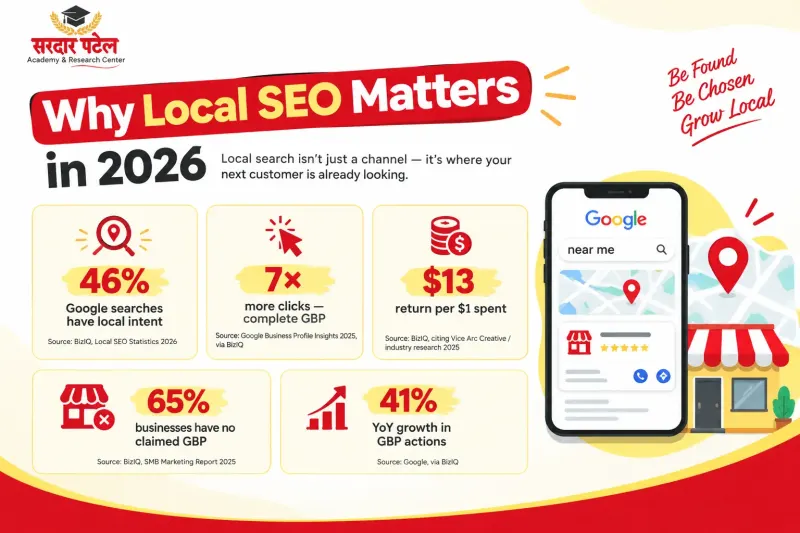
Local search is not a side channel anymore — it is where most buying decisions begin. Nearly half of all Google searches now carry local intent, and the businesses that show up first capture customers competitors never even see.
| Sources: BizIQ, Local SEO Statistics 2026 | Shopify, Local SEO Statistics 2026 |
The gap between businesses that optimize and businesses that don't is only widening, which makes this the right moment for small businesses — including those in Delhi NCR and beyond — to build a proper local SEO strategy rather than leaving visibility to chance.
How Local Search Ranking Actually Works
Google has confirmed that local rankings depend on three core factors: relevance (how well your listing matches the search), distance (how close you are to the searcher), and prominence (how well-known and trusted your business is online). Every local SEO tactic ultimately supports one of these three pillars.
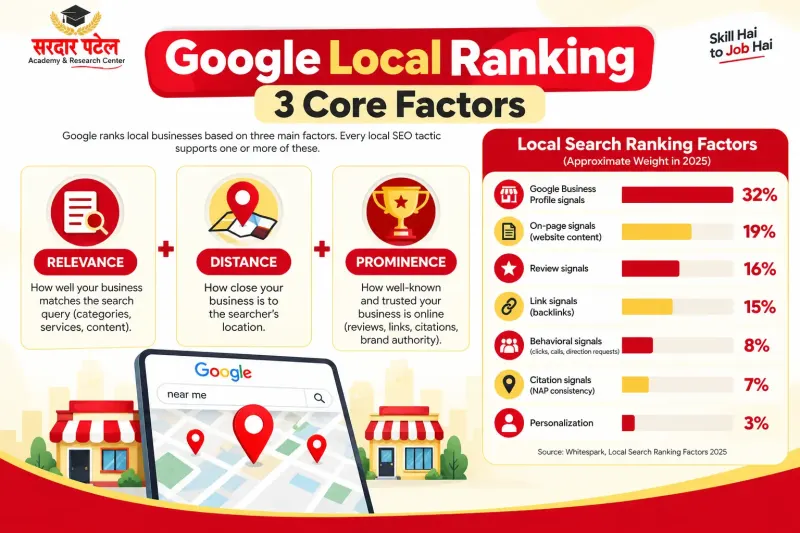
According to Whitespark's Local Search Ranking Factors 2025 survey of local SEO experts, here is how ranking weight is distributed across the Google Local Pack:
| Source: Whitespark, Local Search Ranking Factors 2025. |
This is why a Google Business Profile ranking guide has to sit at the centre of any local SEO strategy — it carries the single largest share of ranking weight, ahead of your website's on-page SEO or backlinks.
Step-by-Step Local SEO Strategy for Small Businesses
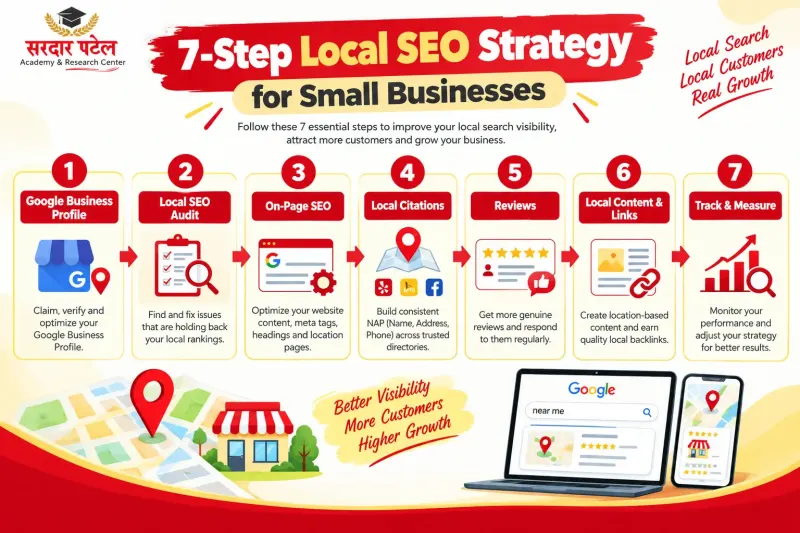
Step 1: Claim and Fully Optimize Your Google Business Profile
Start at business.google.com and claim your listing if you haven't already. Then optimize every field:
- Choose the most accurate primary category — Whitespark ranks this among the top individual GBP ranking factors.
- Add your exact business name (no keyword stuffing), address, and phone number, matching your website exactly.
- Select every relevant secondary category and service.
- Upload at least 10 real photos of your storefront, team, and work to make your profile more informative and engaging.
- Set accurate hours, including holiday hours — "open at time of search" is a consistently high-ranking signal per Whitespark's survey.
- Post weekly updates using Google Posts to keep the profile active.
Quick Win: Businesses with 50+ reviews earn 4.4x more clicks than those with under five reviews, based on Visionary Marketing's 2026 local SEO research. Reviews can play a significant role in improving trust, engagement, and local search performance.
Step 2: Run a Local SEO Audit
Before making changes, check where you currently stand:
- Search your main keywords in incognito mode to see if you appear in the Map Pack.
- Check your NAP (Name, Address, Phone) consistency across your website, GBP, and directories — inconsistencies are common and hurt trust signals.
- Review your competitors' GBP categories, photo count, and review volume.
- Audit your website for mobile speed, since most local searches happen on mobile.
Step 3: Optimize On-Page Local SEO
On-page signals account for roughly a fifth of local ranking weight. Focus on:
- City and neighbourhood names in title tags, H1s, and meta descriptions (natural placement, not stuffing).
- A dedicated location or service-area page for each city you serve.
- LSI and semantic terms around your core service — for example, alongside "local SEO strategy," naturally use phrases like "Google Maps ranking," "near me search visibility," and "local search optimization."
- Embedded Google Maps on your contact page and LocalBusiness schema markup, so Google can read your address and hours directly from your code.
Step 4: Build Consistent Local Citations
A citation is any online mention of your business name, address, and phone number — directories like Justdial, Sulekha, IndiaMART, and industry-specific listings all count. According to BizIQ's 2026 data (citing Visionary Marketing and Semrush), 64% of small businesses have at least one NAP inconsistency across major directories, and NAP inconsistencies across three or more citation sources can exclude a business from Google's AI Mode local answers roughly 74% of the time. Audit and correct these first, then expand to new, relevant directories.
Step 5: Earn and Manage Reviews Actively
Reviews influence 16% of Local Pack rankings per Whitespark's 2025 survey and are one of the biggest trust signals for consumers, with a large majority of people reading reviews before choosing a business. Ask happy customers for reviews right after a positive interaction, respond to every review (positive and negative), and prioritise recent reviews — review velocity (how often new reviews arrive) has become a meaningfully weighted ranking factor, and consumers increasingly look for reviews written in the last few months.
Step 6: Create Local Content and Earn Local Links
Publish blog content that answers real local questions — "best [service] in [city]," neighbourhood guides, or local event coverage. This supports your on-page signals and naturally attracts backlinks from local news sites, business associations, and directories, which feed into the 15% of ranking weight tied to link signals.
Step 7: Track, Measure, and Adjust
Use Google Business Profile Insights and Google Search Console to track calls, direction requests, website clicks, and keyword impressions. GBP-driven actions like calls and direction requests grew 41% year-over-year, so treat these engagement metrics — not just rankings — as your real success measure.
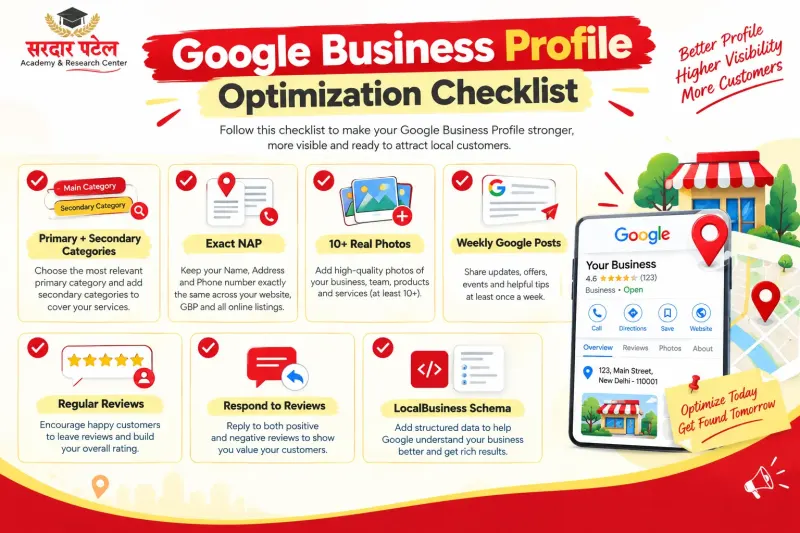
Google Business Profile Optimization Checklist
| Action |
Why It Matters |
Priority |
| Correct primary + secondary categories |
Top individual GBP ranking factor |
High |
| Complete NAP matching website exactly |
Prevents citation and trust issues |
High |
| 10+ recent, real photos |
Linked to meaningfully higher engagement |
High |
| Weekly Google Posts |
Signals an active, prominent profile |
Medium |
| Consistent review requests |
4.4x more clicks at 50+ reviews |
High |
| Respond to all reviews within 48 hours |
Builds trust and behavioural signals |
Medium |
| LocalBusiness schema on website |
Reinforces relevance signals |
Medium |
Common Local SEO Mistakes Small Businesses Make
Many small businesses undo their own progress with avoidable errors: leaving their Google Business Profile incomplete, using a virtual office address that violates Google's guidelines, stuffing city names unnaturally into content, ignoring negative reviews instead of responding professionally, and forgetting to update hours during festivals or holidays. Some also duplicate listings for the same location, which splits reviews and confuses Google's trust signals instead of strengthening them. Each of these mistakes directly weakens either the relevance, distance, or prominence signal Google relies on to decide who ranks first.
Conclusion
Local SEO is one of the most effective ways for small businesses to reach customers who are actively searching for products or services nearby. By optimizing your Google Business Profile, maintaining consistent business information, earning genuine reviews, improving on-page local SEO, and tracking your results regularly, you can build stronger visibility in local search.
The key is consistency. Start with the basics, focus on the areas that have the biggest impact, and continue improving your local presence over time.
As digital marketing continues to evolve, understanding the skills and opportunities shaping the industry can help learners prepare for future career opportunities. A well-planned local SEO strategy can help your business attract more relevant traffic, calls, enquiries, and customers.
For aspiring digital marketers, understanding how local businesses hire and evaluate fresh talent can also help you prepare for real-world marketing roles. Learn more about How Delhi Companies Hire Fresh Digital Marketers
Learn Local SEO Live with Practical Training
Reading about local SEO strategy is a start, but ranking a real Google Business Profile takes hands-on practice — auditing live listings, fixing citations, and watching Map Pack movement in real time.
If you're planning to learn digital marketing professionally, it's also important to understand the difference between a short-term and comprehensive course before choosing one. Explore our comparison of a 3 Month vs 7 Month Digital Marketing Course
Learn Local SEO Live Join Sardar Patel Academy & Research Centre (SPARC)'s Digital Marketing Course in GTB Nagar, Delhi, where practical local SEO, Google Business Profile optimization, and full digital marketing training are taught through live projects.
Call +91 93129-66129 or visit sparc.org.in to know more about upcoming batches.
If your business is still invisible in local search, the fastest fix is structured, guided practice rather than trial and error — Learn Local SEO Live with mentors who review your GBP and website hands-on at SPARC.
FAQs
Local SEO is optimizing your business's online presence so it shows up when nearby customers search for your product or service, primarily through your Google Business Profile and local search rankings.
Most small businesses see initial Map Pack movement within 4–8 weeks of consistent optimization, with stronger results after 3–6 months of steady reviews, citations, and content.
Yes, creating and managing a Google Business Profile is completely free; you only pay if you choose paid local ads on top of it.
There's no fixed number, but data shows profiles crossing 50–100 reviews see significantly higher click-through and lead volume than those with under five.
NAP stands for Name, Address, and Phone number. Keeping these identical across your website, GBP, and directories builds the trust signals Google uses for prominence.
Yes, a dedicated, unique page per location or service area helps relevance signals far more than one generic "service area" page.
Yes, most of the highest-impact actions — GBP optimization, review requests, citation fixes — cost time, not money, making local SEO one of the most affordable channels for small businesses.
Yes, consistent NAP data, strong reviews, and structured on-page content increasingly determine whether a business appears in AI-generated local answers, alongside traditional rankings.
Regular SEO targets broad, often national visibility, while local SEO specifically targets map rankings, "near me" searches, and geographically limited intent.
Either can work; many small business owners start by learning the fundamentals through a structured, practical course before deciding whether to manage it in-house or outsource.