+91 9312966129
 sparc.enquiry01@gmail.com



How to Become Job-Ready for an Accounting Career in 9 Months
Follow a 9-month plan to become job ready with Tally, Busy, GST and TDS. Compare a job ready accounting course in 9 months and start planning today.
Table of Contents
- What “Job Ready” Really Means for an Accountant
- Is Nine Months Enough? An Honest Answer
- The Nine-Month Accounting Career Roadmap
- Months 1 and 2: Build the Base
- Months 3 to 5: Tally Prime Volumes 2 and 3
- Month 6: A Second Software, Busy
- Months 7 to 9: Return Filing and Interview Readiness
- Accounting Skills in 9 Months: What to Prioritise
- How to Choose a Job-Ready Accounting Course in 9 Months
- Course Snapshot: E-DFCA at SPARC
- Self-Study, Classroom or Online? A Quick Comparison
- A Weekly Routine That Keeps You on Track
- Common Mistakes to Avoid
- After Month Nine: Landing the First Job and Growing
- Conclusion
Most accounting freshers do not struggle with theory. They struggle on the first Monday, when a manager hands over a bank statement, a purchase register and a half-filled GST sheet and says, “Get these ready by evening.” Closing that gap is the whole purpose of a job-ready accounting course in 9 months, and it is achievable when the plan is focused and the practice is daily.
This guide lays out a month-by-month accounting career roadmap for beginners, built around the curriculum of SPARC’s E-Diploma in Financial Computer Accounting (E-DFCA): what to learn, in what order, how to practise, how to judge a programme before paying for it, and which mistakes quietly cost weeks. Use it as a self-study plan, or as a checklist to hold against any job-ready accounting course in 9 months you are considering.
| Note: Income-tax Act, 2025. The Income-tax Act, 2025 took effect on 1 April 2026 and replaced the 1961 Act. Older section and form numbers (such as 44AD, 44ADA, 24Q, 26Q, 27EQ, Form 16, 16A and 26AS) are being replaced by new ones, and “previous year” and “assessment year” are now “Tax Year”. Check the current numbers on the e-filing portal. This plan teaches the logic that carries over, and older numbers appear below only as “earlier” references. |
What “Job Ready” Really Means for an Accountant
A job-ready accountant is not someone who has memorised every rule in a textbook. It is someone who can take a pile of documents and return books that balance, tax figures that match the returns, and a short note on what is still pending. Employers rarely expect perfection from a fresher. They do expect you to work without being guided through every click.
In practice, that readiness shows up in four ways:
- Correct entries: you post transactions in accounting software and can explain why each ledger was chosen.
- Reconciliation: you can match the bank statement, party balances and GST figures instead of hoping they agree.
- Tax awareness: you know what GST and TDS do to a transaction before it is recorded.
- Clear communication: you tell your senior what looks wrong and what you suggest, not just that something is wrong.
Notice that a certificate is not on the list. A job-ready accounting course in 9 months should be judged by the work you can show at the end, not by the hours you spent sitting in a classroom.
Is Nine Months Enough? An Honest Answer
It depends on where you start. A commerce student who already understands debit and credit, and who can give two to three focused hours a day, can realistically reach entry-level readiness within nine months. Someone with no accounting background will need a slower first month, even inside a structured programme, and that is perfectly fine. Nine months gives you room to practise payroll, tax compliance and return filing properly instead of rushing through them.
| Your starting point |
What to expect |
| Commerce background, daily practice |
Entry-level readiness is a realistic target, with time left for extra practice |
| Non-commerce, starting from zero |
Spend extra weeks on fundamentals; the plan may stretch slightly |
| Already working in another department |
Faster progress on reporting, since you know how the business runs |
Be clear about what nine months cannot do. It will not turn you into a tax consultant or an auditor. It builds a base: the daily bookkeeping, compliance and filing work that most junior accounting roles are made of. Speed and judgement come later, on the job. That is why a job-ready accounting course in 9 months works best when you learn by doing rather than by reading chapter after chapter.
If you are still deciding whether accounting suits you, begin with our guide to starting an accounting career after 12th before committing to the plan below.
The Nine-Month Accounting Career Roadmap
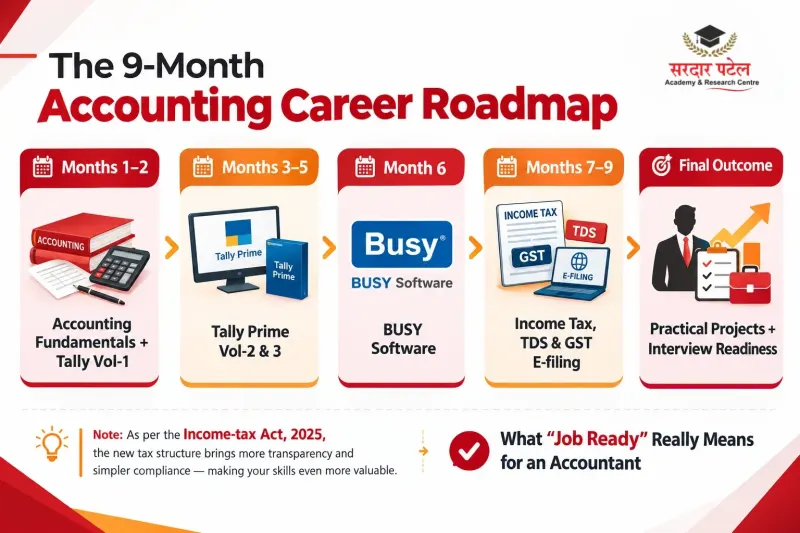
Here is a pacing plan you can follow, whether you study alone or through a structured programme. It follows the order of the E-DFCA curriculum: accounting fundamentals, Tally Prime Volumes 1 to 3, Busy, and then income tax, TDS and GST e-filing. The month-wise split is a suggested pace for learners, not an official timetable.
| Month |
Curriculum focus |
What you should be able to show |
| 1 | Accounting fundamentals: journal entries, ledgers, trial balance, financial statements |
A trial balance and a profit and loss account prepared by hand |
| 2 | Tally Vol-1: stock groups, units, stock items, godowns; receipt, payment, contra, purchase, sales, debit note, credit note and journal vouchers; bill-wise tracking; purchase and sales orders |
A full set of books, with inventory, for a sample trading business |
| 3 | Tally Vol-2: cheque management, bank reconciliation, cost centres, price lists, bills of material, job costing, job work, interest calculation |
A bank reconciliation and a cost centre report |
| 4 | Tally Vol-3, part 1: payroll with PF, EDLI, ESI, professional tax, NPS and gratuity; TDS and TCS in Tally |
A salary register with statutory deductions, and TDS and TCS entries with reports |
| 5 | Tally Vol-3, part 2: GST for goods and services, intrastate and interstate supply, returns of goods, input tax credit set-off, tax payment, challan reconciliation |
GST invoices and GST reports for a sample company |
| 6 | Busy: company setup, masters, vouchers, budgets, credit limits, cost centres, POS, bills of material, and TDS, TCS and GST in Busy |
The same sample company recorded in Busy |
| 7 | Income Tax e-filing: Tax Year basics, heads of income, slab rates, advance tax, ITR-1, ITR-3 and ITR-4 |
Practice returns for a salaried person, a business and a presumptive-income taxpayer |
| 8 | TDS e-filing: sections and rates, Challan 281, returns for non-salary, salary and TCS payments, FVU files, TRACES |
A TDS working sheet and a return file ready for upload |
| 9 | GST e-filing at working level: supply, time and place of supply, composition scheme, e-way bill, input tax credit, return filing; then mock projects, resume and interview practice |
Three case files you can discuss confidently |
Months 1 and 2: Build the Base
Whichever route you follow, start on paper. Write journal entries for forty or fifty simple transactions, post them to ledgers, and extract a trial balance. It feels slow, but this is the exercise that makes software feel logical instead of magical later.
A quick example: a trader buys goods worth ₹50,000 on credit. You debit Purchases and credit the supplier. When the trader pays by bank, you debit the supplier and credit the bank. Tally Prime records the same logic through vouchers, so your job is to understand why each side is chosen.
Once the logic is comfortable, move to accounting software. Software is where theory becomes work. Check a few accounts job listings in your city to see which tools they name; this plan uses Tally, and Tally’s own overview describes Tally Prime as one place for accounting, inventory, banking and compliance. Create a dummy company, record a month of purchases, sales, receipts and payments, and print the reports. Practise every voucher type, including debit notes, credit notes and journals. Set up stock groups, units of measure, stock items and godowns so inventory stops feeling unfamiliar, then try purchase orders, sales orders and bill-wise tracking of receivables and payables. For a closer look at what to practise, see the Tally Prime skills freshers need.
Start a list of the abilities recruiters keep asking for, too. Our guide to the skills a professional accountant needs is a useful yardstick to measure yourself against.
You do not need the full set of accounting standards in this window, but you should know they exist. ICAI’s website carries the text of both the Accounting Standards and the Indian Accounting Standards, and skimming how they are organised once will make later job conversations less intimidating.
Months 3 to 5: Tally Prime Volumes 2 and 3
These three months are where many learners move from “I can enter vouchers” to “I can run a business’s books.” In month three, practise banking: cheque management, deposit slips and bank reconciliation with a realistic statement. For instance, if the statement shows ₹12,400 cleared but your books show ₹12,000, the ₹400 gap is your clue: a bank charge, a missed entry or a typing slip. Add cost centres, price lists and interest calculation. If you are curious about manufacturing businesses, try a small bill of materials, job costing and job work exercise, but do not let it eat the month.
Month four is for payroll, TDS and TCS inside Tally. Create employee masters and pay heads, process a month of salaries, and see how provident fund, ESI, professional tax and other statutory deductions change the net pay. Then configure TDS, book expenses with tax deducted, record the payment and read the TDS reports. Payroll and TDS are routine work in almost every office, so a fresher who can run them without help stands out.
Month five is for GST in Tally. Cover intrastate and interstate supply of goods, sales and purchase returns, GST rates at stock group, stock item and transaction level, input tax credit set-off, tax payment and challan reconciliation. Then repeat the same ideas for services. This is the stretch that separates a bookkeeper from a job-ready accountant.
Employers often hire for the combination rather than each skill alone, a point explored in our piece on Tally, GST and TDS together.
Month 6: A Second Software, Busy
Many small businesses and CA firms use Busy, so month six is for recording the same sample company in it. Set up the company, create account and item masters, enter the usual vouchers, then try budgets, credit limits, cost centres, price levels and point of sale. Finish with TDS, TCS and GST in Busy. Seeing the same transactions in two tools proves that you understand accounting, not just menus.
Months 7 to 9: Return Filing and Interview Readiness
The last three months move from recording to filing. In month seven, learn the income tax basics: who is an assessor, the heads of income, slab rates and prepaid taxes, all worked out by Tax Year (the term that replaces “previous year” and “assessment year” under the Income-tax Act, 2025). Then practise filing on the portal with ITR-1 for salary and one house property, ITR-3 for business income and ITR-4 for presumptive income. Presumptive taxation for small businesses and professionals was earlier covered by sections 44AD and 44ADA and has been consolidated under the new Act, so confirm the current section on the portal.
Month eight is for TDS e-filing. In simple terms, a person making certain payments, such as salary, rent or professional fees, deducts tax at prescribed rates. That person then deposits it with the government and files periodic statements. The Income Tax Department’s page on tax deducted at source lays out these duties and what happens when they are missed. Build a small working sheet with columns for payment, section, rate, amount deducted and due date. Then practise preparing the TDS return for non-salary payments (earlier Form 26Q), the return for salary (earlier Form 24Q) and the return for TCS (earlier Form 27EQ), generate the FVU file, and log in to TRACES to view your annual tax statement (earlier Form 26AS) and download the TDS certificates (earlier Forms 16 and 16A). Use the form numbers currently shown on the portal.
Month nine is for GST e-filing. Learn how supply is defined, how time and place of supply work, and why the monthly return must agree with your books. The GST Council’s guide to returns under GST explains the electronic filing structure and the different return types. Add the composition scheme, e-way bills, input tax credit and the electronic ledgers, then practise the outward supply return and the summary return. Treat this as working-level practice: the goal is to file a clean sample return, and the deeper judgement comes on the job. If month nine feels crowded, start your first mock project in month eight and use the last two weeks of month nine to finish and polish it.
Use those last two weeks for mock projects. Prepare books for a small trader, a service business and a business with TDS deductions. Keep each as a case file: the data, your entries, your reports and a one-paragraph summary of what you found. These become your talking points in interviews, and they are the real proof that the training did its work.
Accounting Skills in 9 Months: What to Prioritise
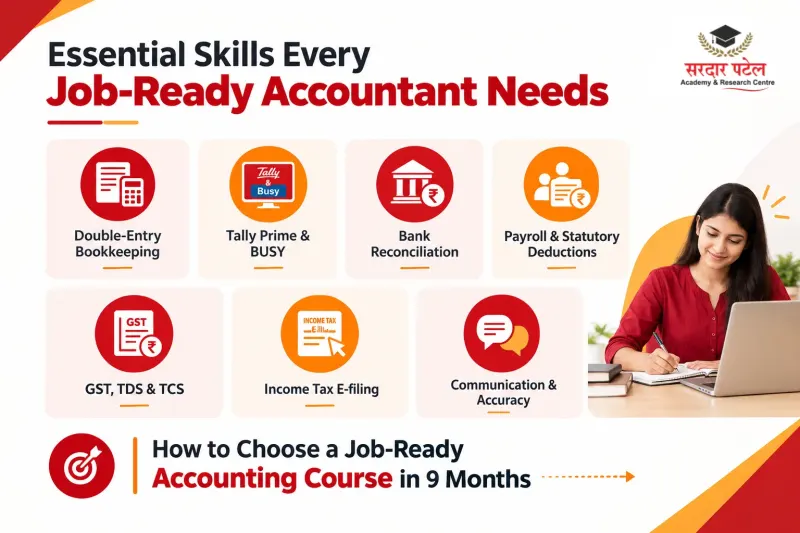
You cannot learn everything in a job-ready accounting course in 9 months, so rank what you practise. This table shows where the effort should go.
| Skill |
Why it matters |
How to practise |
| Double-entry bookkeeping |
Everything else rests on it |
Daily journal drills in the first month |
| Tally Prime, Volumes 1 to 3 |
Used for day-to-day entries and reports |
Maintain a dummy company for 90 days |
| Bank reconciliation |
Proves your books match reality |
Match a bank statement to the books |
| Payroll and statutory deductions |
Salary processing is routine in most offices |
Run a month of salaries with PF, ESI and professional tax |
| GST |
Most business transactions touch it |
Create invoices and a sample return working |
| TDS and TCS |
Payroll and vendor payments depend on it |
Prepare a deduction sheet and a sample TDS return for non-salary payments |
| Income tax e-filing |
Many accounts roles help with returns |
File practice ITR-1 and ITR-4 returns |
| Busy |
Shows you can adapt to a new tool |
Re-record one company in Busy |
| Written and spoken clarity |
Managers need explanations, not just numbers |
Summarise each case file in a short note |
Soft skills deserve a place on the list. Accuracy, respect for deadlines and the habit of asking a good question early are hard to teach and easy to notice. For a wider list from the recruiter’s side, read about the skills employers want in freshers. Gaining these accounting skills in 9 months is demanding, but it is far more manageable when each skill is tied to a small project.
How to Choose a Job-Ready Accounting Course in 9 Months
Training options vary widely, and the brochure is rarely the best guide. Before you commit to a job-ready accounting course in 9 months, ask these questions:
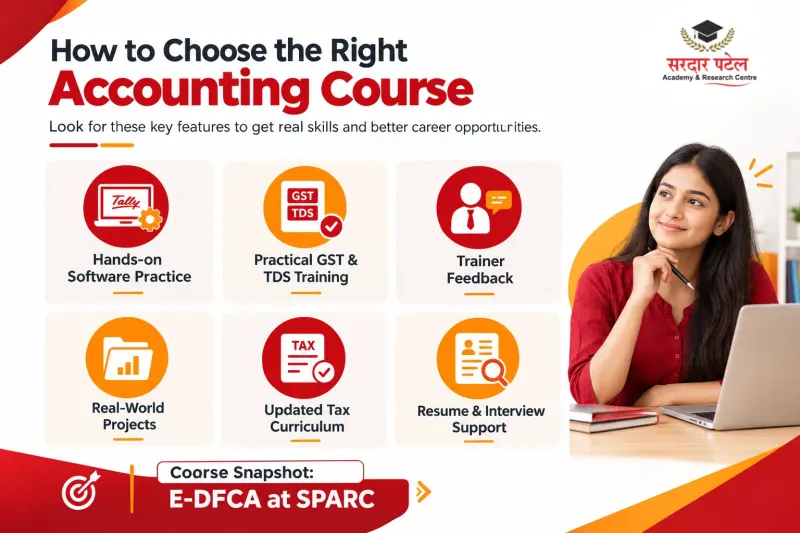
- How much time is spent in software? Look for regular hands-on practice, not just demonstrations.
- Are GST and TDS taught with practical work? Theory alone will not help on day one.
- Will someone review your work? Feedback on real entries speeds up learning.
- Are there projects or case files? You need something to show an interviewer.
- Is the syllabus visible? A clear module-wise plan is a good sign; vague promises are not.
- Is the syllabus current? Ask whether tax modules reflect the Income-tax Act, 2025 forms and sections.
- How is placement support described? Be careful with guaranteed jobs. Help with resumes, mock interviews and referrals is realistic; a guarantee is a warning sign.
If you prefer a structured route, Sardar Patel Academy & Research Centre (SPARC) offers the E-Diploma in Financial Computer Accounting (E-DFCA) at its GTB Nagar, Delhi centre. It is a 9-month offline programme that starts with accounting fundamentals and moves through Tally Prime (Volumes 1 to 3), Busy, income tax, TDS and GST e-filing, with assignments and practice work along the way. Check the syllabus and fees on the course page and compare them with the list above before deciding. Whichever route you pick, remember that a job-ready accounting course in 9 months only pays off when you practise outside class as well.
Course Snapshot: E-DFCA at SPARC
| Detail |
Information |
| Syllabus |
Accounting fundamentals; Tally Prime Vol-1 (inventory, vouchers, orders), Vol-2 (banking, cost centres, job costing, interest) and Vol-3 (payroll, TDS, TCS, GST); Busy; Income Tax e-filing; TDS e-filing; GST e-filing |
| Duration |
9 months |
| Fees |
40k |
| Mode of learning |
Offline training at SPARC, GTB Nagar, Delhi |
| Tools covered |
Tally Prime, Busy, Income Tax e-filing portal, GST portal, TRACES and Webtel practice software |
| Practical and project work |
Assignments in modules, software-based exercises and real business scenarios |
| Certificates |
SPARC E-DFCA certificate and Webtel Academy certificate |
| Placement support |
Resume building, mock interviews and communication training; [add exact job-support wording from the SPARC Placement Support page] |
| Roles to aim for |
Accounts assistant, accounts executive, Tally operator, Busy operator, billing executive, GST and taxation executive, TDS compliance executive, back-office executive |
Want a guided plan? Review the syllabus and see how the programme fits your schedule: Explore the E-Diploma in Financial Computer Accounting (E-DFCA).
Self-Study, Classroom or Online? A Quick Comparison
| Route |
Works well when |
Watch out for |
| Self-study |
You are disciplined and already know basic accounting |
No one reviews your entries, so errors repeat |
| Classroom |
You want fixed timings and face-to-face doubts |
The pace may not match yours |
| Online or hybrid |
You need flexibility around work or college |
You must finish the practical work on your own |
Whichever route you choose, a job-ready accounting course in 9 months should still end with case files you can show an interviewer.
A Weekly Routine That Keeps You on Track
- Monday to Friday: two to three hours a day, split between one hour of new concepts and one to two hours of practice.
- Saturday: a mini-test. Prepare a trial balance from a transaction list without looking at notes.
- Sunday: review your errors and rest. Keep a mistake log with the error, the cause and the correction.
Consistency beats intensity. Two focused hours a day for nine months beats a burst of ten-hour days followed by a month-long break. Followed this way, a job-ready accounting course in 9 months leaves you with muscle memory, not just notes.
Common Mistakes to Avoid
Learners tend to repeat the same few errors:
- Skipping fundamentals to jump into software. Without double entry, software errors stay invisible.
- Learning Tally without GST and TDS. Books without compliance are only half a job.
- Watching more than practising. If you have not made mistakes, you have not practised.
- Reading about returns without filing practice ones. The portals only become familiar when you use them.
- Collecting certificates instead of case files. Interviewers ask what you did, not what you attended.
- Memorising old sections and form numbers. Learn the logic and check current numbers on the portal.
- Waiting until month nine to apply. Update your resume in month seven and start reaching out in month eight.
After Month Nine: Landing the First Job and Growing
A job-ready accountant who can explain their case files is easier to hire than someone with a longer list of course names. Put your three case files in a simple folder, write a one-page resume that lists tools, tasks and outcomes, and rehearse explaining each file aloud in two minutes.
Expect to apply widely and learn from every interview. If you have no work experience yet, our guide to getting an accounting job without experience walks through ways to present projects, internships and practice work. Be open to roles such as accounts assistant, Tally operator, billing executive, GST and taxation executive or TDS compliance executive. The first job is a learning platform, and the real value of good training is that it lets you step onto that platform with confidence.
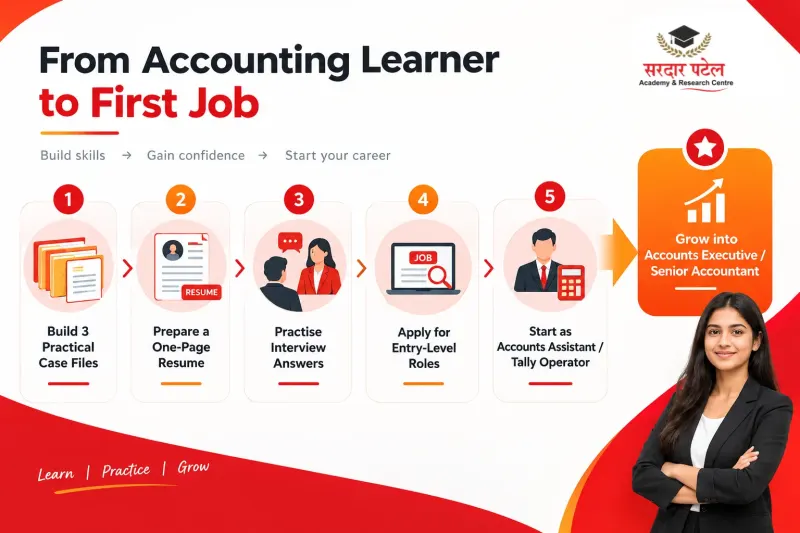
Once you start working, widen your base. Advanced Excel, e-invoicing and deeper payroll compliance are natural next topics, and so is keeping up with changes under the Income-tax Act, 2025. Many people move from accounts assistant to accounts executive and then to senior accountant roles, though titles vary by employer. Pay also varies by city and company, so check live listings instead of relying on a single quoted figure.
Conclusion
A job-ready accounting course in 9 months gives you a long enough runway to learn each skill properly instead of skimming it. Spend month one on fundamentals and month two on Tally Volume 1, months three to five on Tally Volumes 2 and 3 with payroll, TDS, TCS and GST, month six on Busy, months seven to nine on income tax, TDS and GST e-filing, and finish with mock projects and interviews. Keep a mistake log, build three case files and treat the first role as step one of a longer accounting career roadmap, not the finish line.
If you would like guidance and regular feedback along the way, you can become job-ready with the E-Diploma in Financial Computer Accounting (E-DFCA) at Sardar Patel Academy & Research Centre. Either way, the plan works for the person who practises every day.
FAQs
For entry-level accounts work, yes, provided you start with a reasonable base and practise daily. A job ready accounting course in 9 months builds the foundation; seniority comes with experience.
At minimum: double-entry fundamentals, Tally Prime, payroll, GST, TDS and income tax with filing practice on current forms, a second package such as Busy, and projects with feedback. If any of these is missing, ask how the gap will be filled.
Not strictly, but it shortens the road. If you come from another stream, give extra weeks to fundamentals before moving to software.
Learn the logic first, then Tally Prime, then Busy. Software is much easier once you understand why each entry is made.
Two to three focused hours is a workable range for most learners. The quality of practice matters more than the number on the clock.
No honest programme can promise that. A good one improves your skills, your portfolio and your interview confidence; the job still depends on your preparation and the market.