+91 9312966129
 sparc.enquiry01@gmail.com


Online vs Offline Data Analytics Course in Delhi
Confused between online and offline Data Analytics courses in Delhi? Compare flexibility, practical training, placement support, fees, and career outcomes to choose the right learning path.

Table of Contents
- Starting Your Data Analytics Journey
- Why Data Analytics Is One of the Fastest-Growing Careers
- Understanding Online Data Analytics Courses
- Understanding Offline Data Analytics Courses
- Online vs Offline: Quick Comparison
- Learning Experience Comparison
- Flexibility vs Classroom Discipline
- Practical Training and Live Projects
- Placement Support Comparison
- Course Fees and Learning Value
- Skills You Will Learn
- Career Opportunities After Completing a Data Analytics Course
- Salary Comparison for Data Analysts
- Which Learning Mode Is Best for You?
- What Makes SPARC a Practical Choice for Data Analytics?
- Conclusion: Which Learning Mode Should You Choose?
- Compare Learning Modes & Start Your Data Analytics Journey
Starting Your Data Analytics Journey
Data has quietly become the backbone of business decisions, which is why Data Analytics keeps showing up on lists of the best careers to build right now.
If you've decided to learn analytics, the next question is format: online or a classroom? Online wins on convenience — learn whenever, from wherever. Offline wins on structure — a trainer in front of you, a lab to practice in, classmates to compare notes with.
Not sure you even need a degree to start? Our guide on How to Choose the Right Data Analytics Institute in Delhi breaks down the eligibility path in detail.
Learners in Delhi can explore SPARC's Data Analytics programs, which combine practical projects, expert guidance, and career-focused support to build job-ready skills.
Why Data Analytics Is One of the Fastest-Growing Careers
Every click, purchase, and transaction leaves a data trail, but it's only useful once someone analyses it and turns it into a decision. The U.S. Bureau of Labour Statistics lists analytics-driven roles among the fastest-growing occupations, tied to how many industries now run on data-first decision-making.
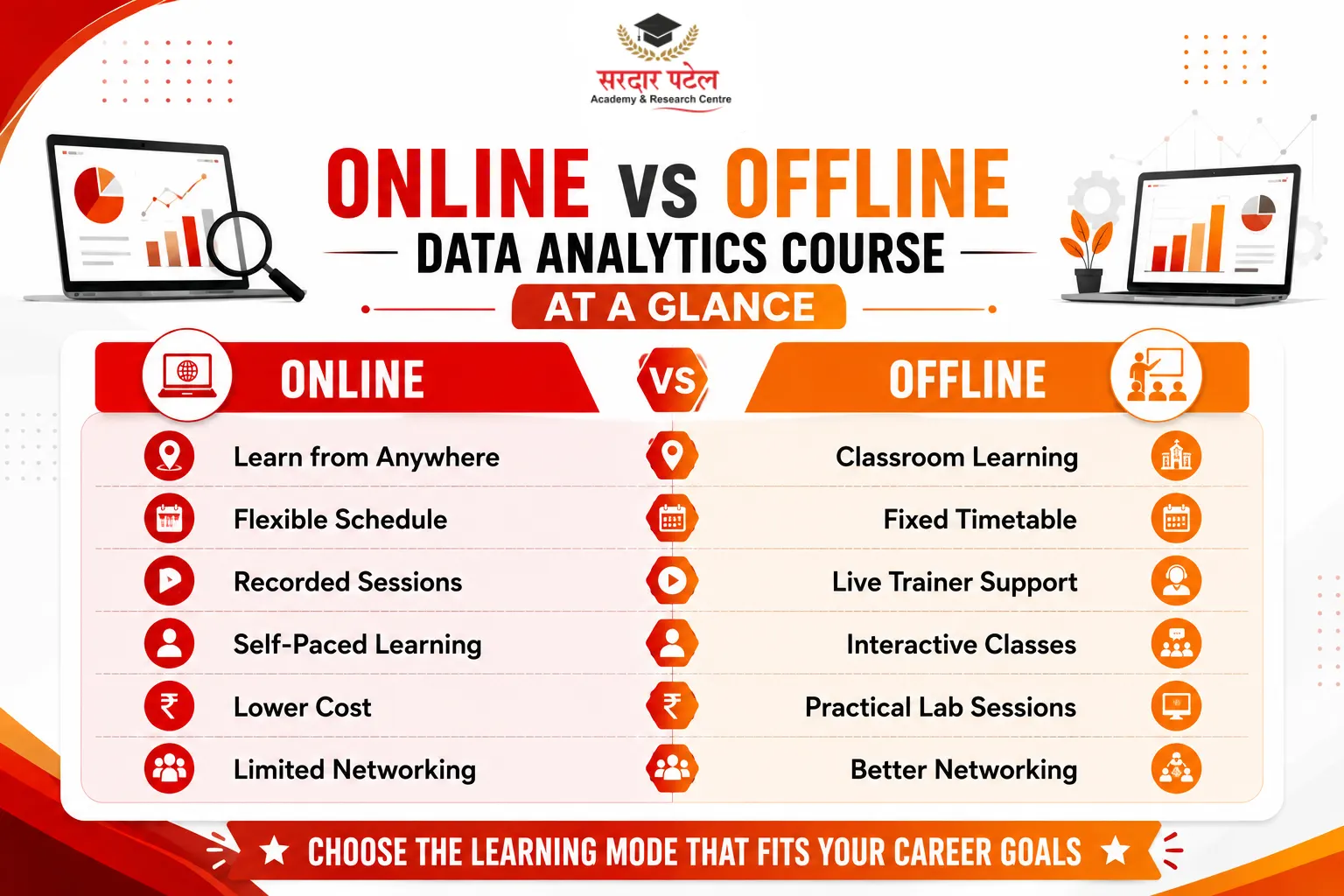
A Data Analyst pulls together data, cleans it, interprets it, and presents it in a way that changes what a business does next. AI, BI tools, and cloud platforms have widened the field — analysts are now hired across IT, banking, healthcare, e-commerce, retail, manufacturing, marketing, government, education, and startups.
Strong pay, steady demand, and freedom to move between industries make this a dependable career bet.
Understanding Online Data Analytics Courses
An online course is delivered entirely over the internet — recorded lectures, live sessions, quizzes, and projects, routed through a Learning Management System instead of a classroom. It suits people who need to fit learning around a job or a schedule that doesn't allow fixed timings.
What it gets right: flexible schedule, learn from anywhere, self-paced (rewatch lectures as needed), generally cheaper, and resources that stay accessible after the session ends.
Where it falls short: little face-to-face contact, demands real self-discipline, motivation can dip without a fixed routine, thin networking, and doubts can sit unresolved longer.
If you learn best with someone actively checking your progress, self-paced online learning can feel like it's missing that layer.
Understanding Offline Data Analytics Courses
Offline courses put you in a physical classroom — live instruction, lab time, and classmates working the same problems alongside you. Institutes like Sardar Patel Academy & Research Centre (SPARC) pair lectures with hands-on lab work, case studies, and one-on-one mentoring, so concepts get tested immediately.
What it gets right: direct access to trainers, a fixed schedule that builds consistency, dedicated lab time on Excel, SQL, Python, Power BI, Tableau and statistics, real networking with peers and industry visitors, and structured placement prep (resume workshops, mock interviews, aptitude drills, placement drives).
That combination of routine and supervision tends to translate into faster, more confident job-readiness. A well-prepared resume matters too — our Data Analyst Resume Guide can help.
Online vs Offline: Quick Comparison
| Feature |
Online Course |
Offline Course |
| Learning Mode |
Virtual/recorded |
Classroom-based |
| Flexibility |
High |
Moderate |
| Trainer Interaction |
Limited to live sessions |
Direct, face-to-face |
| Practical Learning |
Virtual labs, assignments |
Dedicated computer labs |
| Networking |
Limited |
Strong peer/industry contact |
| Doubt Resolution |
Chat/scheduled sessions |
Instant, in-classroom |
| Self-Discipline Needed |
Very high |
Moderate |
| Placement Support |
Varies by provider |
Usually stronger |
| Cost |
Generally lower |
Slightly higher |
| Best Suited For |
Working professionals, remote learners |
Freshers, structured learners |
Recruiters still tend to favour candidates with strong, verifiable hands-on practice — the kind classroom settings make easier to build.
Learning Experience Comparison
Analytics isn't a watch-and-learn subject; you need to wrestle with messy data, build dashboards, and defend conclusions.
Online: study at your own pace, full library of recordings, works well for busy professionals, digital resources easy to reach — but time management is the trade-off, since consistency tends to slip without a routine.
Offline: daily contact with trainers, doubts resolved immediately, fewer distractions, group discussion sharpens understanding, frequent structured practice, regular evaluation. For beginners, classroom learning usually builds a sturdier foundation since an instructor can spot gaps early. SPARC pairs lectures with practical exercises so concepts and confidence build together.
Flexibility vs Classroom Discipline
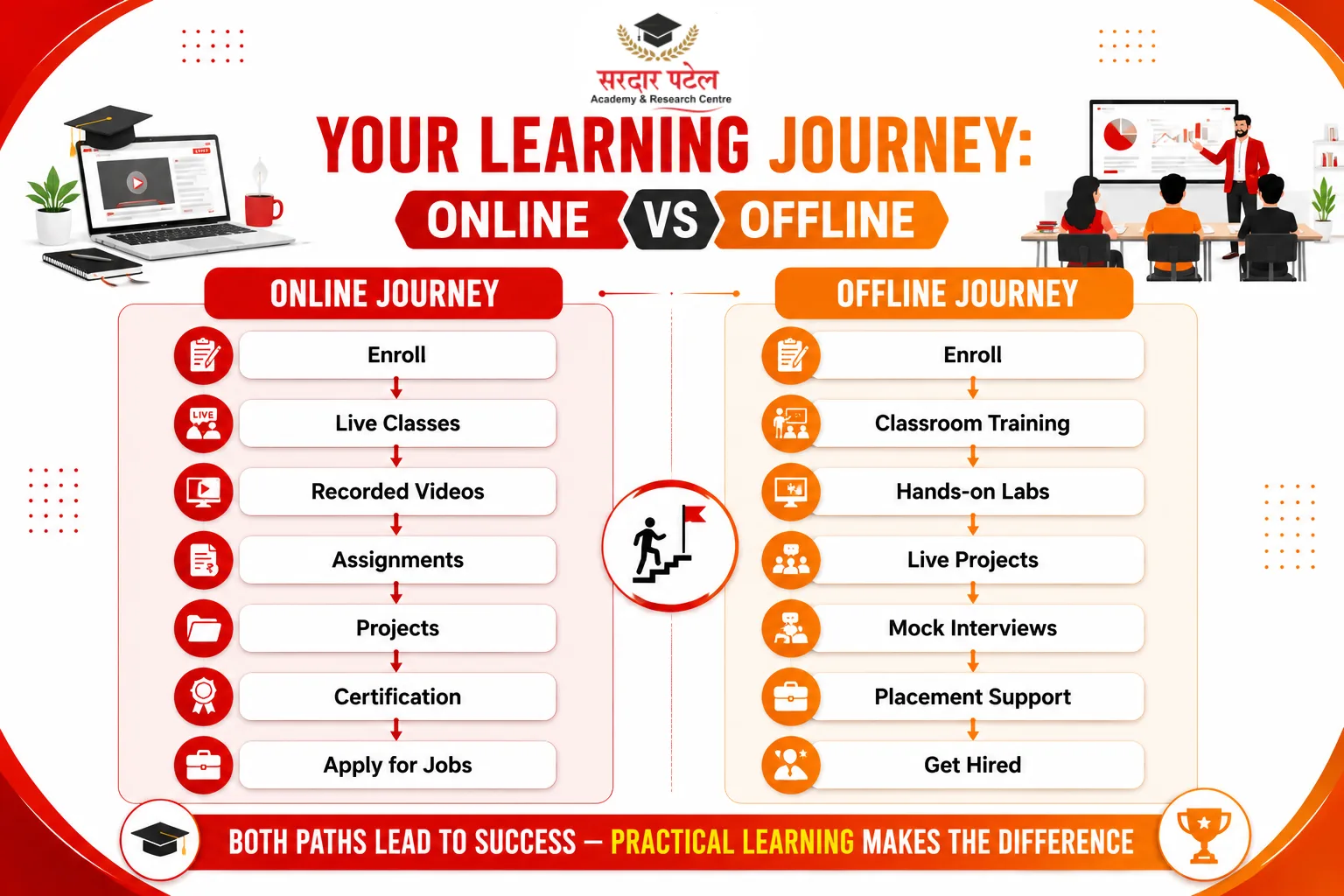
Online — maximum flexibility: study evenings or weekends, ideal for working professionals, students, freelancers, business owners, and career changers. The catch: flexibility only helps if you use it — pushing lessons back delays completion.
Offline — built-in consistency: a fixed timetable does some of the discipline work for you, helping learners stay motivated, finish modules on schedule, build a daily habit, and get assessed consistently. If you need external structure, offline is the safer bet.
Practical Training and Live Projects
Employers care less about theory and more about whether you can work a real dataset.
Online: practice assignments, case studies, mini/capstone projects, virtual labs — but quality varies a lot by provider, and some courses lean on recorded demos rather than supervised practice.
Offline: generally a stronger practical setup, with a trainer correcting mistakes in real time. Typical lab work covers data cleaning, SQL practice, Excel dashboards, Power BI reports, Tableau visualisations, Python programming, statistical analysis, and business case studies. At SPARC, learners work through industry-style projects mirroring real workplace problems.
Placement Support Comparison
Online: resume templates, recorded interview walkthroughs, job portal access, career webinars, LinkedIn tips — but personalised help is usually limited, especially in self-paced programs. (See our guide on Data Analytics Course Eligibility and Career Opportunities.)
Offline: resume-building sessions, mock technical and HR interviews, communication training, aptitude practice, portfolio development, internships, and campus recruitment drives — translating into stronger interview performance and ongoing mentor feedback.
Course Fees and Learning Value
Online looks cheaper upfront, but factor in practical exposure, mentorship, networking, and placement help — classroom training often pays off more over a career, not just a semester.
Skills You Will Learn
A solid course should leave you able to both analyse data and explain what it means. SPARC's curriculum balances theory with hands-on application.
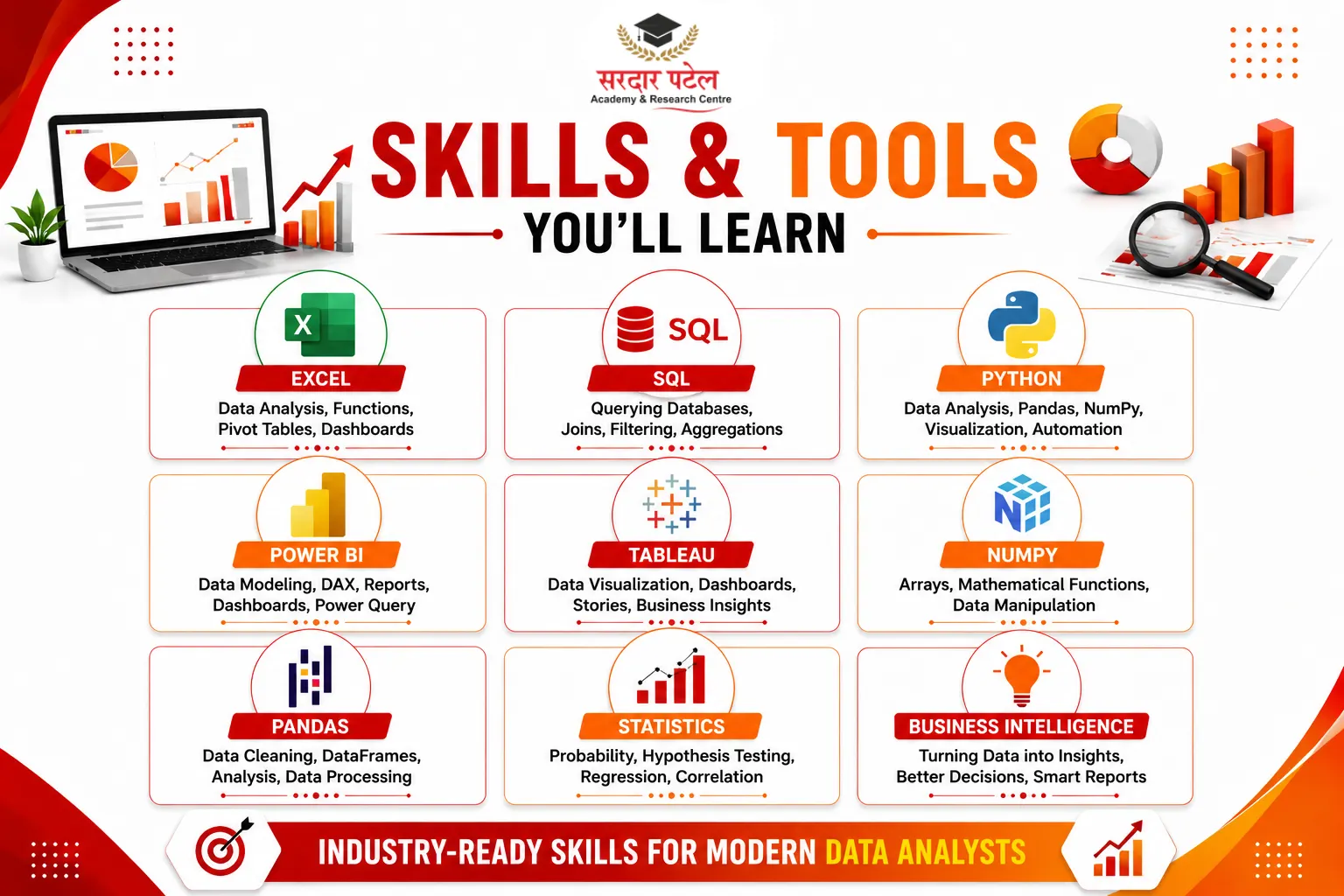
- Microsoft Excel — data cleaning, pivot tables, lookup functions, charts, conditional formatting, data validation, dashboards.
- SQL — SELECT queries, filtering, joins, group by, aggregate functions, subqueries, database management (see the MySQL Documentation for reference).
- Python — variables/data types, Pandas, NumPy, data cleaning, visualisation, EDA.
- Power BI — dashboard design, report creation, data modelling, Power Query, DAX basics, BI reporting (Microsoft Power BI Learning is a good next step).
- Tableau — interactive dashboards, charts, filters, storytelling with data.Statistics — mean, median, mode, probability, correlation, regression, hypothesis testing.
Soft skills matter just as much: analytical thinking, problem solving, critical thinking, communication, presentation, attention to detail, business understanding, teamwork, and time management.
Career Opportunities After Completing a Data Analytics Course
Analytics is now core infrastructure for how companies operate. LinkedIn Jobs regularly lists thousands of open roles such as Data Analyst, Business Analyst, BI Analyst, Reporting Analyst, MIS Executive, Data Visualisation Specialist, Operations/Financial/Marketing/Product Analyst, Junior Data Scientist, SQL Developer, and Analytics Consultant.
Hiring industries: IT, banking and financial services, healthcare, e-commerce, retail, manufacturing, telecom, digital marketing, insurance, logistics, education, and government.
Top hiring companies: Accenture, Deloitte, TCS, Infosys, Wipro, Capgemini, IBM, Cognizant, Genpact, Amazon, Flipkart, HCLTech, EY, KPMG, PwC.Visualisation
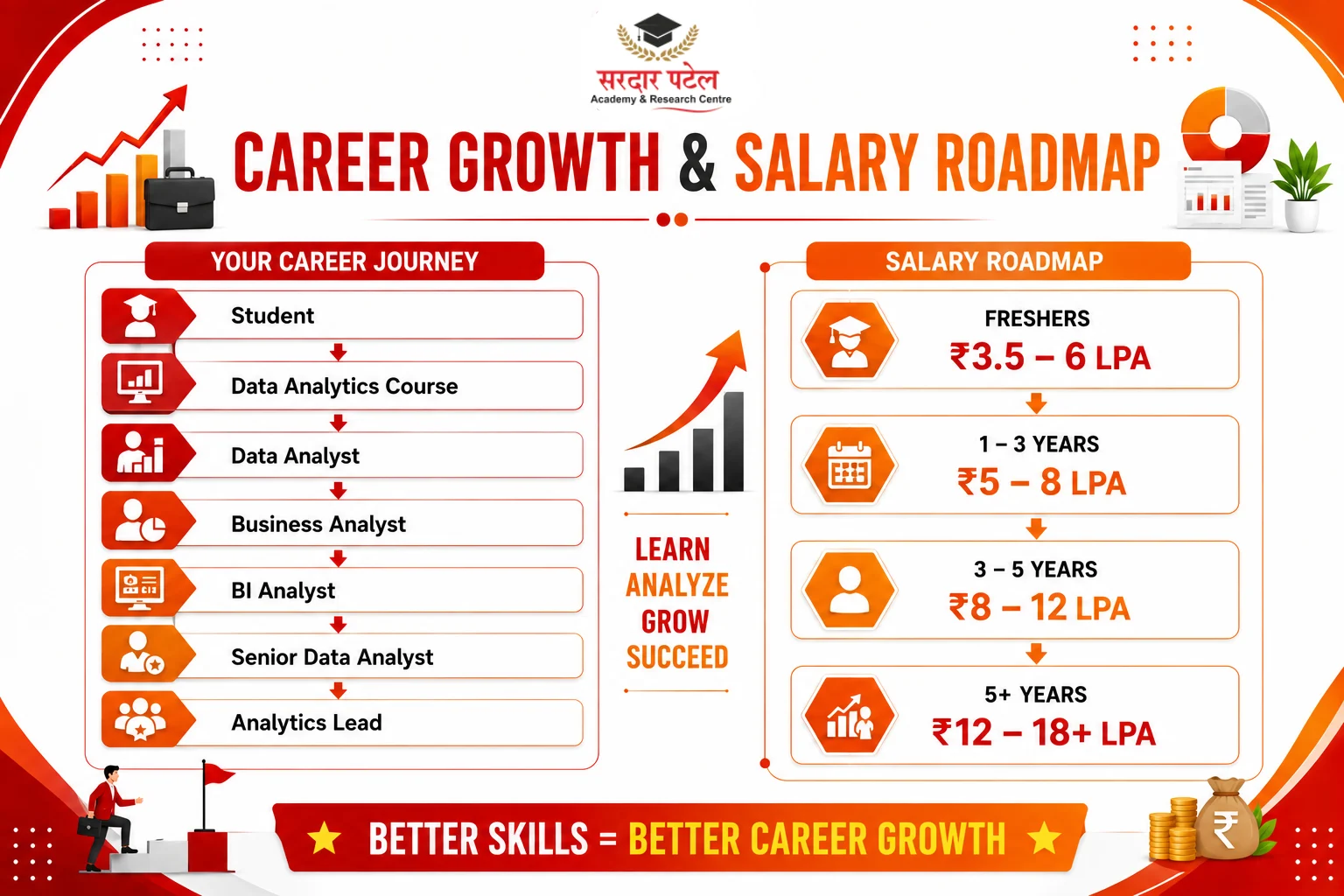
Salary Comparison for Data Analysts
| Experience |
Average Annual (India) |
Approx Monthly |
| Fresher (0–1 yr) |
₹3.5–6 LPA |
₹29,000–50,000 |
| Junior (1–3 yrs) |
₹5–8 LPA |
₹42,000–67,000 |
| Mid-level (3–5 yrs) |
₹8–12 LPA |
₹67,000–1,00,000 |
| Senior (5–8 yrs) |
₹12–18 LPA |
₹1,00,000–1,50,000 |
| Analytics Lead |
₹18–30+ LPA |
₹1.5–2.5+ Lakhs |
Delhi NCR is among India's fastest-growing analytics hubs: Data Analyst ₹4–7 LPA, BI Analyst ₹5–8 LPA, SQL Developer ₹4.5–7.5 LPA, MIS Analyst ₹3.5–6 LPA, Business Analyst ₹6–12 LPA, Power BI Developer ₹5–10 LPA. Analysts fluent in Python, SQL, Power BI, Tableau, and Advanced Excel see faster raises.
Which Learning Mode Is Best for You?
There's no universal answer — it depends on your circumstances and goals. Still weighing the syllabus? Our Questions to Ask Before Joining an Analytics Institute breaks this down further.
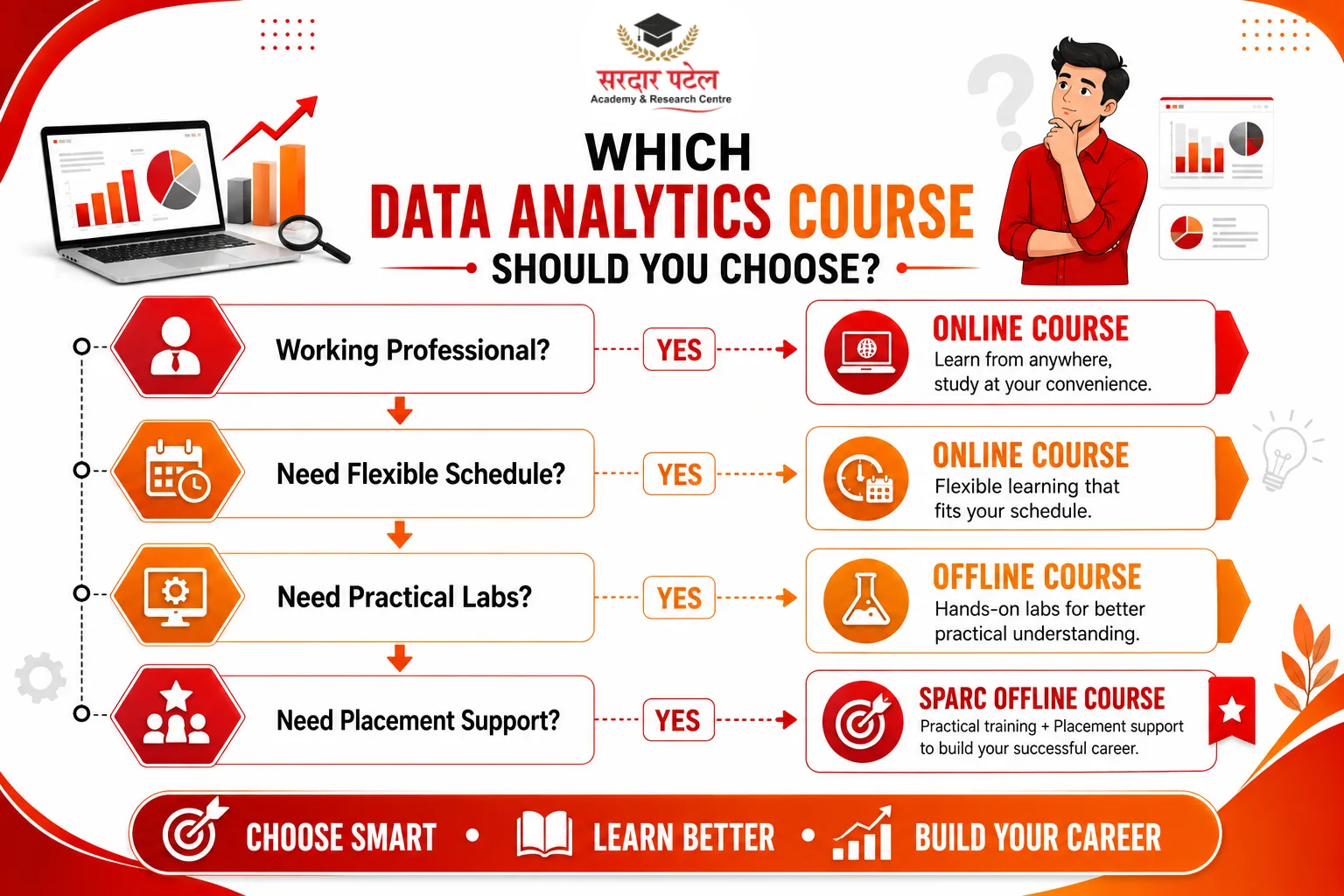
Go online if you: are a working professional, need a flexible schedule, prefer self-paced learning, are comfortable learning independently, and have strong time management.
Go offline if you: are a beginner, learn better face-to-face, want hands-on training, value networking, and need structured placement support.
For a middle path, SPARC combines industry-facing training with experienced mentors, practical assignments, live projects, and career guidance built around what employers are actually hiring for.
What Makes SPARC a Practical Choice for Data Analytics?
The institute shapes the outcome as much as the content. SPARC focuses on practical, career-oriented training: industry-aligned curriculum, experienced trainers, hands-on sessions, real-world case studies, live projects, small batches for personalised attention, resume-building support, mock interviews, career guidance, placement assistance, and modern computer labs.
Whichever format you choose, SPARC's focus stays on making you job-ready, not just certificate-ready. Just starting the Data Analytics Course for Housewives & Freshers walks through the path step by step.
Conclusion: Which Learning Mode Should You Choose?
There's no universally better option — it depends on your goals, schedule, and learning style. If flexibility and self-paced study matter most, online works well, especially for working professionals and freelancers. If you'd rather learn through structured classes, direct trainer access, instant doubt resolution, and heavier hands-on practice, offline is likely the stronger fit.
Either way, your outcome comes down to a few fundamentals: learning industry-relevant tools, working on real projects, building a strong portfolio, practising consistently, developing analytical skills, and staying current with industry trends.
Data Analytics demand keeps climbing, making it a dependable career path for students, graduates, and professionals alike. Pick the right course, stay consistent, and the career follows.
For learners who want practical, industry-facing training, Sardar Patel Academy & Research Centre (SPARC) offers Data Analytics programs designed to close the gap between the classroom and the workplace.
Compare Learning Modes & Start Your Data Analytics Journey
At SPARC, we help students pick the path that fits their goals — backed by an industry-focused curriculum, practical training, live projects, expert mentorship, and placement assistance.
Why Learn Data Analytics with SPARC?
- Industry-aligned curriculum
- Expert trainers with practical experience
- Hands-on training using Excel, SQL, Python, Power BI, and Tableau
- Live projects and business case studies
- Resume-building and interview preparation
- Placement assistance
- Modern learning environment
- Career-focused mentorship
FAQs
Yes, as long as it offers real practical training, live projects, mentorship, and recognized certification — your portfolio and skills matter more than the delivery format.
Offline classroom training generally works better for beginners due to structured guidance and immediate doubt resolution.
Yes — online programs are built exactly for flexible, alongside-a-job upskilling.
Excel, SQL, Python, Power BI, Tableau, and foundational statistics.
Yes — live projects, hands-on exercises, case studies, and career-focused preparation.