+91 9312966129
 sparc.enquiry01@gmail.com


Student Portfolio Showcase
Learn what makes a strong data analytics student portfolio, common mistakes to avoid, and how a project showcase builds trust with employers.
Table of Contents
- The Resume-vs-Portfolio Problem, in One Line
- Building One: A Practical, Step-by-Step Approach
- Step 1 — Start from a question, not a dataset.
- Step 2 — Do the messy part visibly.
- Step 3 — Choose 2–4 projects, not ten.
- Step 4 — Mix your tools deliberately.
- Step 5 — Write a short narrative per project.
- Step 6 — Keep the visuals clean.
- Step 7 — Host it somewhere frictionless.
- Where Most Student Portfolios Quietly Fall Apart
- Does It Replace Certifications Entirely?
- What Employers — and Parents — Are Really Evaluating
- Conclusion
Picture two candidates applying for the same analyst opening. One hands over a resume listing "SQL, Power BI, Excel." The other opens a laptop and walks the interviewer through a dashboard she built, explaining why she chose a particular chart type and what the numbers actually meant for the business. It's not hard to guess who leaves a stronger impression.
That's the entire case for a data analytics student portfolio — it's not a formality tacked onto a resume; it's proof. This piece looks at what belongs in one, how to actually build it (step by step), the mistakes that quietly weaken most student portfolios, and why an analytics student project showcase often does more convincing than a certificate ever will — a dynamic that plays out constantly in a hiring market like Delhi NCR's.
The Resume-vs-Portfolio Problem, in One Line
A resume tells someone what you say you can do. A portfolio lets them check. Recruiters increasingly lean on the second kind of evidence, and it's worth understanding why before you start building.
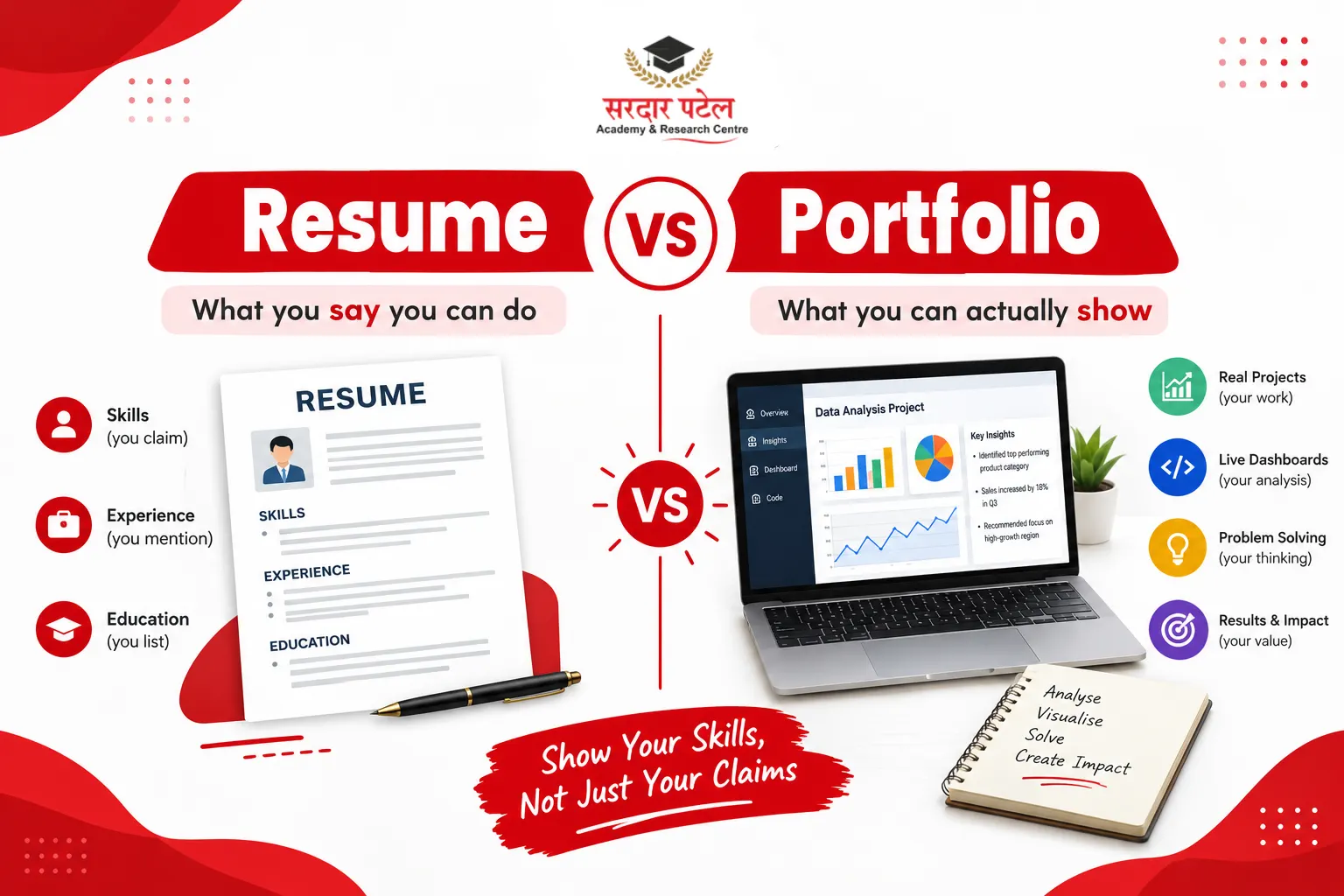
When a recruiter opens a portfolio, they're not reading claims — they're inspecting your actual work: how you framed a problem, what you did when the data was messy, and whether your final dashboard genuinely answers the question it was built for. This is consistent with a broader hiring shift, where LinkedIn's own hiring research has increasingly pointed to project-based evidence as a stronger predictor of on-the-job performance than credentials alone. Students who are still new to the field can first explore data analytics basics for beginners before deciding which of their projects are strong enough to include.
Building One: A Practical, Step-by-Step Approach
Rather than treating "what goes inside" as a checklist, it helps to think of portfolio-building as a process — one most students get wrong the first time simply because no one walks them through the order of operations.
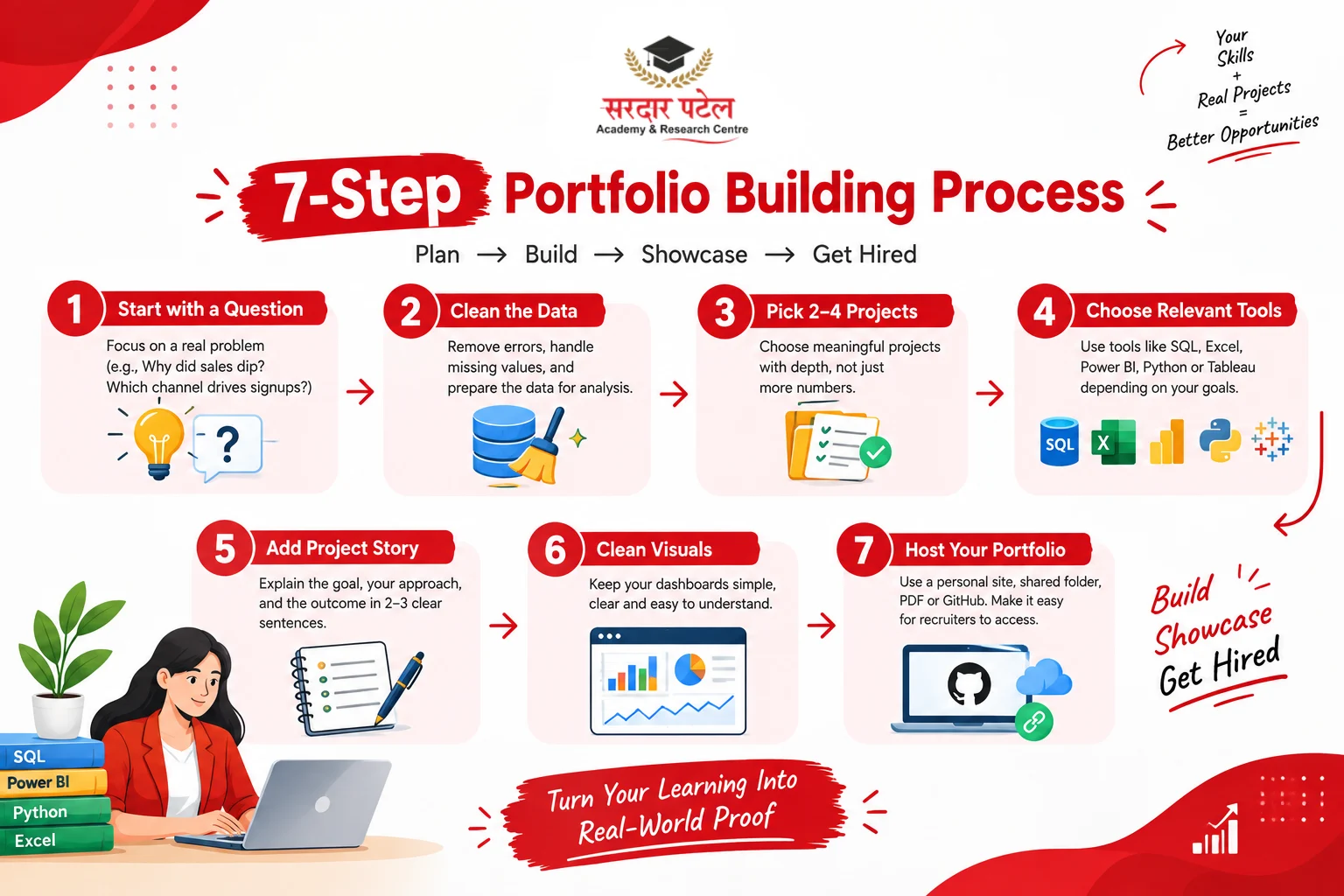
Step 1 — Start from a question, not a dataset.
Don't open a random public CSV and start exploring. Start with something closer to a real business question: "Why did regional sales dip in Q3?" or "Which marketing channel is actually driving signups?"A data analytics learning guide can help you figure out which foundational skills to build before you attempt this.
Step 2 — Do the messy part visibly.
Document how you cleaned the data, what didn't work on the first attempt, and how you adjusted your approach — steps that are also part of a broader data science process. This is often the most convincing part of a portfolio, because it shows judgment rather than a polished, edited-after-the-fact result.
Step 3 — Choose 2–4 projects, not ten.
A portfolio with three deeply explained projects beats one with ten shallow ones. Depth signals more than volume ever will.
Step 4 — Mix your tools deliberately.
Draw from SQL, Excel, Power BI, Python, or Tableau depending on what you've learned — and be intentional about which data analytics tools are actually worth featuring for the kind of role you want.
Step 5 — Write a short narrative per project.
Two or three sentences on the goal, your method, and the outcome are often more useful to a reader than the underlying code. This is also where you explain why you picked this project, not just what you did in it.
Step 6 — Keep the visuals clean.
A cluttered dashboard undercuts good analysis underneath it. Resources like Storytelling with Data are a solid reference if you want to sharpen chart design specifically.
Step 7 — Host it somewhere frictionless.
A simple personal site, a shared folder, or even a well-organized PDF works fine. For code-heavy work like SQL scripts or Python notebooks, many students use GitHub so recruiters can browse — or even run — the work themselves. GitHub repositories can keep project files, code, documentation, and revision history together, making them useful for presenting technical work in an organized way
Where Most Student Portfolios Quietly Fall Apart
Instead of a generic mistakes list, it's more useful to look at why these mistakes happen — because most of them come from the same root cause: treating the portfolio as a display case instead of a conversation starter.
- Overloading it. Students often assume more projects signal more effort. In practice, it signals the opposite — that nothing got the attention it needed.
- Skipping the "why." A dashboard with no framing around the business problem reads like a tool exercise, not applied thinking. This is the single easiest fix with the biggest payoff.
- Recycling tutorial projects untouched. Recruiters recognize common tutorial datasets on sight. If you use one, add your own twist, extra question, or deeper analysis on top of it.
- Ignoring presentation. Inconsistent formatting or messy visuals undercut solid analytical work underneath — first impressions still matter here.
- Leaving out trade-offs. Saying what you'd do differently with more time or data isn't a weakness — it's a sign of maturity that experienced interviewers specifically look for.
If you want to see how these portfolio decisions can fit into a real learning journey, you can explore the story of a student who became a data analyst in seven months and see how project work contributed to that transition.
Does It Replace Certifications Entirely?
Not quite — certifications still play a role, particularly at the initial screening stage for entry-level roles where recruiters are filtering large volumes of applications.
But once a candidate reaches the interview stage, the actual weight of the conversation tends to shift toward the analytics student project showcase. Think of it this way: certifications get you through the door; the portfolio decides what happens in the room.
What Employers — and Parents — Are Really Evaluating
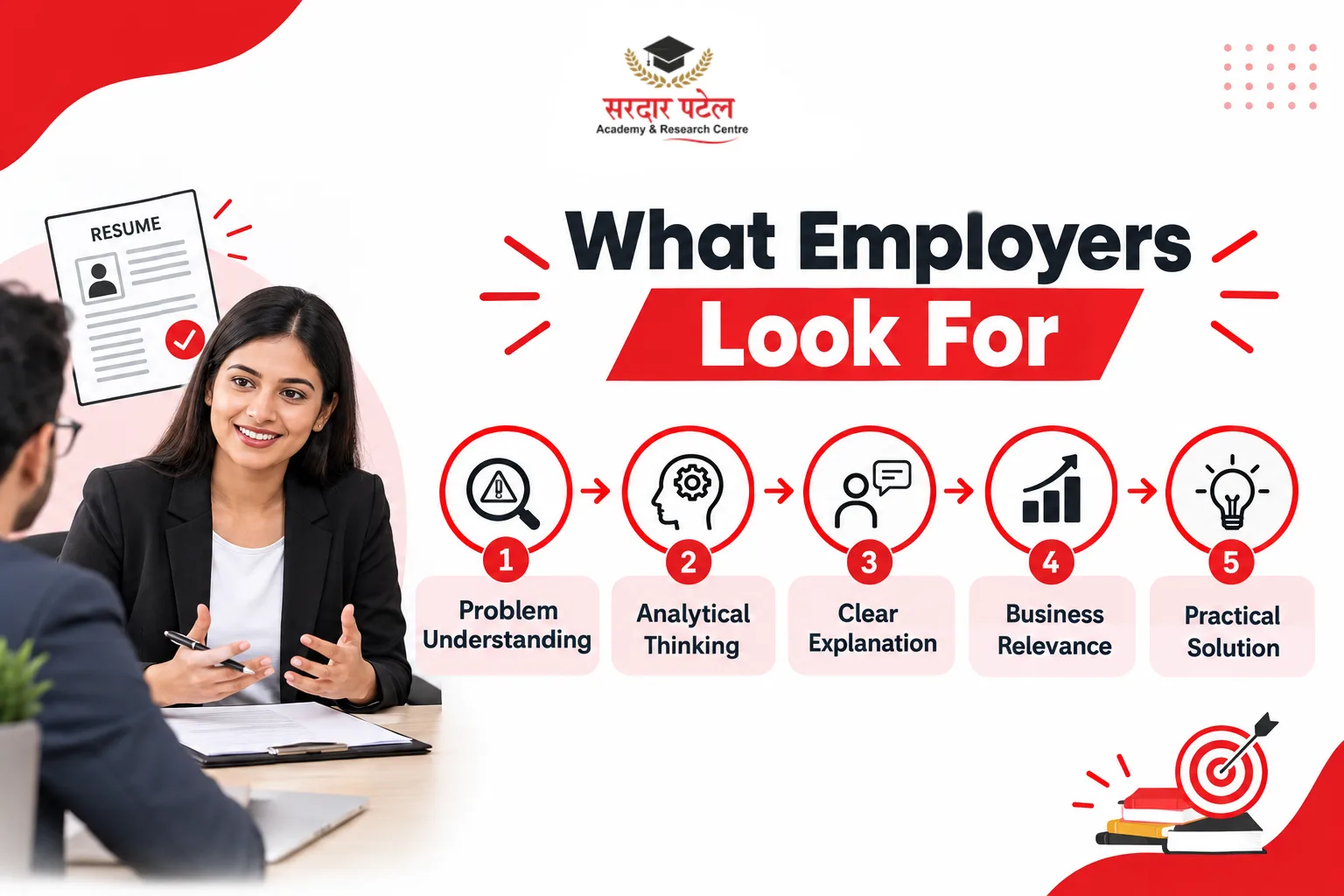
Employers are usually less interested in technical complexity and more interested in clarity: can this student explain their project simply, and does their solution genuinely solve the problem they set out to solve? Students still exploring their options can look into analytics course paths and career directions before deciding what kind of portfolio to build around.
Parents evaluating a training program, on the other hand, are often looking for a different kind of reassurance — proof that the learning translates into something concrete their child can point to. If that's your concern as a parent or guardian, reading parents' feedback about data analytics training can provide a clearer picture of how learners and families view practical training, project work, and career preparation.
For students weighing which skills and roles to build a portfolio around in the first place, our guide to data analytics skills and career opportunities is a useful starting point, and Kaggle remains one of the most widely used free sources of real datasets to practice on before working with proprietary business data, while exploring the best free tools for data analytics can help students choose practical resources for building portfolio projects.
Conclusion
A data analytics student portfolio isn't decoration on top of a resume — for a lot of recruiters, it's the thing that actually decides whether they trust what a candidate claims to know. Build it around real questions, document your process honestly, and resist the urge to pad it with quantity.
Start with one project, done properly. If you want structured mentorship while you build it out, you can work on real project portfolios with guided feedback at Sardar Patel Academy & Research Centre.
FAQs
A curated set of real projects — dashboards, queries, and short write-ups — that shows how you actually solve data problems, rather than just listing tools you've learned.
Two to four well-explained projects consistently outperform a longer list of shallow ones.
Excel, SQL, Power BI, Tableau, and Python are all common choices — the tool matters less than how clearly you explain your reasoning around it.
Yes, especially once you're at the interview stage, where real project work tends to be more persuasive than a certificate alone.
Anywhere that's easy to open without friction — a personal site, a shared drive link, or a clean PDF all work.
Many do, especially for analytics and data roles, because a portfolio gives a far clearer read on applied skill than a resume alone.
A real showcase adds context — the business question, your reasoning, and the outcome — around the code, not just the raw files.
Yes, as long as you're clear and specific about your own individual contribution to it.