+91 9312966129
 sparc.enquiry01@gmail.com


Top Job Roles After a Data Analytics Course in 2026
Explore the top jobs after a Data Analytics course in 2026, including salaries, career opportunities, in-demand skills, and hiring industries. Learn more with SPARC.
Table of Contents
Every business decision today — from launching a product to managing supply chains — is backed by data. Companies are no longer guessing; they are analysing. This shift has created massive demand for professionals who can turn raw numbers into meaningful insights.
If you have recently completed or are planning to enrol in a data analytics programme, understanding the career opportunities available to you, data analytics skills, and salary. The field offers multiple entry points depending on your background, skills, and interests — whether you come from a commerce, science, or arts background.
This guide covers the top jobs after a data analytics course, expected salaries, the industries that are hiring, and how to position yourself for a successful career in 2026.
Why Data Analytics Is a High-Growth Career in 2026
The volume of data generated globally continues to grow at an unprecedented pace. According to the World Economic Forum’s Future of Jobs Report 2025, data analysts and business intelligence specialists rank among the top ten fastest-growing professions worldwide, with demand projected to rise by over 30% through 2030.
Several factors are driving this sustained growth:
- Digital transformation across industries — From banking to healthcare, every sector is modernising its operations using data-driven tools.
- Explosion of e-commerce and fintech — Online businesses generate enormous volumes of transactional and behavioural data that need constant analysis.
- Wider adoption of AI and automation — AI systems require clean, structured data pipelines managed by skilled analysts.
- Growing need for customer analytics — Understanding consumer behaviour has become a competitive advantage for brands.
- Business process optimisation — Organisations are using analytics to reduce costs, improve efficiency, and forecast outcomes.
For students and working professionals in Delhi NCR, this creates a strong opportunity. The region hosts a dense concentration of IT companies, startups, banking institutions, and consulting firms — all of which are actively building analytics teams.
Skills You Need to Land a Job After a Data Analytics Course
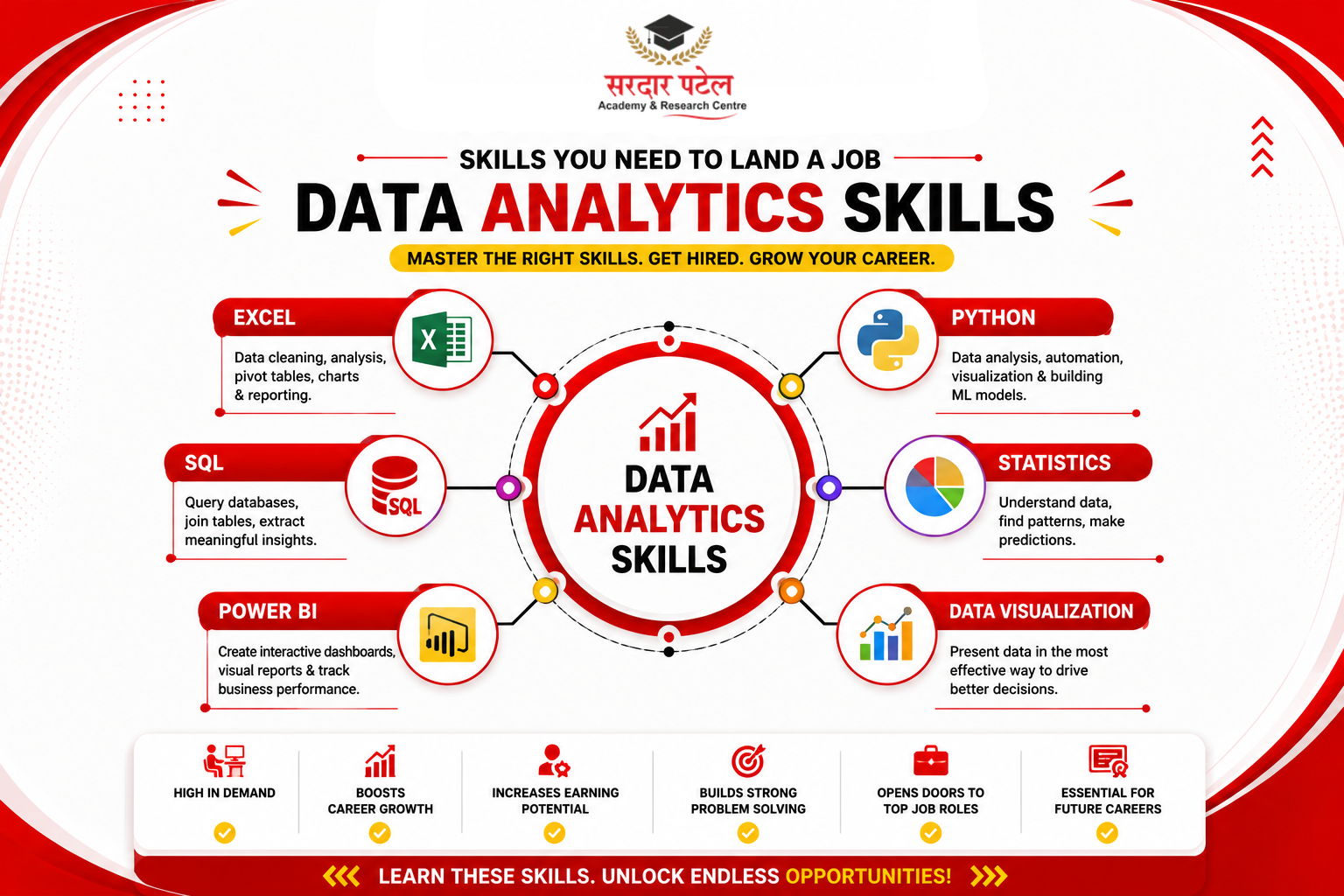
The right skill combination significantly improves your chances of getting hired. Employers typically evaluate candidates across two dimensions: technical capability and business communication. Skills Required to Become a Data Analyst
Technical Skills Employers Look For
Before mastering Excel, SQL, Power BI, and Python, explore the essential data analytics tools every beginner should know.
| Skill |
Why It Matters |
| Microsoft Excel |
Data cleaning, pivot tables, basic modelling |
| SQL |
Querying databases — used in almost every analytics role |
| Power BI |
Dashboard creation and business reporting |
| Python |
Advanced analytics, automation, and data science foundation |
| Statistics |
Hypothesis testing, distributions, and regression analysis |
| Data Visualisation |
Presenting findings in a way that stakeholders understand |
Business and Soft Skills
Technical knowledge alone is not enough. Hiring managers consistently prioritise candidates who can also:
- Communicate complex findings in simple language
- Think critically about business problems before jumping to data
- Present insights confidently to cross-functional teams
- Understand basic business metrics (revenue, churn, LTV, CAC)
At Sardar Patel Academy & Research Centre (SPARC), the curriculum integrates both dimensions — giving learners hands-on exposure to tools while building the communication and presentation skills that differentiate candidates during interviews.
Top 10 Job Roles After a Data Analytics Course
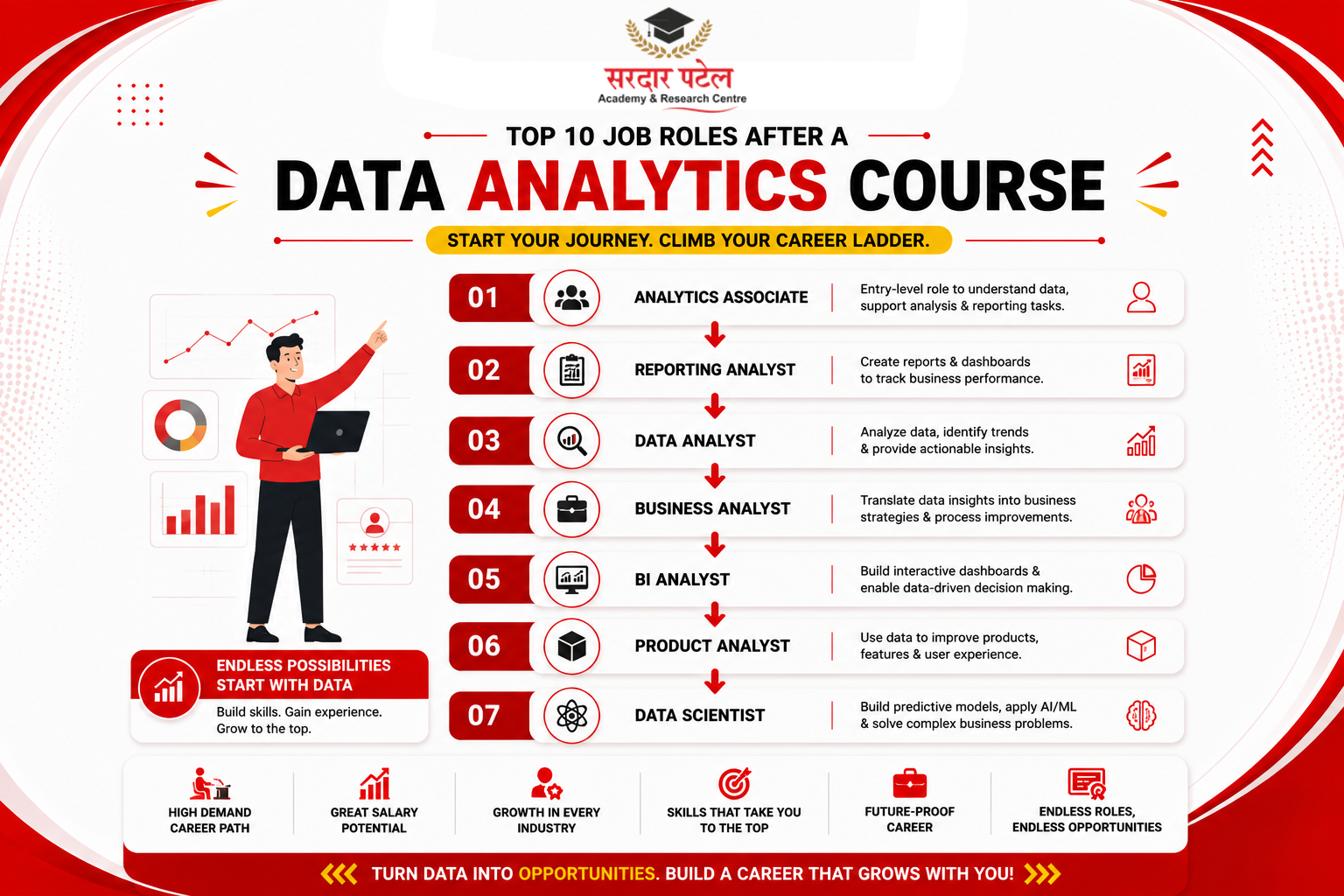
1. Data Analyst
The most accessible and commonly pursued role for freshers entering analytics.
What you will do: Collect, clean, and analyse datasets to identify patterns and generate reports that inform business decisions. You will work with Excel, SQL, and visualisation tools daily.
Average Salary: Fresher ₹4–7 LPA | Experienced (3–5 yrs) ₹8–15 LPA. Want to know city-specific salary trends? Explore our detailed guide on Data Analyst Salary in Delhi for Freshers.
Best Fit For: Beginners from any academic background who want a structured entry into analytics.
2. Business Analyst
Business Analysts operate at the intersection of data and business strategy. Rather than focusing purely on numbers, they translate data findings into operational recommendations.
What you will do: Gather requirements from business stakeholders, analyse existing processes, identify inefficiencies, and prepare reports that guide strategic decisions.
Average Salary: Entry Level ₹5–8 LPA | Mid-Level ₹10–18 LPA
Best Fit For: Candidates with an interest in business processes, communication, and cross-functional collaboration.
3. Business Intelligence (BI) Analyst
BI Analysts are responsible for turning organisational data into visual dashboards and performance reports that leadership teams use to track progress and make decisions.
What you will do: Build and maintain dashboards in Power BI or Tableau, monitor KPIs, automate reporting, and perform performance analysis across business units.
Average Salary: ₹5–20 LPA (highly dependent on Power BI and SQL proficiency)
Best Fit For: Learners who enjoy designing dashboards and want to work directly with senior stakeholders.
4. Data Visualisation Specialist
As organisations generate more data, communicating it clearly has become a specialised skill. Data Visualisation Specialists focus exclusively on presenting complex datasets in formats that are easy to interpret.
What you will do: Design interactive dashboards, create visual reports, build data storytelling presentations, and work with design principles to make analytics accessible to non-technical audiences.
Average Salary: ₹5–12 LPA
Best Fit For: Analytically minded individuals who also enjoy design thinking and visual communication.
5. Reporting Analyst
Reporting Analysts ensure that business data flows consistently and accurately to decision-makers through structured, recurring reports.
What you will do: Build and maintain daily, weekly, and monthly reports; validate data accuracy; track KPIs; and flag anomalies to relevant teams.
Average Salary: ₹4–9 LPA
Best Fit For: Detail-oriented candidates who prefer structured work and want a reliable entry point into corporate analytics.
6. Operations Analyst
Operations Analysts help organisations improve internal efficiency by identifying bottlenecks, reducing waste, and optimising workflows using data.
What you will do: Evaluate operational processes, prepare performance reports, analyse cost data, and recommend improvements to operations managers.
Average Salary: ₹5–10 LPA
Best Fit For: Candidates with an interest in logistics, manufacturing, supply chain, or healthcare operations.
7. Marketing Analyst
Marketing Analysts use customer and campaign data to evaluate the effectiveness of marketing initiatives and guide future spending decisions.
What you will do: Analyse campaign performance, segment customer audiences, evaluate ROI across channels, conduct A/B tests, and generate insights for marketing teams.
Average Salary: ₹5–12 LPA
Best Fit For: Candidates with an interest in consumer behaviour, digital marketing, or brand strategy.
8. Financial Analyst
Financial Analysts apply quantitative skills to evaluate a company’s financial health, forecast performance, and support budgeting decisions.
What you will do: Build financial models, analyse revenue and cost trends, prepare budget reports, and conduct risk assessments.
Average Salary: ₹6–15 LPA
Best Fit For: Candidates from commerce, finance, or economics backgrounds who want to combine domain knowledge with analytics skills.
9. Product Analyst
Product Analysts help technology companies understand how users interact with their products and use that knowledge to drive feature development and improvements.
What you will do: Track user behaviour, run A/B experiments, evaluate feature performance, build product dashboards, and present findings to product managers.
Average Salary: ₹7–18 LPA
Best Fit For: Candidates with an interest in technology products and user experience who want to work in fast-paced startup or tech environments.
10. Junior Data Scientist (With Additional Specialisation)
A solid analytics foundation can serve as a stepping stone toward a data science career, particularly for candidates who go deeper into Python and statistical modelling.
What you will do: Assist in data preparation, build basic predictive models, apply machine learning algorithms, and support senior data scientists in research and experimentation.
Average Salary: ₹6–15 LPA
Important: This role typically requires skills beyond a standard analytics course — specifically, advanced Python (Scikit-learn, TensorFlow), statistical modelling, and machine learning concepts. If this is your goal, plan for additional learning after completing your core analytics programme.
Best Fit For: Candidates with strong Python and statistics skills who want to specialise further in data science.
Industries Actively Hiring Analytics Professionals
One of the major advantages of building a career in data analytics is its cross-industry applicability. Here are the sectors with the highest demand for analytics professionals in 2026:
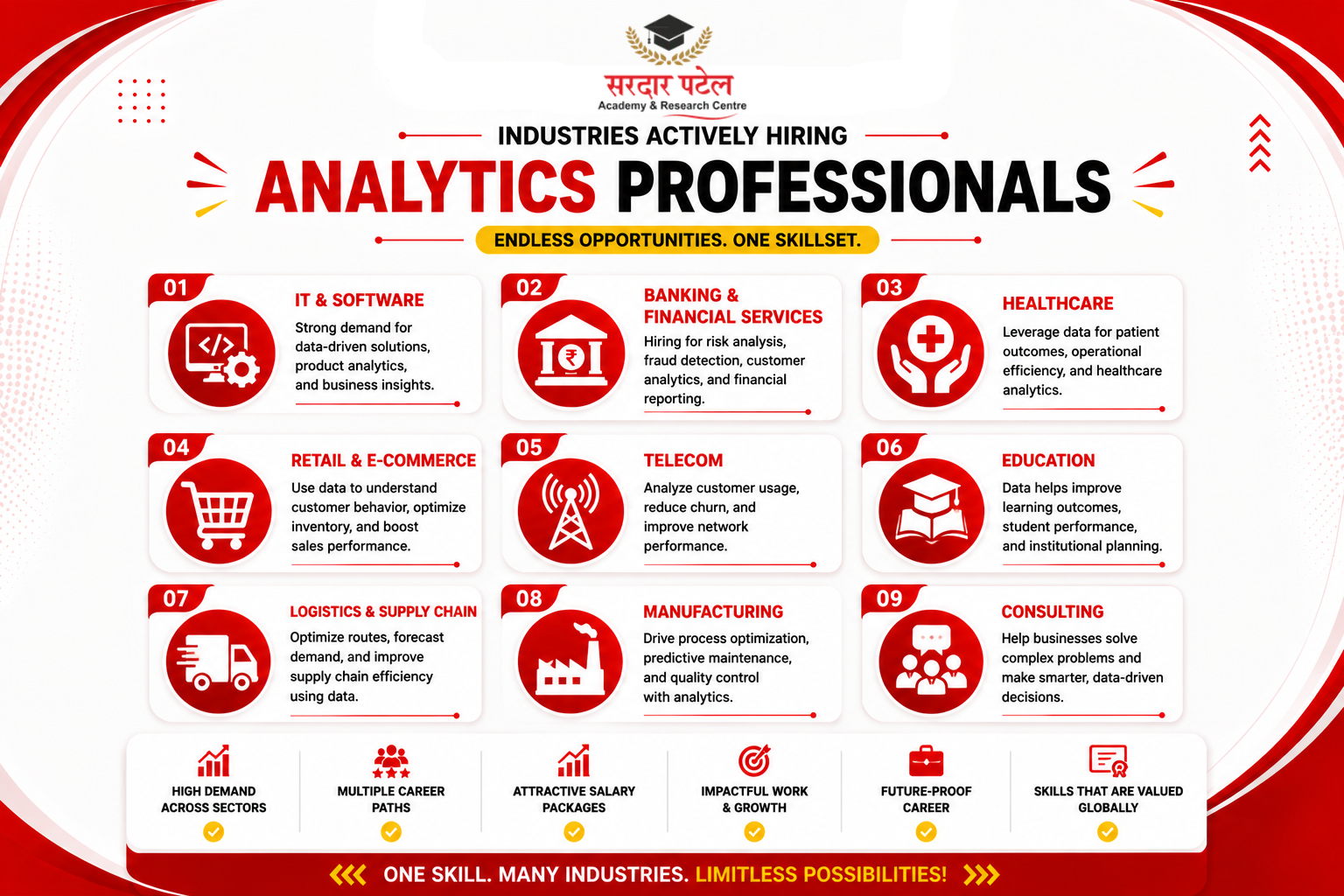
- Information Technology — Software companies, SaaS platforms, and IT consulting firms
- Banking and Financial Services — Risk modelling, fraud detection, customer analytics
- Healthcare — Patient data analysis, operational efficiency, clinical reporting
- E-Commerce and Retail — Customer segmentation, demand forecasting, supply chain analytics
- Manufacturing — Quality control, production analytics, cost optimisation
- Logistics and Supply Chain — Route optimisation, inventory management, delivery analytics
- Telecommunications — Network performance, customer churn analysis
- EdTech and Consulting — Learning analytics, business performance reporting
Interested in understanding recruitment trends? Learn more about how Delhi Companies Hire Data Analysts and what employers look for in fresh candidates.
Salary Growth at Every Career Stage
Your earning potential in analytics grows consistently with experience, certifications, and the complexity of projects you handle.
| Experience Level |
Average Annual Salary |
Note |
| Fresher (0–1 Year) |
₹4–7 LPA |
Includes IT and fintech sector premiums; general market entry may start at ₹3.5–5 LPA |
| Early Career (2–4 Years) |
₹8–12 LPA |
|
| Mid-Level (5–8 Years) |
₹12–20 LPA |
|
| Senior or Lead Roles |
₹20+ LPA |
Salary data referenced from AmbitionBox, Glassdoor, and LinkedIn Salary Insights (2025–26). Fresher figures of ₹4–7 LPA reflect the premiums available in the IT and fintech sectors in Delhi-NCR; broader market entry may start at ₹3.5–5 LPA, depending on company tier and industry.
Salary by Role — Fresher to Senior
| Role | Fresher (0–1 Yr) |
Mid-Level (3–5 Yrs) |
Senior / Lead |
|
| Data Analyst |
₹4–7 LPA |
₹8–15 LPA |
₹18+ LPA | |
| Business Analyst |
₹5–8 LPA |
₹10–18 LPA |
₹20+ LPA | |
| BI Analyst |
₹5–8 LPA |
₹10–18 LPA₹ |
₹22+ LPA | |
| Data Visualisation Specialist |
₹5–7 LPA |
₹8–12 LPA |
₹15+ LPA | |
| Reporting Analyst |
₹4–6 LPA |
₹7–10 LPA |
₹14+ LPA | |
| Operations Analyst |
₹5–7 LPA |
₹8–12 LPA |
₹15+ LPA | |
| Marketing Analyst |
₹5–7 LPA |
₹8–12 LPA |
₹15+ LPA | |
| Financial Analyst |
₹6–9 LPA |
₹10–15 LPA |
₹20+ LPA |
Factors that accelerate salary growth include:
- Proficiency in high-demand tools like Power BI, Python, and SQL
- Building a strong project portfolio with real business impact
- Obtaining relevant certifications (Microsoft PL-300, Google Data Analytics, etc.)
- Industry experience in high-paying sectors like banking, fintech, or product companies
- Strong communication and stakeholder management skills
How to Choose the Right Data Analytics Institute
Before enrolling in any programme, evaluate these key factors:
- Curriculum Depth: The programme should cover Excel, SQL, Power BI, Python, and Statistics — not just one or two tools. Verify the syllabus matches current job descriptions on platforms like Naukri and LinkedIn.
- Hands-On Projects: Theoretical knowledge alone will not get you hired. Look for programmes that include real datasets, capstone projects, and case studies from actual industries.
- Placement Track Record: Ask for verifiable placement statistics — not just claims. Check alumni reviews on Google, Justdial, or LinkedIn.
- Internship Access: Internship experience during or after a course significantly improves your resume and interview readiness.
- Faculty Expertise: Trainers with industry backgrounds bring practical insights that classroom-only educators cannot.
- Batch Flexibility: Look for weekend, weekday, and fast-track options that align with your schedule.
How SPARC Prepares You for Analytics Placement
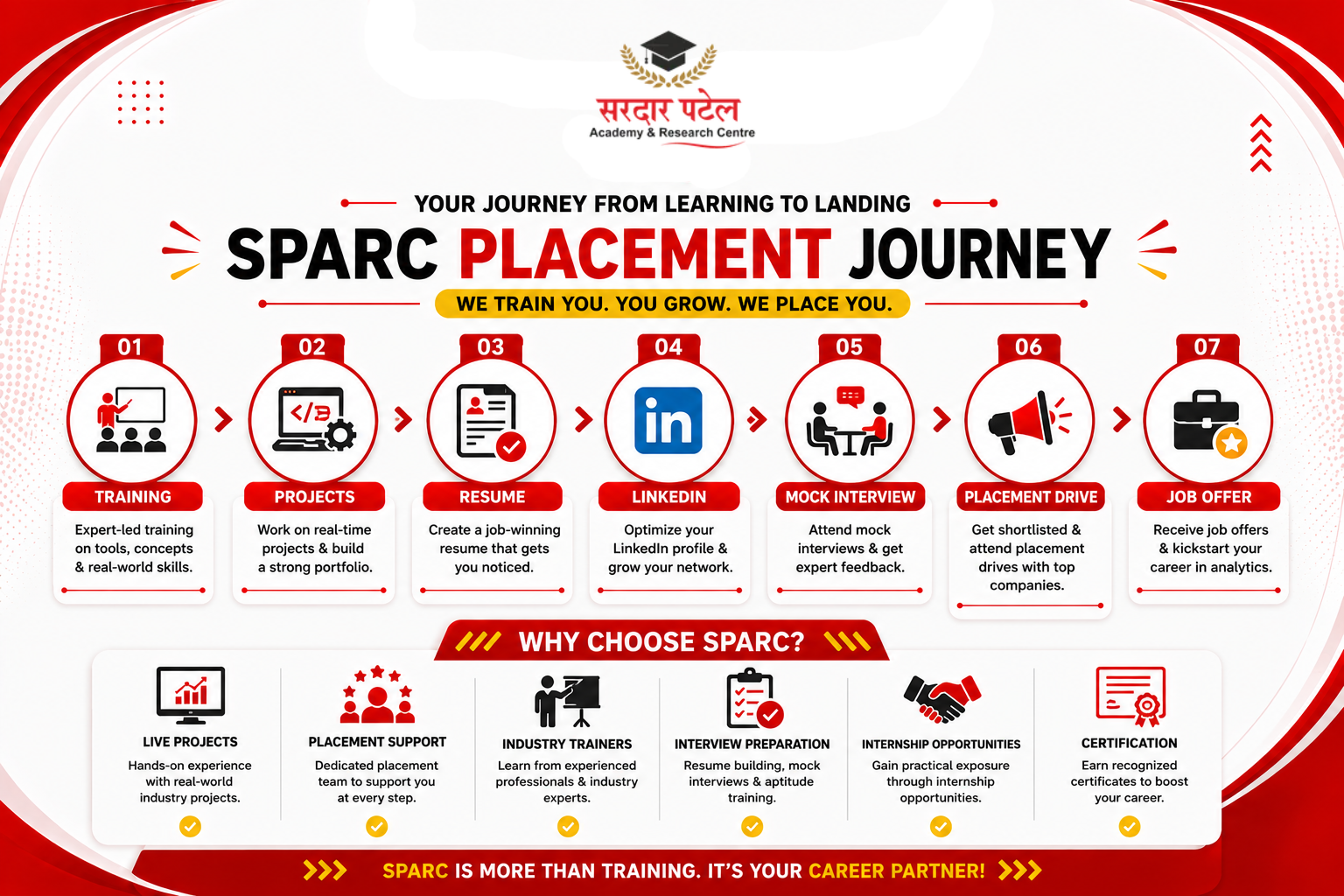
At Sardar Patel Academy & Research Centre (SPARC), the training programme is built around one goal: making you job-ready, not just course-complete.
What the Programme Covers
- Microsoft Excel (Advanced)
- SQL (Queries, Joins, Aggregations)
- Power BI (Dashboard Development, DAX
- Python (Pandas, NumPy, Matplotlib, Seaborn)
- Statistics for Data Analysis
- Real-World Industry Projects
Placement Support
To improve your chances of selection, read our expert guide on SQL Interview Questions for Freshers and learn the most common interview questions, technical assessments, and hiring expectations.
- Resume building tailored for analytics roles
- LinkedIn profile optimisation
- Mock interviews with feedback
- Direct hiring connections with partner companies
- Career counselling and role guidance
Programme Options
| Format |
Duration |
| Standard Programme |
3–4 Months |
| Programme with Internship |
6 Months |
| Weekday / Weekend / Fast-Track Batches |
Available |
Conclusion
A data analytics course opens doors across industries and job functions — from entry-level analyst positions to specialised roles in business intelligence, product analytics, and financial modelling. The key is to match your skills and interests with the right role, build a portfolio that demonstrates real capability, and connect with an institute that supports your career journey beyond the classroom.
Whether you are a recent graduate, a working professional looking to upskill, or someone switching careers entirely, the analytics field in 2026 offers strong opportunities across Delhi NCR and beyond.
Success in analytics depends on mastering both technical and business skills. If you're unsure where to start, explore our complete guide on Skills Required to Become a Data Analyst to understand the tools, technologies, and soft skills most valued by employers.
New batches starting soon. Book a free demo session to learn more about the SPARC Data Analytics Programme.
📞 Call: +91 93129-66129
📧 Email: admissions@sparc.org.in
FAQs
Product Analyst, Business Intelligence Analyst, and Financial Analyst roles tend to offer the highest packages at mid to senior levels, often exceeding ₹15–20 LPA with the right experience.
Freshers in IT and fintech sectors typically earn between ₹4–7 LPA. Across all industries, the general entry range is ₹3.5–5 LPA, with higher figures achievable at top-tier companies or in high-demand sectors.
Python is not always required at the entry level, but it significantly expands your opportunities — especially for product analyst, data science, and advanced analytics roles. Learning it early gives you a competitive edge.
A focused 3–4-month programme covering core tools can make you job-ready for entry-level roles. A 6-month programme with an internship component offers better preparation and practical exposure.
Yes. Students from commerce, arts, management, and science backgrounds regularly transition into analytics careers. The learning curve for tools like Excel, SQL, and Power BI is manageable with structured training.
IT, banking and financial services, e-commerce, healthcare, and consulting firms are the top recruiters in the Delhi NCR region.
Yes. Sardar Patel Academy & Research Centre (SPARC) provides resume building, LinkedIn optimisation, mock interviews, and direct hiring connections through its placement assistance programme.
Absolutely. As organisations across every sector continue to invest in data infrastructure, the demand for analytics professionals shows no signs of slowing down. It remains one of the most future-proof career paths available today.