+91 9312966129
 sparc.enquiry01@gmail.com


Which Institute Offers Practical Data Analytics Training in Delhi?
Looking for practical data analytics training in Delhi? Learn Excel, SQL, Power BI, Python, live projects, certifications, and placement support.
Table of Contents
- Why Practical Data Analytics Training Matters
- Industry Demands Hands-On Skills
- Employers Prefer Project Experience
- Better Job Readiness
- Key Features to Look for in a Data Analytics Institute in Delhi
- Comprehensive Curriculum
- Live Projects & Case Studies
- Experienced Industry Trainers
- Placement Assistance
- Flexible Learning Options
- How to Choose the Right Data Analytics Institute for Your Career Goals
- For Beginners
- For Working Professionals
- For Career Switchers
- For Students Seeking Placement Support
- Theory-Based Learning vs Practical Data Analytics Training
- Skills You Should Gain from a Practical Data Analytics Course
- Data Cleaning & Preparation
- SQL Querying
- Data Visualization
- Dashboard Development
- Business Intelligence Reporting
- Basic Predictive Analytics
- Sample Projects Students Work On
- Sales Performance Dashboard
- Customer Segmentation Analysis
- Marketing Analytics Project
- HR Analytics Dashboard
- Retail Analytics Project
- Career Opportunities After Completing Data Analytics Training
- Why SPARC Stands Out in Delhi
- What Makes SPARC Different?
- Conclusion
- Why Choose SPARC?
Data Analytics is one of the fastest-growing career fields today. The demand for skilled data professionals is increasing rapidly across industries such as IT, Finance, Healthcare, Retail, and E-commerce. As organisations collect more data than ever before, the need for professionals who can turn raw numbers into actionable business insights continues to grow.
However, simply collecting certificates or studying theory is no longer enough. Employers now ask candidates practical questions such as: What projects have you worked on? Have you worked with real datasets? Can you create dashboards and reports? Can you solve business problems using data?
This is why students are increasingly choosing practical training programs over traditional classroom-based learning. Choosing the right institute is one of the most important decisions in an analytics career — not all programs offer the same depth of hands-on experience, tool coverage, or career support.
This guide will help you understand what to look for in a quality institute, which skills matter most, and why SPARC (Sardar Patel Academy & Research Centre) has become a preferred choice for aspiring data analysts in Delhi.
Why Practical Data Analytics Training Matters
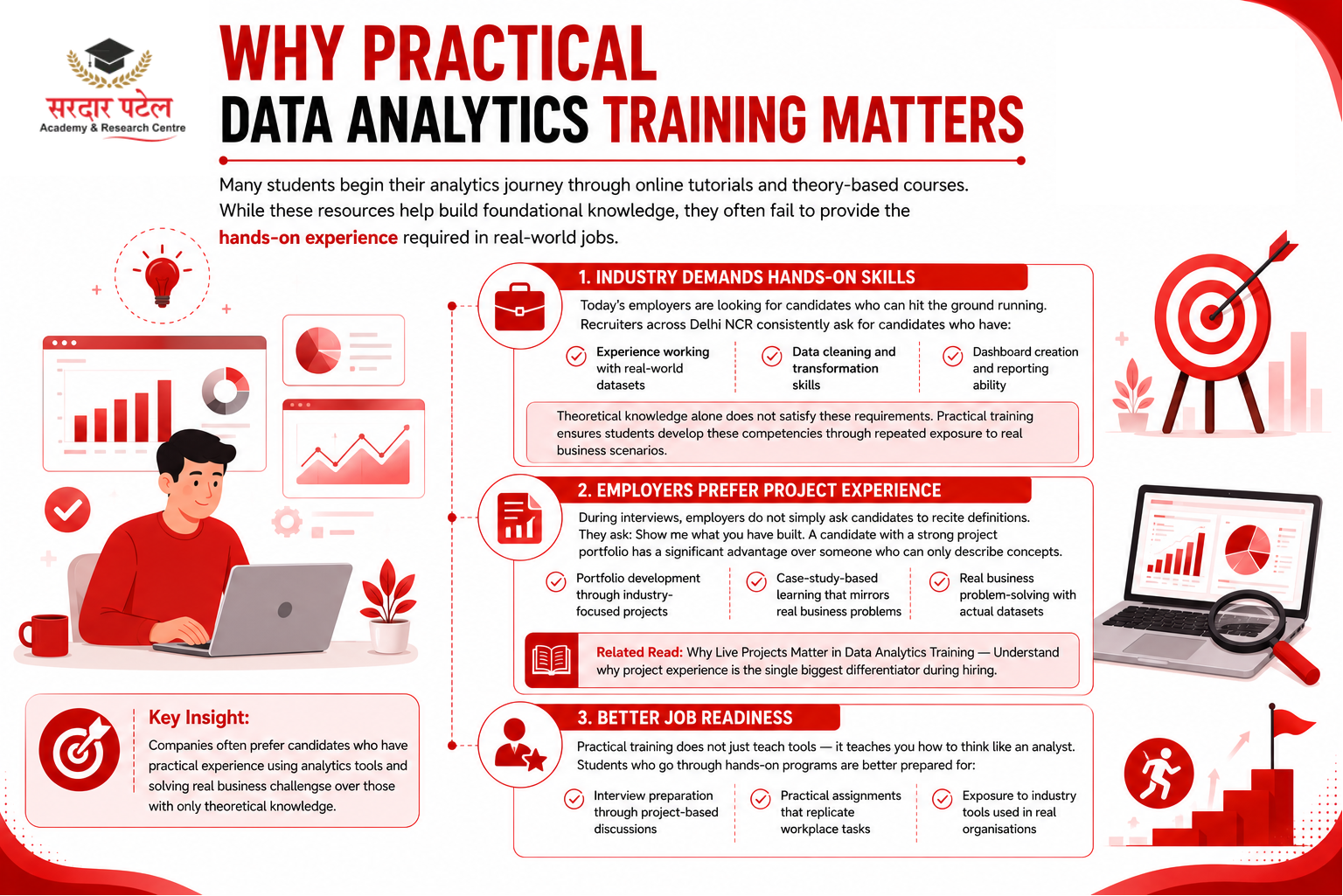
Many students begin their analytics journey through online tutorials and theory-based courses. While these resources help build foundational knowledge, they often fail to provide the hands-on experience required in real-world jobs.
Today, learners are moving beyond theory-based education and choosing hands-on training that prepares them for real-world challenges. Learn more about Student Portfolio Showcase and how practical experience improves job readiness.
Industry Demands Hands-On Skills
Today’s employers are looking for candidates who can hit the ground running. Recruiters across Delhi NCR consistently ask for candidates who have:
• Experience working with real-world datasets
• Data cleaning and transformation skills
• Dashboard creation and reporting ability
Theoretical knowledge alone does not satisfy these requirements. Practical training ensures students develop these competencies through repeated exposure to real business scenarios.
Employers Prefer Project Experience
During interviews, employers do not simply ask candidates to recite definitions. They ask: Show me what you have built. A candidate with a strong project portfolio has a significant advantage over someone who can only describe concepts.
• Portfolio development through industry-focused projects
• Case-study-based learning that mirrors real business problems
• Real business problem-solving with actual datasets
Related Read: Why Live Projects Matter in Data Analytics Training — Understand why project experience is the single biggest differentiator during hiring.
Better Job Readiness
Practical training does not just teach tools — it teaches you how to think like an analyst. Students who go through hands-on programs are better prepared for:
• Interview preparation through project-based discussions
• Practical assignments that replicate workplace tasks
• Exposure to industry tools used in real organisations
Key Insight: Companies often prefer candidates who have practical experience using analytics tools and solving real business challenges over those with only theoretical knowledge.
Key Features to Look for in a Data Analytics Institute in Delhi
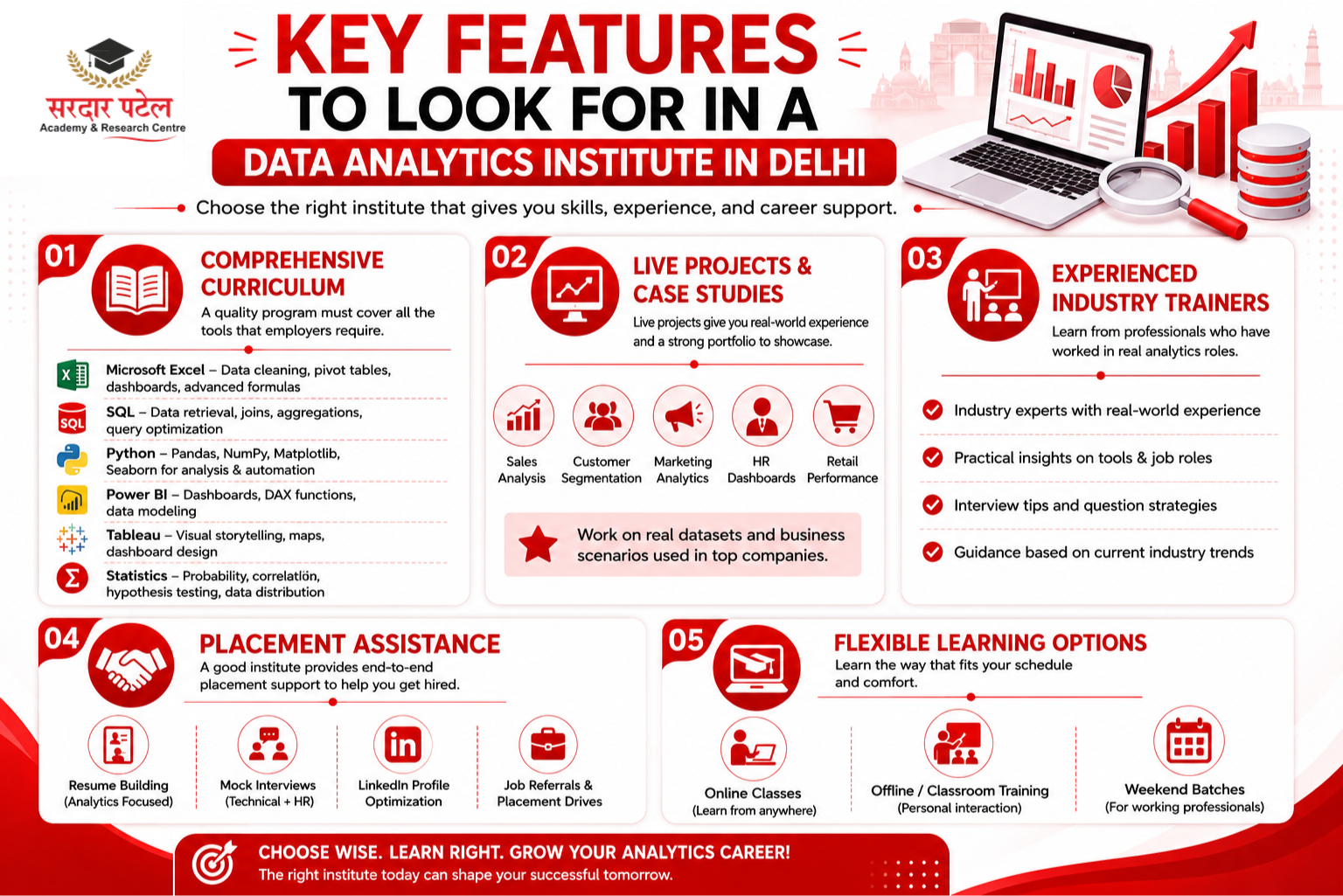
Not all institutes offer the same quality of training. Before enrolling, evaluate each program against these essential criteria:
Comprehensive Curriculum
A quality analytics program must cover all the tools that employers currently require. Ensure the curriculum includes:
• Microsoft Excel — data cleaning, pivot tables, dashboards, advanced formulas
• SQL — data retrieval, joins, aggregations, query optimisation
• Python — Pandas, NumPy, Matplotlib, Seaborn for data analysis and automation
• Power BI — interactive dashboards, DAX functions, data modeling
• Tableau — visual storytelling, geographic maps, dashboard design
• Statistics — probability, correlation, hypothesis testing, data distribution
Explore our data analytics tools guide.
Live Projects & Case Studies
Live projects are the most reliable indicator of a quality training program. Ask any institute: How many live projects are included? What kind of datasets do students work with? At SPARC, students complete multiple industry-focused projects covering sales analysis, customer segmentation, marketing analytics, HR dashboards, and retail performance — giving them concrete portfolio items to present during interviews.
Experienced Industry Trainers
The quality of instruction directly impacts learning outcomes. Look for trainers who have worked in analytics roles in real organisations — not just academic instructors. Experienced trainers can share real-world context, explain how tools are used on the job, and prepare students for the kinds of questions asked during hiring.
Placement Assistance
Placement support is more than a vague promise. Before enrolling, ask specifically what is included:
• Resume building tailored to analytics roles
• Mock interviews covering technical and HR rounds
• LinkedIn profile optimization for recruiter visibility
• Job referrals and placement drives with hiring companies
Related Guide: Data Analytics Classes with Placement Support — What placement assistance really means and how to evaluate it before enrolling.
Flexible Learning Options
Different learners have different schedules. A good institute should offer:
• Online classes for remote or outstation learners
• Offline / classroom training for in-person interaction
• Weekend batches for working professionals
How to Choose the Right Data Analytics Institute for Your Career Goals
The right institute depends on where you are in your career journey. Here is a breakdown by learner profile:
For Beginners
If you have no prior experience with analytics tools or coding, look for a program that starts from the fundamentals. The curriculum should begin with Excel — which requires no coding — before gradually introducing SQL and Python. SPARC’s beginner-friendly approach ensures students from commerce, arts, and non-technical backgrounds can build confidence step by step without feeling overwhelmed.
"If you're completely new to analytics, start with our data analytics basics for beginners guide before moving to advanced tools and projects."
For Working Professionals
Working professionals need flexible schedules without compromising on depth. Look for weekend batches or evening sessions that allow you to continue working while upskilling. Focus on institutes that offer fast-track options and cover the specific tools your target industry uses — Power BI for finance, Python for IT, or SQL for operations roles.
For Career Switchers
If you are transitioning from a non-analytics background, the most important factor is project depth. Career switchers need a portfolio that compensates for limited prior experience. Choose a program that includes at least 4–5 industry projects, a capstone assignment, and dedicated interview coaching so you can walk into interviews with confidence despite the career gap.
For Students Seeking Placement Support
Final-year students and fresh graduates should prioritise institutes with active placement networks. Ask specifically: How many students were placed in the last batch? Which companies were they placed with? What is the average time to placement after completing the course? These questions separate institutes with genuine placement pipelines from those that offer placement assistance in name only.
Theory-Based Learning vs Practical Data Analytics Training
This comparison clearly shows why students today prefer practical learning over traditional theory-focused training programs:
| Feature | Theory-Based Courses | Practical Training at SPARC |
| Learning Method | Classroom Lectures | Hands-on Learning |
| Real Datasets | Limited Exposure | Extensive Practice |
| Live Projects | Rarely Included | Multiple Industry Projects |
| Portfolio Development | Minimal | Strong Project Portfolio |
| Tool Practice | Mostly Demonstrations | Real-Time Implementation |
| Interview Preparation | Basic | Project-Based Preparation |
| Placement Support | Limited | Dedicated Career Assistance |
| Industry Readiness | Moderate | High |
Skills You Should Gain from a Practical Data Analytics Course
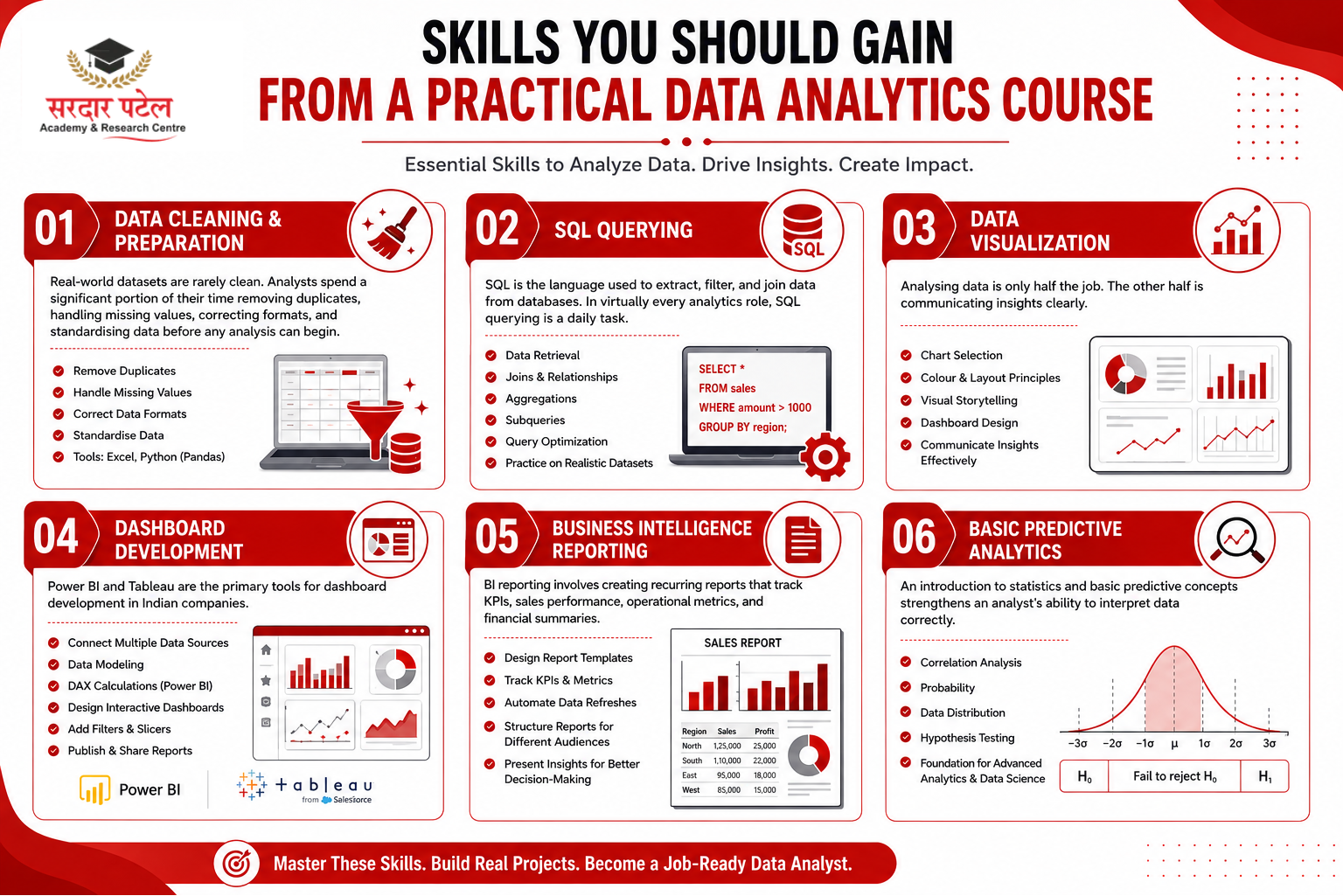
A quality practical training program should build proficiency across the following skill areas:
Data Cleaning & Preparation
Real-world datasets are rarely clean. Analysts spend a significant portion of their time removing duplicates, handling missing values, correcting formats, and standardising data before any analysis can begin. Practical training should include extensive exercises using Excel and Python (Pandas) to build this foundational skill.
SQL Querying
SQL is the language used to extract, filter, and join data from databases. In virtually every analytics role, SQL querying is a daily task. Training should cover data retrieval, joins, aggregations, subqueries, and query optimization — with practice on realistic datasets rather than toy examples.
Data Visualization
Analysing data is only half the job. The other half is communicating insights clearly. Data visualization training should cover chart selection, colour and layout principles, visual storytelling, and the creation of dashboards that non-technical stakeholders can understand at a glance.
Dashboard Development
Power BI and Tableau are the primary tools for dashboard development in Indian companies. Students should learn to connect data sources, model data, write DAX calculations in Power BI, design interactive filters, and publish reports — skills directly tested during analytics interviews and required from day one on the job.
Business Intelligence Reporting
BI reporting involves creating recurring reports that track KPIs, sales performance, operational metrics, and financial summaries. Training should include designing report templates, automating data refreshes, and structuring reports for different audiences — from frontline managers to senior leadership.
Basic Predictive Analytics
An introduction to statistics and basic predictive concepts — including correlation analysis, probability, data distribution, and hypothesis testing — strengthens an analyst’s ability to interpret data correctly. These concepts also serve as a foundation for those who later want to transition into data science roles.
Sample Projects Students Work On
At SPARC, students work on multiple industry-focused projects that significantly improve their practical understanding and job readiness:
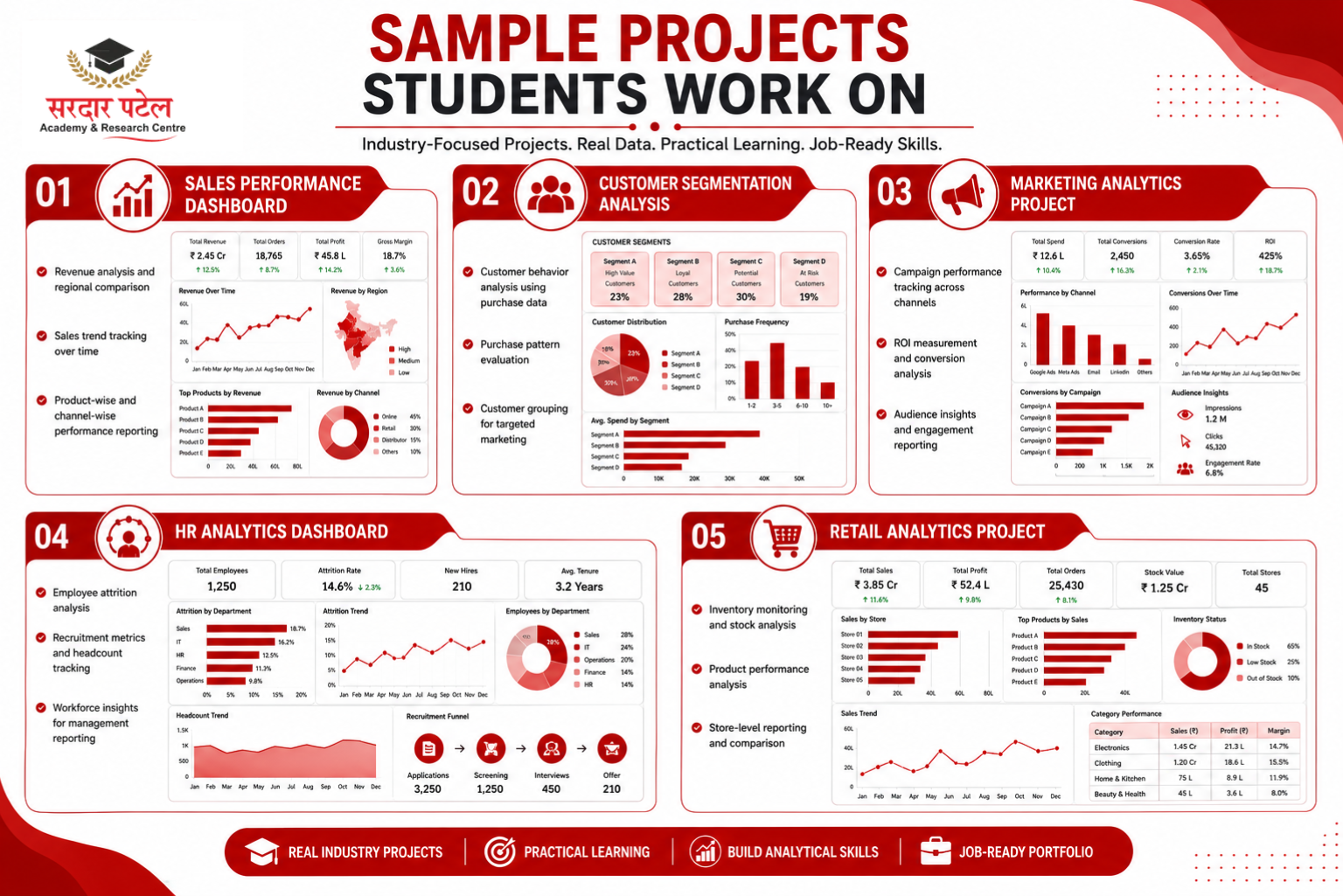
Sales Performance Dashboard
• Revenue analysis and regional comparison
• Sales trend tracking over time
• Product-wise and channel-wise performance reporting
Customer Segmentation Analysis
• Customer behavior analysis using purchase data
• Purchase pattern evaluation
• Customer grouping for targeted marketing
Marketing Analytics Project
• Campaign performance tracking across channels
• ROI measurement and conversion analysis
• Audience insights and engagement reporting.
HR Analytics Dashboard
• Employee attrition analysis
• Recruitment metrics and headcount tracking
• Workforce insights for management reporting
Retail Analytics Project
• Inventory monitoring and stock analysis
• Product performance analysis
• Store-level reporting and comparison
Career Opportunities After Completing Data Analytics Training
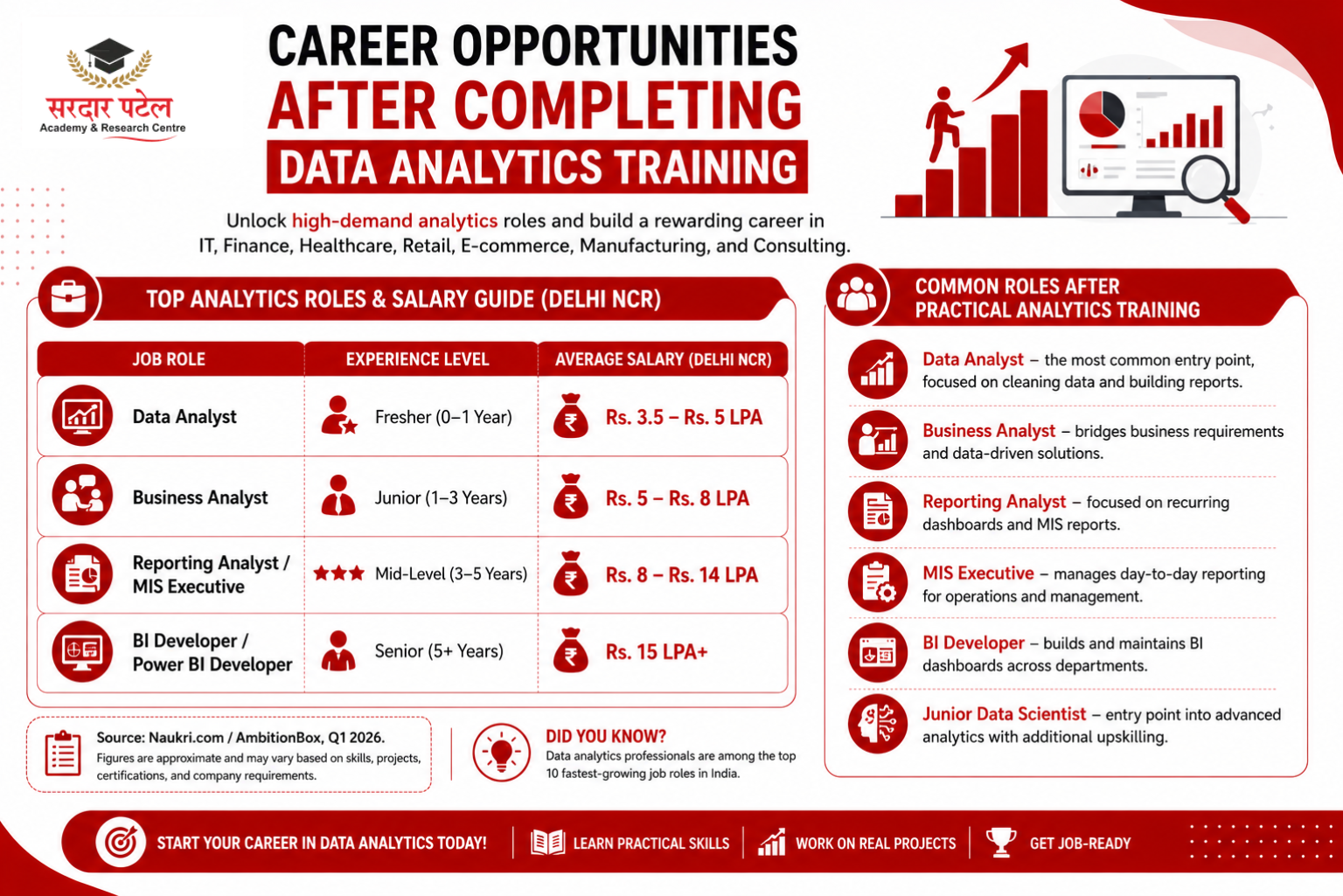
After completing practical data analytics training, students can apply for various entry-level and mid-level analytics roles across industries such as IT, Finance, Healthcare, Retail, E-commerce, Manufacturing, and Consulting.
| Job Role | Experience Level | Average Salary (Delhi NCR) |
| Data Analyst | Fresher (0–1 Year) | Rs. 3.5 – Rs. 5 LPA |
| Business Analyst | Junior (1–3 Years) | Rs. 5 – Rs. 8 LPA |
| Reporting Analyst / MIS Executive | Mid-Level (3–5 Years) | Rs. 8 – Rs. 14 LPA |
| BI Developer / Power BI Developer | Senior (5+ Years) | Rs. 15 LPA+ |
"To explore job roles, required skills, and salary trends in detail, read our guide on data analytics career scope, skills, and salaries."
Source: Naukri.com / AmbitionBox, Q1 2026. Figures are approximate and may vary based on skills, projects, certifications, and company requirements.
Common roles available after completing practical analytics training:
• Data Analyst — the most common entry point, focused on cleaning data and building reports
• Business Analyst — bridges business requirements and data-driven solutions
• Reporting Analyst — focused on recurring dashboards and MIS reports
• MIS Executive — manages day-to-day reporting for operations and management
• BI Developer — builds and maintains BI dashboards across departments
• Junior Data Scientist — entry point into advanced analytics with additional upskilling.
Related Guide: Data Analytics Certification Courses in Delhi Guide — Learn what employers look for and how to prepare for your first analytics role.
Why SPARC Stands Out in Delhi
SPARC’s goal is not simply to help students complete a course. The institute focuses on making students job-ready through practical learning and industry-relevant training.
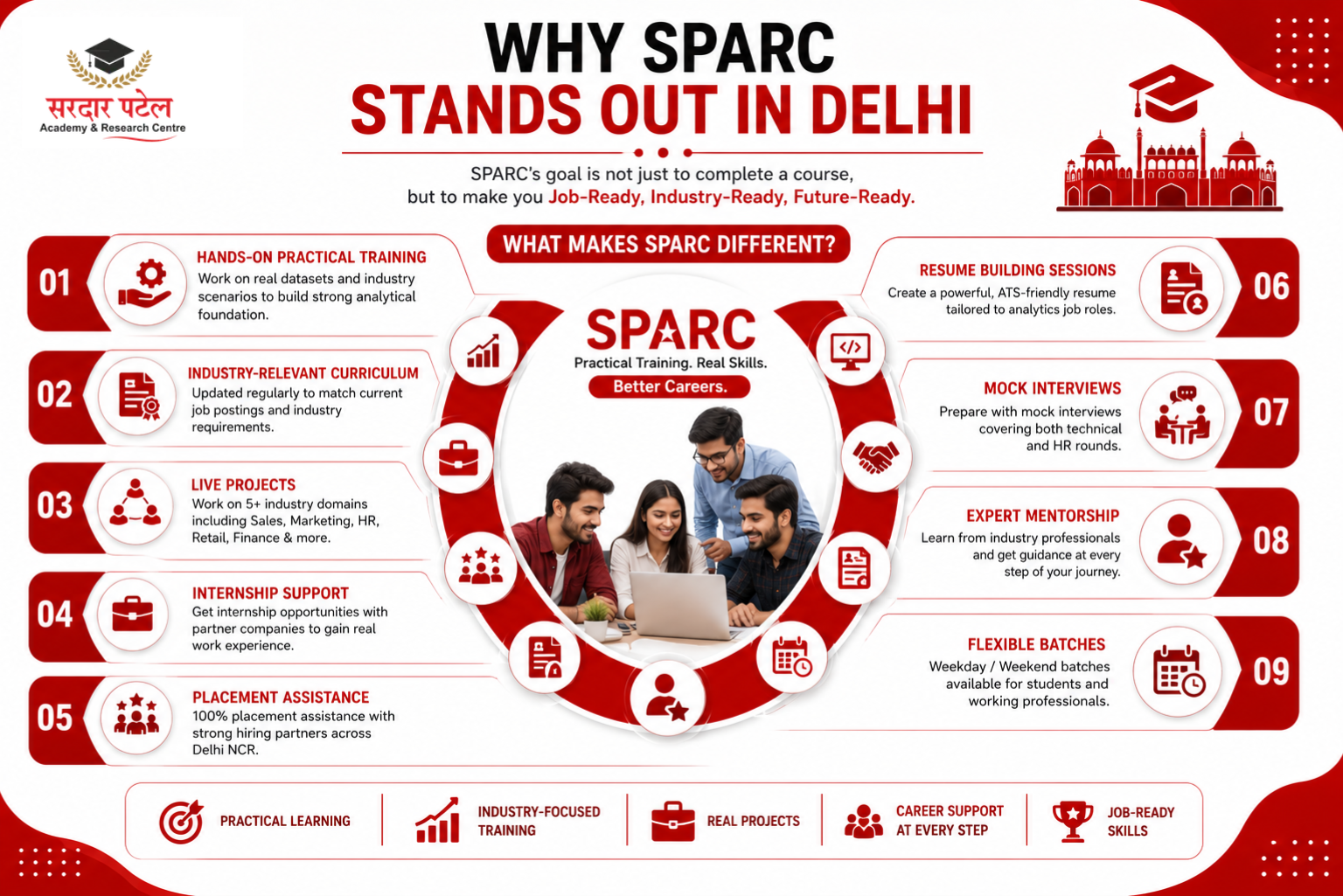
What Makes SPARC Different?
✔ Hands-on Practical Training with real datasets
✔ Industry-Relevant Curriculum updated to match current job postings
✔ Live Projects across 5+ industry domains
✔ Internship Support for eligible students
✔ Placement Assistance with hiring partners in Delhi NCR
✔ Resume Building Sessions tailored to analytics roles
✔ Mock Interviews covering both technical and HR rounds
✔ Expert Mentorship from industry professionals
✔ Flexible Batches for students and working professionals
Related Guide: Is Placement Guaranteed After Analytics Course?
Conclusion
If you want to build a successful career in Data Analytics, choosing a theory-only course is not enough. Practical learning — through live projects, real datasets, and hands-on tool training — is what separates candidates who get hired from those who don’t.
When comparing institutes, evaluate them on three factors: the depth of the curriculum, the number and quality of live projects, and the strength of their placement support. An institute that scores well on all three is worth serious consideration.
SPARC’s Practical Data Analytics Training Program helps students develop real-world skills, complete industry-based projects, and confidently prepare for a successful career in analytics. Whether you are a beginner, a working professional, or a career switcher, investing in practical training is one of the most effective steps you can take toward a data analytics career.
Next Step: Book a demo class, review the full curriculum, and start building industry-ready analytics skills today.
Ready to Start Your Data Analytics Career?
At Sardar Patel Academy & Research Centre (SPARC), students learn through practical assignments, live projects, and industry-relevant tools that employers actively seek.
Why Choose SPARC?
✔ Excel, SQL, Power BI & Python Training
✔ Live Industry Projects
✔ Internship Opportunities for Eligible Students
✔ Resume Building & LinkedIn Profile Support
✔ Mock Interviews & Career Guidance
✔ Placement Assistance
Phone: +91 93129-66129
FAQs
Several institutes offer analytics training in Delhi NCR, but students should evaluate programs based on hands-on projects, tool coverage, trainer experience, and placement support. SPARC is one of the institutes known for its practical learning approach, live industry projects, and dedicated career assistance.
Yes. Data analytics continues to be one of the fastest-growing career fields in India. Organisations across IT, Finance, Healthcare, Retail, and E-commerce are actively hiring analytics professionals. Candidates with practical skills and strong portfolios are in high demand.
No. Most beginner-friendly programs start with Excel and SQL — neither of which requires coding. Python is introduced later and is taught from the basics at SPARC, so students from non-technical backgrounds can build genuine proficiency without prior programming experience.
Most students become job-ready within 4–8 months, depending on the course structure, practical exposure, and time dedicated to learning. Short-term programs covering Excel and SQL can be completed in 1–2 months, while comprehensive programs including Python and placement support may run for 5–8 months.
A comprehensive practical analytics course should cover Microsoft Excel, SQL, Power BI, Tableau, Python (with Pandas, NumPy, Matplotlib, and Seaborn), and Statistics. These are the core tools that employers actively look for in data analyst candidates across Delhi NCR.
Yes. Students who complete practical training, build a strong project portfolio, and prepare effectively for interviews can qualify for entry-level analytics roles. No institute can guarantee employment — employers make hiring decisions — but quality training significantly improves your chances.
Practical data analytics training focuses on hands-on learning through real datasets, industry projects, assignments, and business case studies rather than theory alone. It prepares students for actual job tasks from day one.
A quality course should include at least 4–5 real-world projects that allow students to work with actual business datasets and build a professional portfolio. At SPARC, students complete projects across sales, customer segmentation, marketing, HR analytics, and retail domains.
Yes. Many students from commerce, arts, management, and non-technical backgrounds successfully transition into data analytics through structured training programs. SPARC’s curriculum is designed to accommodate complete beginners.
Employers generally prefer candidates who can demonstrate practical skills through projects, portfolios, and problem-solving abilities. Certifications add credibility to a resume, but live project experience is typically the deciding factor during interviews.