+91 9312966129
 sparc.enquiry01@gmail.com


Advanced vs Basic Data Analytics Course Comparison
Compare an advanced data analytics course in Delhi with a basic analytics course — curriculum, tools, real salary data, and career outcomes — to pick the right path.
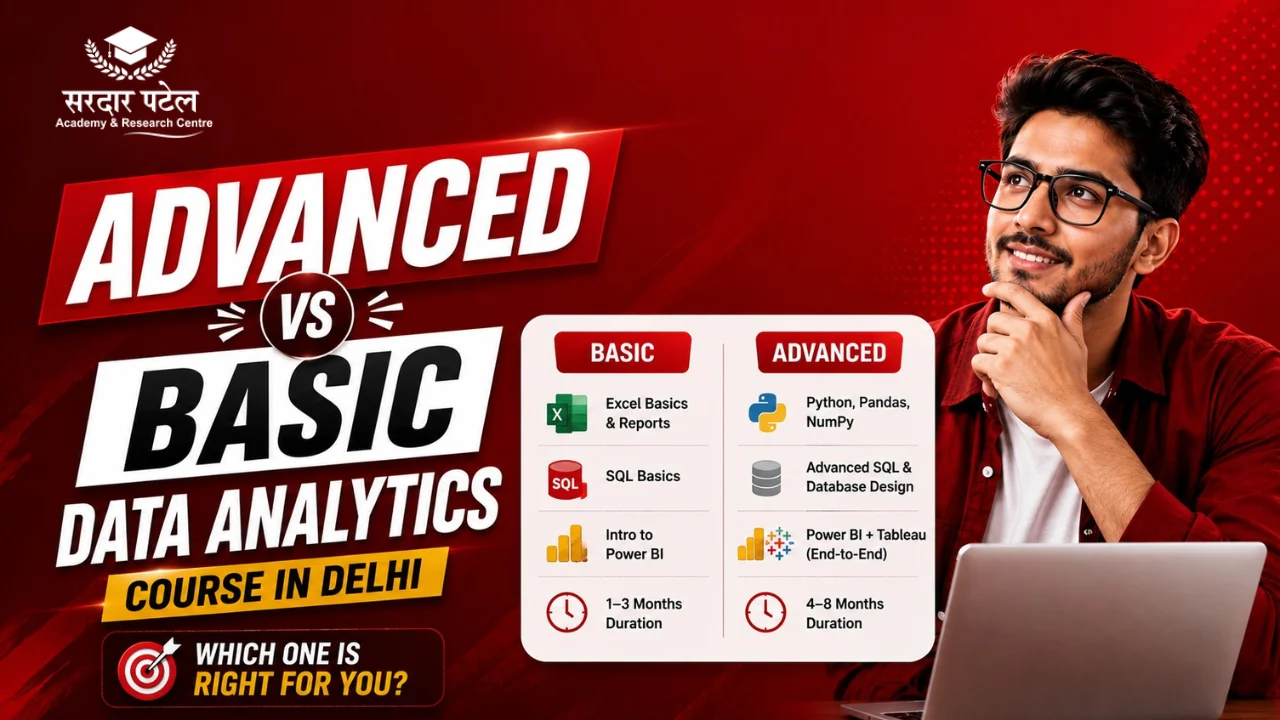
Table of Contents
- Basic vs Advanced: The Core Difference
- A basic course
- An advanced course
- Side-by-Side Comparison
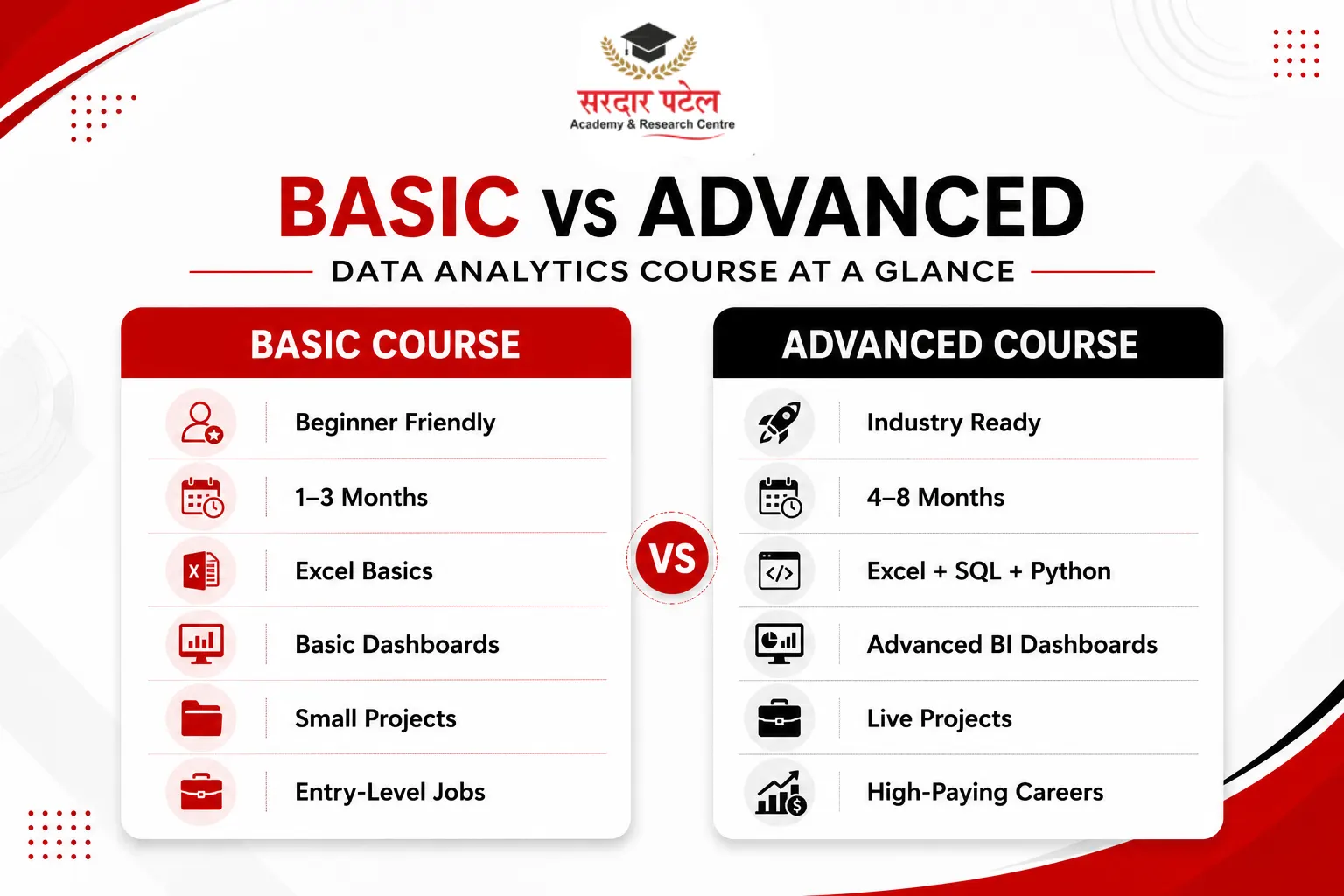
- FeatureBasic CourseAdvanced CourseDifficultyBeginnerIntermediate–AdvancedProgrammingNot requiredPython includedSQLBasic queriesQuery optimization, database managementExcelBasic functionsAdvanced formulas, automationBI ToolsPower BI intro onlyPower BI + Tableau, full dashboardingProjectsSmall practice setsLive, business-style projectsPlacement SupportUsually limitedDedicated (resume, mock interviews)Duration1–3 months4–8 monthsCurriculum, Skills & Tools
- Practical Projects
- Who Should Choose Which Path
- Career Outcomes & Real Salary Data
- What the current market actually pays
- Duration, Cost & ROI
- Job Market Demand in Delhi NCR
- What Students Are Actually Saying
- Conclusion
Two learners can sit through the same "Data Analytics" course title and walk out with completely different job prospects. The difference almost always comes down to one thing: did the course stop at Excel and basic reporting, or did it go all the way to SQL, Python, and business intelligence tools that employers actually screen for?
This guide compares a basic analytics course against an advanced data analytics course in Delhi — with real curriculum differences, current salary data, and job-market numbers — so you can pick based on evidence, not marketing copy.
If you're still deciding whether analytics suits you right after school, see our guide on Can 12th Pass Students Learn Analytics?
Basic vs Advanced: The Core Difference
A basic course
teaches you to organise, clean, and present data — Excel, pivot tables, basic SQL, an introduction to Power BI, and simple dashboards. No programming required. It's a solid on-ramp, not a destination.
An advanced course
adds the layer that actually gets interviews: Python (NumPy, Pandas), advanced SQL, full Power BI and Tableau dashboarding, business intelligence concepts, and live projects that mimic real company problems. At SPARC, this is built around a capstone project and placement preparation rather than isolated exercises.
Think of it this way: a basic course teaches you to read a company's dashboard. An advanced course teaches you to build the dashboard the company's leadership actually relies on.
Side-by-Side Comparison
Curriculum, Skills & Tools
Why this matters: across current Delhi NCR job postings, SQL and at least one BI tool (Power BI or Tableau) show up as baseline requirements even for many "junior" analyst roles — Excel alone rarely clears the first resume screen anymore.
To understand these data analytics tools and how they are used in real-world analytics, beginners can explore the key tools covered in data analytics.
Practical Projects
Basic course: attendance dashboards, simple sales reports, student databases — good for building comfort, not for a portfolio.
Advanced course: sales performance dashboards, customer segmentation, HR analytics, financial reporting, executive KPI dashboards — the kind of project you can actually walk an interviewer through and explain the business decision it supported. Explain the importance of data analytics in business.
That distinction matters more than it sounds: recruiters consistently favour candidates who can point to a visible, explainable project over a resume that only lists tool names.
Who Should Choose Which Path
Basic course is right if you:
- Have zero analytics or programming background
- Want a short, low-cost introduction before committing further
- Are testing interest before a bigger investment
- Need a credential mainly to read/interpret business reports, not build them
Advanced course is right if you:
- Want an actual Data Analyst / BI Analyst job, not an entry-level MIS role
- Can commit 4–8 months of consistent, hands-on practice
- Want an actual Data Analyst / BI Analyst job and explore data analytics career opportunities beyond entry-level MIS roles
- Are switching careers and need a portfolio, not just a certificate
If you’re new to analytics, planning a career change, or looking to resume your professional growth, our Data Analytics Course for Housewives & Freshers guide can also help you explore suitable learning options.
It explains how learners from different educational and professional backgrounds can start a successful career in data analytics.
Career Outcomes & Real Salary Data
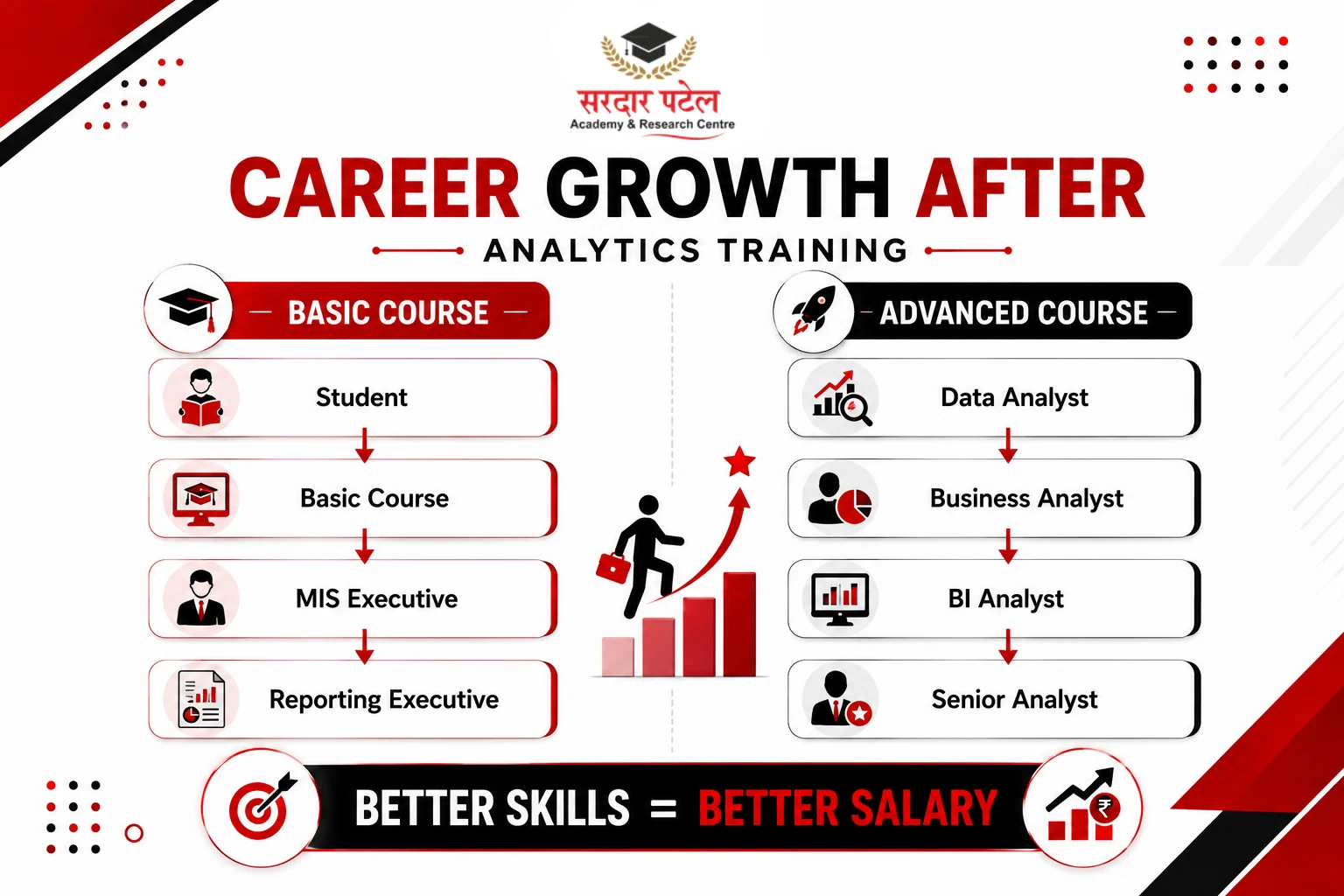
Typical roles after a basic course: Data Entry Executive, MIS Executive, Reporting Assistant, Junior Data Analyst.
Typical roles after an advanced course: Data Analyst, Business Analyst, BI Analyst, Marketing/Financial Analyst, BI Developer. Data analytics career scope, skills and salaries can vary depending on the learner's technical skills, experience, portfolio and the type of role they target.
What the current market actually pays
Recent aggregated 2026 salary data gives a clearer picture than generic estimates:
- National median: AmbitionBox's April 2026 dataset — drawn from over 38,000 verified salary reports — puts the median data analyst salary in India at roughly ₹7.4 LPA, with the 25th percentile near ₹4.5 LPA and the 90th percentile around ₹19.8 LPA.
- National average: Glassdoor's March 2026 data shows a national average close to ₹6.87 LPA, with Delhi NCR averaging around ₹7.5 LPA — near the national figure, slightly below Bengaluru and Hyderabad.
- Fresher range: Multiple 2026 sources converge on roughly ₹3.5–6 LPA for freshers, but candidates who enter with SQL, Python, and a real dashboard project frequently land offers toward the higher end of that band or above it.
- The real driver isn't experience — it's tool stack. One 2026 analysis of Naukri postings found that the specific tools an analyst knows often outweigh years of experience as a salary driver in the first four years, unlike software engineering roles where tenure tends to dominate.
Practical takeaway: the gap between a ₹4 LPA offer and a ₹7–8 LPA offer at the fresher stage is frequently explained by exactly the skills an advanced course adds — SQL depth, Python, and a BI tool — not by years of experience, since freshers by definition don't have those yet.
Duration, Cost & ROI
A basic course costs less and moves faster — a reasonable choice if you're testing the waters. But given the salary data above, the additional months an advanced course requires are frequently recovered within the first year through a meaningfully higher starting offer, not just a "better long-term outlook."
Job Market Demand in Delhi NCR
This is a fast-moving number, so treat any fixed figure as a snapshot rather than a permanent fact — but as of mid-2026, Glassdoor listed roughly 799 open data analyst roles in New Delhi alone, and Naukri showed over 11,000 fresher-level data analyst openings across Delhi NCR. Demand spans IT, BFSI, healthcare, e-commerce, retail, manufacturing, and EdTech.
Across these postings, SQL, Python, Power BI, and Tableau appear far more consistently as requirements than Excel alone — reinforcing why an advanced skill set converts to more applicable openings, not just more course content.
For your own decision, it's worth spending 10 minutes on Naukri or LinkedIn filtering "Data Analyst, Delhi NCR" and reading 15–20 real job descriptions — the skill requirements listed there are more current than any single article, including this one.
What Students Are Actually Saying
Beyond curriculum comparisons, it helps to hear from people who've actually sat in the classroom. Here's a recent verified Google review from a SPARC learner:
"Practical & Project-Based Learning: Instead of just memorising theory, the focus here is on hands-on practice. Classes are designed around real-time projects, which makes learning much faster. Good Lab Infrastructure: well-equipped computer labs with personal computer time to practice after or during classes. Helpful & Patient Faculty who approach topics from a beginner's level. Value for Money: quality education and professional certifications at a reasonable fee compared to high-end premium institutes in Delhi. They also provide an in-house mobile app to track daily practice, access study materials, and take tests."
— NG bhai, Google review, verified on Google Maps, posted ~1 month ago
This kind of feedback — project-based teaching, dedicated lab time, and approachable faculty — lines up with what the curriculum sections above describe, but it's worth reading a handful of independent reviews yourself (Google Maps, JustDial, or course-comparison forums) before enrolling anywhere.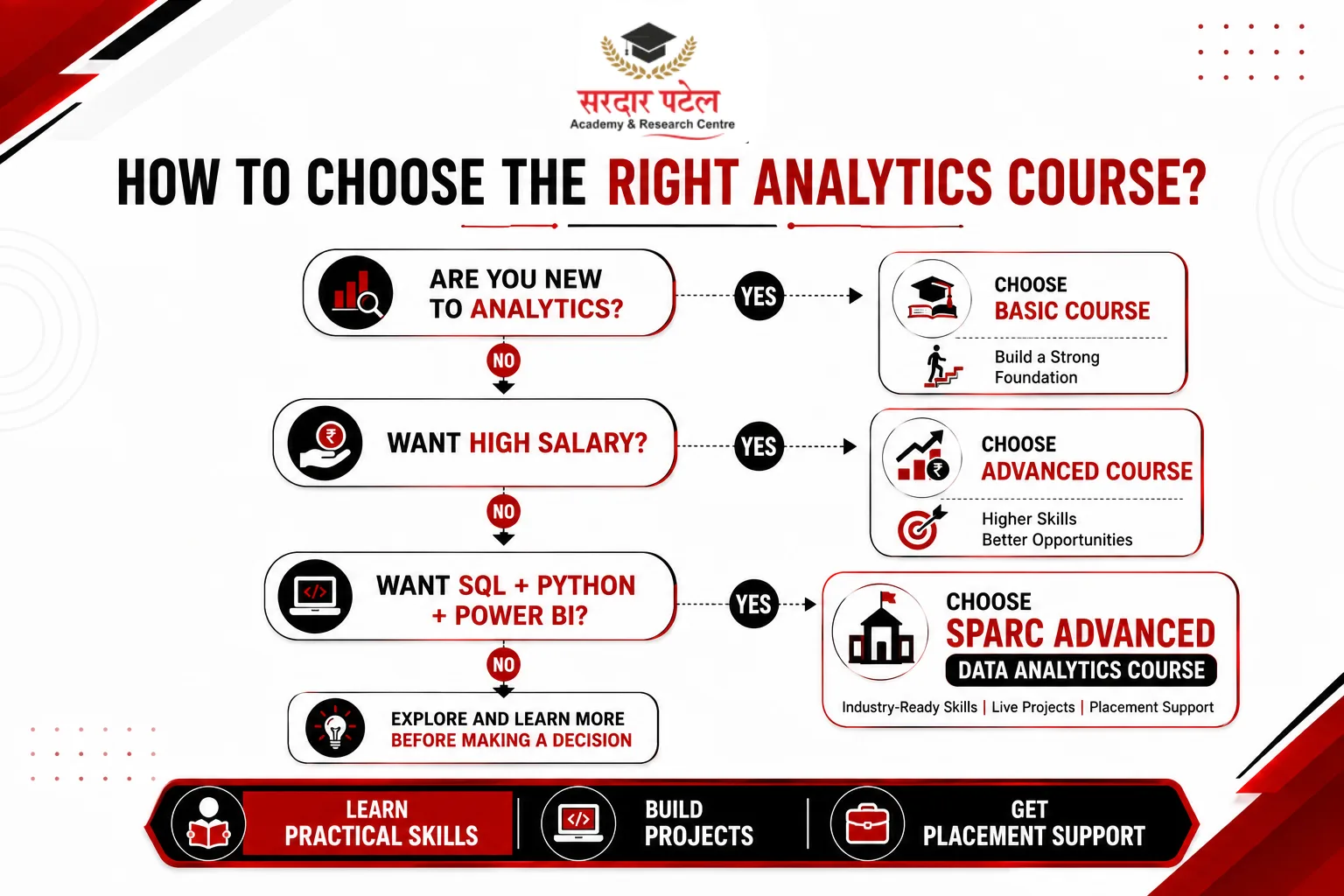
Conclusion
If you’re looking to get familiar with analytics or want to start learning within a limited timeframe, a beginner-friendly course can be a practical way to begin. If you’re unsure which learning path suits you best, explore our Online vs Offline Data Analytics Course in Delhi to compare the syllabus, career scope, earning potential, and current industry requirements before choosing a course.
If your goal is an actual analytics job, the 2026 salary and demand data both point the same direction: the SQL + Python + BI tool combination that advanced courses teach is what separates a ₹3.5 LPA offer from a ₹7–8 LPA one, and it's what shows up as a baseline requirement across live Delhi NCR job postings.
SPARC's advanced program is structured around that gap — live projects, placement preparation, and a curriculum updated against current hiring requirements. Explore SPARC's Data Analytics Course for details, and ask directly about verified recent placement outcomes before enrolling — any reputable institute should be able to share them.
FAQs
It can qualify you for entry-level roles like MIS Executive or Reporting Assistant. Data Analyst and Business Analyst roles generally require the SQL/Python/BI depth an advanced course adds.
Yes — most structured advanced programs start with fundamentals before progressing, so no prior experience is required, just willingness to commit the time.
Based on 2026 AmbitionBox and Glassdoor data, advanced-skill profiles (SQL, Python, BI tools) consistently land nearer the ₹7–8 LPA+ fresher range rather than the ₹3.5–4.5 LPA range — though individual outcomes vary.
Typically 4–8 months, depending on format and depth.
In order of what shows up most in current job postings: SQL, Excel, Power BI or Tableau, then Python.
Recruiters can verify a claimed skill on a resume in seconds by asking about a real project. Candidates with an explainable, business-style project consistently outperform resume-only applicants in interviews.