+91 9312966129
 sparc.enquiry01@gmail.com



AI Predictive Analytics: Meaning, Benefits and Real-World Examples
Learn what AI predictive analytics is, how it works, its key benefits, and real-world examples from retail, healthcare, banking, and manufacturing for beginners.
AI Predictive Analytics: Meaning, Benefits and Real-World Examples
Every business wants to know what happens next. Which customers will leave? How much stock will you need next month? Which loan might default? For decades, companies answered these questions with gut feeling and spreadsheets. Today, AI predictive analytics gives them a far more reliable way to look ahead.
This guide explains what predictive analytics means, how it works, the benefits it brings, and real-world examples. If you are new to the field, start with What Is Data Analytics? A Beginner Guide, then come back here. By the end, you will also know how to start learning it yourself.
What Is AI Predictive Analytics?
Predictive analytics is the practice of using artificial intelligence and machine learning to study historical and current data, find patterns, and estimate what is likely to happen next. Instead of only describing what already happened, it answers a more valuable question: what will probably happen, and what should we do about it?
Traditional analytics is mostly descriptive. A monthly sales report tells you that revenue dropped by 8 percent. AI-based prediction goes further: it can tell you that revenue will probably drop another 5 percent next quarter unless you change pricing in two regions, and show which factors drive that outcome. Older statistical methods needed analysts to define every rule by hand. Modern AI models learn those rules from data, handle thousands of variables at once, and improve as new data arrives.
How It Works in Five Steps
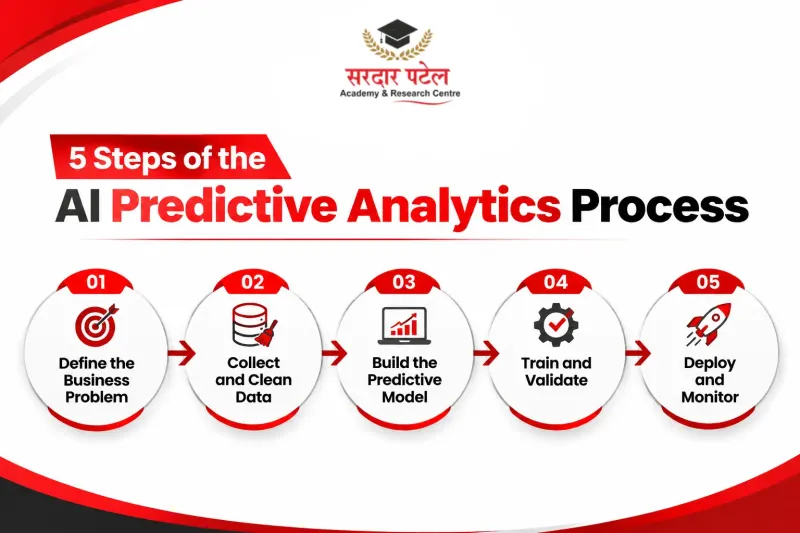
- Define the business question, such as “which subscribers will cancel in the next 30 days?”
- Collect and clean the data. Missing values and duplicates weaken results, and querying is easier with an AI SQL query generator.
- Build the model. Common techniques include regression, decision trees, random forests, gradient boosting and neural networks. Predicting a number (next month’s demand) needs a different approach from predicting a category (fraud or not fraud).
- Train and validate. The model learns from one portion of the data and is tested on a portion it has never seen, which shows whether it truly predicts or has merely memorised the past.
- Deploy and monitor. Connect the output to dashboards (for example, a Power BI dashboard; see Power BI Copilot in 2026: Features, Uses and Limitations) and retrain regularly, because customer behaviour and markets change.
Predictive Modelling vs. Traditional Forecasting
Classic forecasting usually projects a single time series forward, such as last year’s monthly sales to estimate next year’s. It works well when patterns are stable. Forecasting with AI is more flexible: a machine learning model can combine sales history with weather, holidays, promotions, competitor prices and economic indicators, and capture non-linear relationships that simple methods miss.
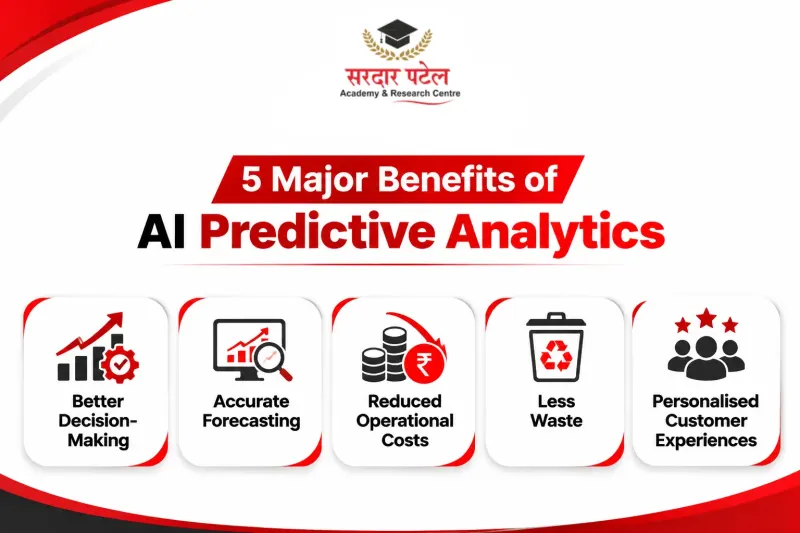
Key Benefits of AI Predictive Analytics
Better and faster decisions. Leaders can see likely outcomes before they happen, so they stop reacting and start planning. This shift shows up in the Latest Data Analytics Trends in 2026 too.
More accurate forecasting. Because models learn from many data sources at once, they can often beat spreadsheet estimates for demand, revenue and risk. This depends on data quality, and a simple model sometimes performs just as well, so always compare against your current method. McKinsey research on supply-chain networks, widely cited in industry write-ups, estimates that AI-driven forecasting can reduce forecast errors by 20–50 percent; results vary with data quality and implementation.
Lower costs and less waste. Predicting equipment failure, excess stock or inefficient routes lets companies fix problems before they become expensive.
Personalised customer experiences. Predicting what a customer is likely to buy or watch next lets businesses send relevant offers instead of generic messages.
Real-World Examples of Predictive Analytics
| Each example below is a named, published case. Results belong to the organisations and studies cited and will differ for your business. |
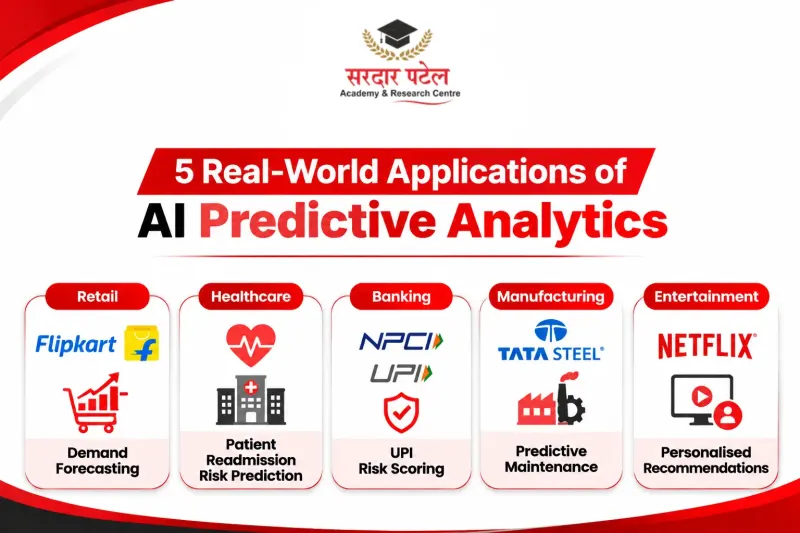
Retail and e-commerce: Flipkart
Flipkart built a central supply chain planning platform on machine learning and operations research, with two core layers: forecasting and optimisation. The forecasting layer produces demand forecasts at category and product level, which feed inventory, capacity and network-flow decisions. The work is described in an INFORMS Journal on Applied Analytics paper, “Faster, Smarter, Leaner: How Flipkart Optimized Its Supply Chain to Unlock Growth” (January–February 2026).
Healthcare: readmission risk
A 2022 study in BMC Health Services Research used data from 428,669 patients discharged from acute care facilities in Alberta, Canada. Its machine learning model scored an AUC of 0.83, against 0.66 for the widely used LACE index, helping identify high-risk patients for early follow-up.
Banking and payments: NPCI and UPI
India’s NPCI has been testing AI models that give accounts risk scores based on the history of money flows, so suspicious transfers can be flagged to banks. MediaNama reported the plan in April 2025 after remarks by NPCI’s chief risk officer.
Manufacturing: Tata Steel
Tata Steel worked with the data science firm Xomnia on a solution that predicts roll failures on its manufacturing line and supplies actionable warnings, built from an anomaly-detection model and a classification model. This is a classic predictive maintenance use case; the Xomnia case study explains the approach.
Marketing and personalisation: Netflix
Two Netflix executives wrote that personalisation and recommendations together save the company more than $1 billion a year, mainly by keeping members subscribed. Their paper is “The Netflix Recommender System: Algorithms, Business Value, and Innovation”.
What This Means for Indian Businesses
You do not need to be as large as Flipkart or NPCI. Keshav Kumar, who was BigBasket’s Head of Engineering at the time, told YourStory that demand planning is one of the most impactful uses of machine learning there, with roughly 20,000–30,000 SKUs planned across thousands of stores. A local retailer can start with one category and one city. Career demand is growing too; see Future of Data Analytics Jobs in India.
Common Challenges
Predictive modelling is powerful, but not magic. Poor or biased data produces poor predictions, and models can repeat unfair patterns in historical data, so audit them, especially in hiring, lending and healthcare. Complex models can be hard to explain, which is why human judgement still matters. Customer data must be handled under laws such as India’s Digital Personal Data Protection Act and global rules like GDPR. Finally, models lose accuracy when conditions shift, so monitoring and retraining are ongoing work.
How to Get Started
- Pick one high-value problem, such as churn, demand or lead quality.
- Audit your data: what you have, how clean it is and what is missing.
- Start simple. A basic regression or tree-based model often delivers most of the value and is easier to explain. You can explore a first dataset with ChatGPT for Excel data analysis.
- Measure business impact, not just accuracy: revenue saved, time gained, risk reduced.
- Scale gradually once one use case works.
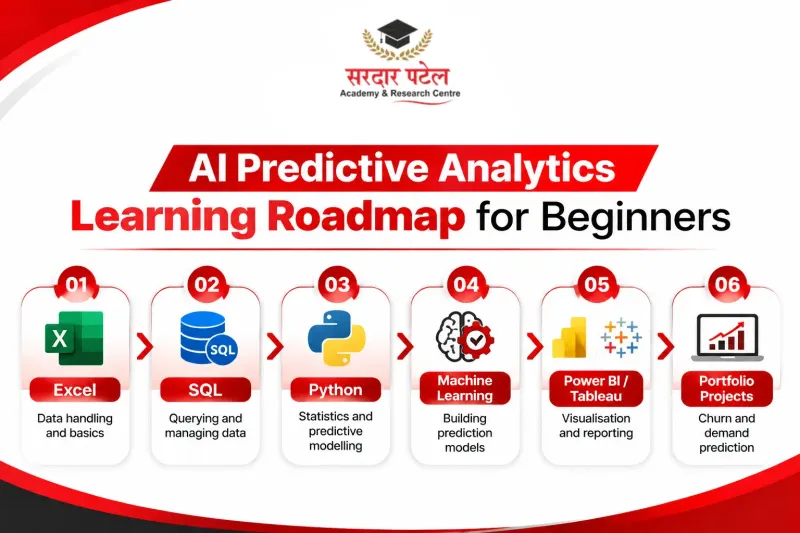
For individuals, the most useful skills are Python or R, SQL, basic statistics and machine learning concepts. A simple learning order works well: Excel, then SQL, then Python for modelling, then Power BI or Tableau for dashboards, with AI tools at each stage. Build a small portfolio project, such as a churn or demand model.
Final Thoughts
AI predictive analytics turns data into foresight. It helps businesses forecast demand, reduce risk, cut costs and understand customers before they act. The professionals who understand it early will be better prepared for whatever comes next, which is one reason AI + analytics professionals are in demand.
Learn predictive analytics step by step at SPARC
The Data Analytics Course with AI at Sardar Patel Academy & Research Centre covers Excel, SQL, Python, Power BI, Tableau and modern AI tools over 8 months with 40+ projects and placement support. A free demo class is available.
Call: +91 93129 66129 or +91 93129 77129
Visit: 2514, Ground & First Floor, Hudson Lane, Kingsway Camp (opposite Laxmi Dairy), near GTB Nagar Metro Station, Gate No. 4, Delhi – 110009
Book your demo: sparc.org.in/contact
FAQs
Machine learning is the set of techniques that learns patterns from data. Predictive analytics is the business use of those techniques to forecast outcomes such as demand, churn or risk.
No. Cloud tools and open-source libraries let small and mid-sized businesses start with one use case, such as sales forecasting or churn prediction.
Accuracy depends on data quality, the problem and how often the model is retrained. No model is perfect, so teams track error metrics and compare them with their old method.
Predictive analytics estimates what is likely to happen, such as which customers may leave. Prescriptive analytics goes one step further and recommends what to do about it, such as which offer to send to each at-risk customer.
Most beginners work with Excel for data handling, SQL for querying, Python for building models, and Power BI or Tableau for dashboards. AI assistants can speed up each stage, but their output still needs checking.
Yes. Start with Excel and SQL, add basic statistics, then learn Python for simple models such as regression. Practising on real datasets and building one small project matters more than covering every algorithm.
Flipkart uses machine learning for demand forecasting in its supply chain, NPCI has tested AI risk scoring for UPI accounts, and BigBasket uses machine learning for demand planning.