+91 9312966129
 sparc.enquiry01@gmail.com



AI Agents in Digital Marketing
Learn how AI agents in digital marketing work, where they help, key risks and how to start safely. A practical 2026 guide for Indian marketers.
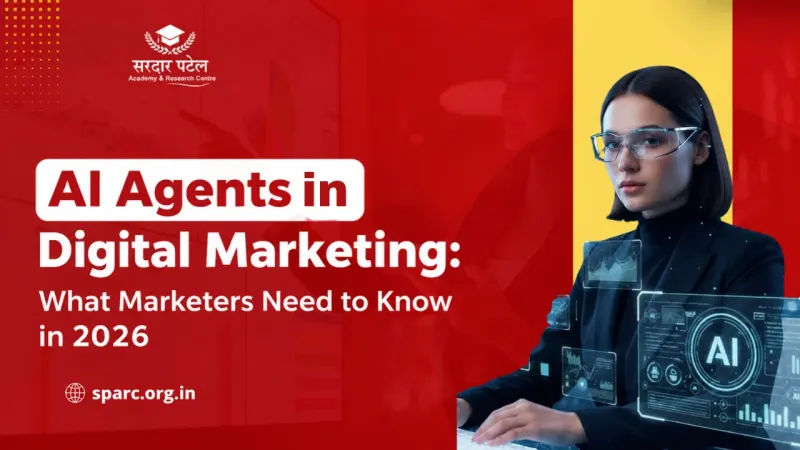
A year or two ago, most marketers used AI like a search box: ask a question, copy the answer. In 2026, the conversation has moved on. Platforms now describe tools that can set up a campaign, explain a drop in performance, or follow up with a lead, which is a different job than writing a caption.
This guide is for marketers, business owners and learners who want a clear picture of what these agents are, where they help, where they do not, and how to begin without losing control. If you are also wondering what this means for search itself, see the section on visibility in AI search further below.
What Are AI Agents in Digital Marketing?
An AI agent is a system built on a language model that pursues a goal instead of answering a single question. It decides what to do next, calls tools such as an ad platform, a spreadsheet or an email service, looks at the result and adjusts. In marketing, that loop covers checking campaigns, preparing reports, scheduling content and qualifying leads.
The word “agent” is used loosely, so a definition helps. Anthropic’s guide to building effective agents separates workflows, where models and tools follow predefined code paths, from agents, where the model directs its own process and tool use. Many marketing products sold today sit somewhere between the two.
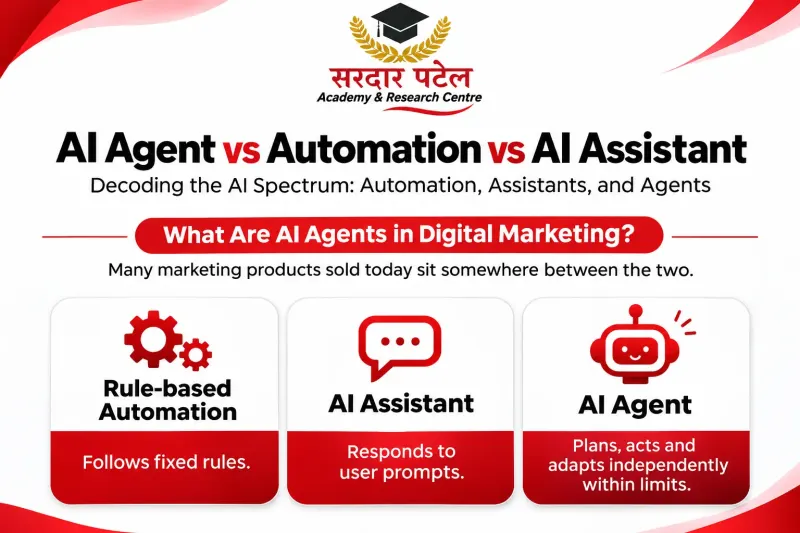
Automation, assistant or agent?
| - | Rule-based automation |
AI assistant |
AI agent |
| Who decides the steps? |
You, in advance |
You, prompt by prompt |
The system, within limits you set |
| Marketing example |
Send a welcome email when a form is submitted |
Draft three subject lines when asked |
Watch a campaign, spot a cost spike, pull data and propose a fix |
| Main risk |
Rigid and easy to forget |
Output needs checking |
Actions need permissions and oversight |
A tool like ChatGPT sits in the middle column when you simply prompt it. It becomes part of an agent only when it can act through tools and keep working toward a goal.
Agentic AI vs marketing agents
Agentic AI is the broader approach: systems designed to act with some independence toward goals. AI marketing agents are the marketing-specific products, such as an agent inside an ad platform, a CRM assistant that follows up leads, or a reporting agent that watches analytics.
Why AI Agents Are Getting Attention in 2026
The clearest signal came from Google. At its May 2026 event, the company presented Gemini-powered creative tools, stronger ads and agentic technology as the next stage of marketing, and spoke of laying groundwork for agentic commerce. In simple terms, agentic commerce means AI agents that can research, compare and buy on a person’s behalf, using shared standards so shops and agents can talk to each other. Google’s Marketing Live shopping update says its agentic commerce plans, first shared at Google I/O in May 2026, are anchored by Universal Cart, the Agent Payments Protocol (AP2) and the Universal Commerce Protocol (UCP). Marketing Live then added more UCP features.
The headline launch was a cross-product agent built with Gemini. It works across Google Ads, Analytics and Marketing Platform, with a Merchant Centre agent joining soon. Google’s own example shows where this is heading: ask it to find new customers for a product line, and it can pull product details from the Merchant Center and set up a campaign in Google Ads. The person states an outcome, and the agent handles setup across products that once needed separate logins.
Google calls this assistant Ask Advisor. It is a beta for English-language accounts, with more features to follow, so availability will vary. Details are on the Ask Advisor announcement page. Whatever platform you use, dashboards that once needed a specialist are becoming conversations, and the person who asks the right question and checks the answer becomes more valuable.
How AI Marketing Agents Work Behind the Scenes
- Goal. A person states what success looks like, for example, “reduce cost per lead this month”.
- Plan. The agent breaks the goal into steps and picks tools.
- Act. It reads analytics, drafts copy or adjusts a setting .
- Check. It compares the result with the goal.
- Repeat or escalate. It tries again or hands the decision to a human.
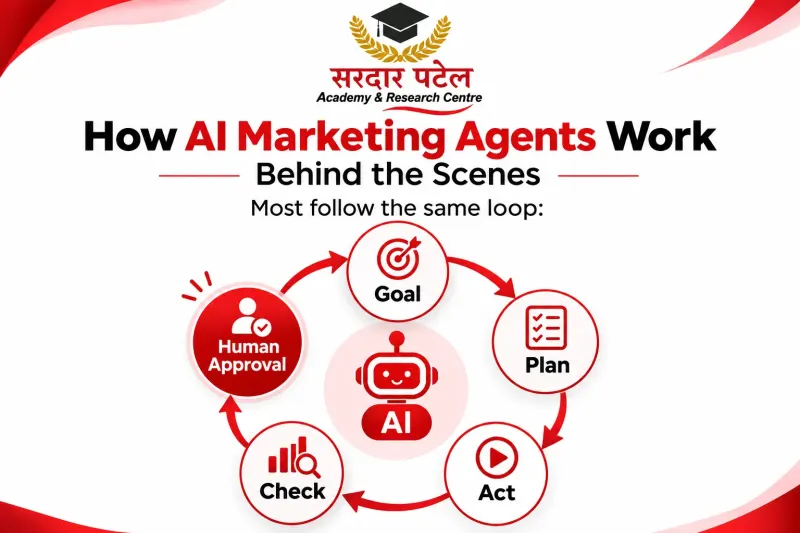
The human gate is not a decoration. Good setups give the agent only the permissions it needs, log every action and require sign-off before money is spent or content goes live. Some employers are starting to look for people who can set exactly these limits. See why AI and digital marketing professionals are in demand.
Where AI Agents Help Across the Funnel
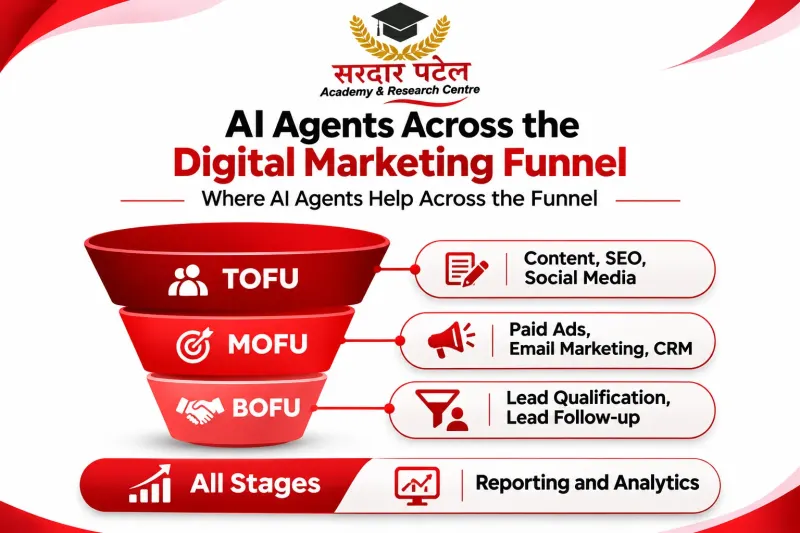
| Funnel stage |
Area |
What an agent can do |
Human checkpoint |
| Top (TOFU) |
Content and SEO |
Research topics, outline drafts, spot missing internal links |
Fact-check, add original insight, approve publishing |
| Top (TOFU) |
Social media |
Draft posts, suggest timings, summarise comments |
Approve brand voice and sensitive replies |
| Middle (MOFU) |
Paid media |
Flag wasted spend, suggest keywords and ad variations |
Approve budget and bid changes |
| Middle (MOFU) |
Email and CRM |
Segment contacts, draft follow-ups, schedule sends |
Review tone, consent and offers |
| Bottom (BOFU) |
Lead response |
Answer common questions, qualify enquiries |
Handle complex or high-value conversations |
| All stages |
Reporting |
Pull data, summarise changes, explain likely causes |
Validate numbers and decide actions |
Content and SEO
Agents speed up research and first drafts, but speed is not quality. Readers and search systems still reward pages with original value. Let the agent handle research, outlines and consistency checks while a person supplies experience, examples and the final edit.
Social media, email and lead follow-up
Here the benefit is consistency. An agent does not forget to follow up and can draft replies in seconds. The risk is tone: a reply that sounds slightly off can cost trust, so keep a person in charge of sensitive conversations.
Paid media
This is where agents feel most tangible. They can suggest keyword themes, test ad copy variations and flag spend that is not converting. Treat every suggestion as a proposal, because the final call on budget should stay with a person.
Reporting and analytics
Google’s August 2026 update to Google Ads and Analytics added AI Overviews to the Analytics homepage, and personalised AI insight cards with a prompt box to the Google Ads homepage. Google Ads also gets Dashboards built from text prompts, while the Analytics version is listed as coming soon. Google has also announced benchmarking against similar businesses in Analytics through Ask Advisor. Several of these features are in beta for English-language accounts. They turn raw data into a first draft of insight. They do not replace the analyst who decides what the numbers mean.
Visibility in AI search
As people ask conversational questions, being understood and cited by AI systems matters alongside rankings. Clear structure, honest sourcing and crawlable pages remain the base, and agents can help audit them at scale, but they cannot invent trust. For the practical steps, read our guide to optimising your website for AI search.
Platforms to Know Beyond Google
- Meta Advantage+: automates parts of audience selection, creative and placement for Facebook and Instagram campaigns.
- Microsoft Advertising and Copilot: adds AI assistance to campaign creation and reporting inside the Microsoft Advertising platform.
- HubSpot Agent Hub (formerly Breeze Agents) : embeds AI agents into CRM, email, content and customer-service workflows.
- Salesforce Agentforce: a platform for building agents that act on CRM data.
Whichever you pick, test it on one narrow task first and compare the result against your manual process.
Want to practise this on real projects? Sardar Patel Academy & Research Centre’s Digital Marketing Course with AI covers SEO, Google Ads, social media, AI tools and analytics in 7 months with 50+ projects. View course details. Book a free demo class |
What This Means for Indian and Delhi Businesses
Many Indian small and mid-sized businesses run lean teams, so agents are most useful for repetitive work: daily ad-cost checks, first replies to enquiries, and weekly reports. WhatsApp is a good example. Many local businesses already take enquiries there, and a drafted, human-approved reply can cut response time without losing the personal touch.
Language matters too. Customers write in Hindi, English, and a mix of both, so review any agent output in the language your customers actually use. Hiring is shifting as well: some roles in Delhi-NCR now ask for AI tool skills alongside SEO, ads and analytics.
Risks of AI Agents to Plan For
Most problems come from unclear permissions and unchecked output rather than from the technology itself, so each risk has a simple safeguard.
- Limited transparency. If you cannot see why an agent changed something, you cannot learn from it or defend it to a client. Digiday’s May 2026 report on marketers and Google’s ad agents describes transparency worries similar to the old Performance Max “black box” complaints, and says marketers want a manual kill switch for problems such as hallucination.
- Confident mistakes. Language models can state wrong details fluently, so check facts and figures.
- Brand drift. Without examples and rules, output drifts towards generic wording.
- Data and privacy. Share the minimum customer data needed, and respect consent.
- Over-automation. Not every task needs an agent. Simple, composable setups usually win.
- Unclear accountability. A named human must own every decision.
A Step-by-Step Way to Start
- Pick one narrow task. Weekly reporting or first-draft replies are safer than “run my ads”
- Write the goal and boundaries. State success, what the agent may touch and what it must never do.
- Grant the least access. Read-only first; add actions as trust grows.
- Keep approval on spending and publishing.
- Record a baseline. Measure time spent, error rate and cost per result first.
- Train the people. Teams need the fundamentals before the tools, starting with the AI tools every digital marketing student should know.
- Review weekly, then widen. Read the action log and expand only what earned trust.
Illustrative example. A small online store runs Google Ads. An agent checks cost per conversion every morning, notices a campaign has become expensive, pulls the search terms behind it and drafts two proposed changes. The owner approves one, rejects the other and notes why. Time is saved, yet the decisions stay human.
Skills and Career Scope
None of this removes the need for trained marketers. It changes what employers value, because someone must direct these systems and judge their output. We look at the same shift in how ChatGPT is changing SEO careers.
- Clear briefing: turning a business goal into precise instructions.
- Data literacy: reading dashboards and spotting a number that looks wrong.
- Platform fundamentals: SEO, paid search, email and social still underpin everything.
- Judgement and ethics: protecting the brand, customers and their data.
We have avoided salary figures, since pay depends on the city, employer and skill depth. Employers tend to value people who can show real project work, not only certificates. For hands-on practice, the digital marketing course at Sardar Patel Academy & Research Centre, GTB Nagar, Delhi runs for 7 months with 50+ projects and placement support, according to the course page. To judge any course, use our checklist on what an AI-based marketing curriculum should include.
Conclusion
AI agents are neither magic nor a passing fad. They are a new layer of tooling that rewards people who can set goals, define limits and judge results. The marketers who benefit most will start small, measure honestly and keep a person in charge of anything that touches money or reputation.
| Ready to build these skills? Sardar Patel Academy & Research Centre has run skill-based courses in Delhi since 2003. Explore the Digital Marketing Course with AI Talk to a counsellor |
FAQs
They are software systems that work toward a marketing goal by planning steps, using connected tools such as ad platforms, analytics or email software, and acting with limited supervision.
No. A chatbot mainly answers prompts. Marketing agents can also take actions in connected tools and keep working toward a goal, which is why they need permissions, limits and human approval.
Agentic AI is the broader approach of designing AI systems that act with some independence toward goals, rather than only answering single questions. Marketing agents are one practical form of it.
They are more likely to change marketing jobs than remove them. Someone still has to set goals, judge quality, protect the brand and take responsibility for results.
Yes, usually through features built into tools they already use, such as ad platforms and email software. Start with one narrow, low-risk task and keep approval on anything involving spend or publishing.
Only with controls. Set budget caps, limit permissions, keep a human approval step and review the action log regularly. Do not hand over control blindly.
Not at the start. Clear goal-setting, data literacy, platform knowledge and good judgement matter more. Basic spreadsheet and analytics skills help a great deal.