+91 9312966129
 sparc.enquiry01@gmail.com



How to Write Content That AI Search Engines Can Understand
Learn how to write content for AI search in 8 steps: answer-first writing, structure, testing and common mistakes, with a before-and-after example.
Table of Contents
- What Does Content for AI Search Mean?
- How AI Search Reads a Page
- Why It Matters Now
- Principles of AI-Friendly Content
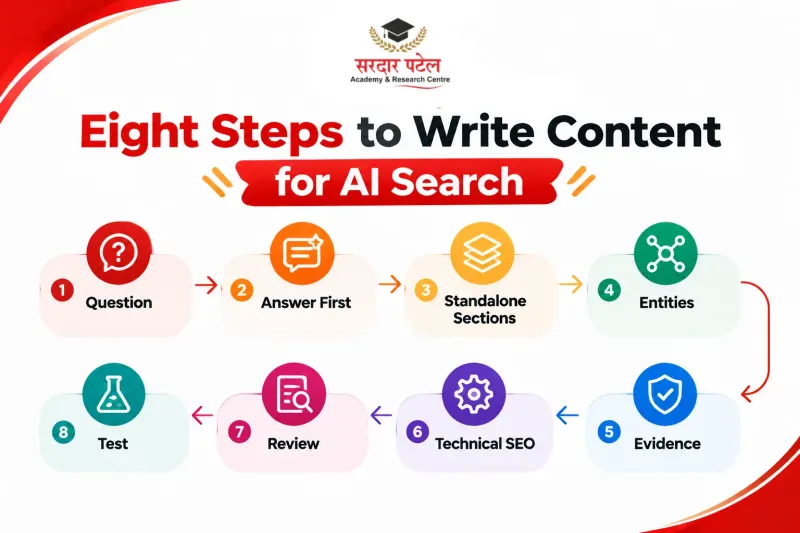
- Step-by-Step Tutorial: Write Content for AI Search
- Step 1: Start with a real question
- Step 2: Answer the first lines
- Step 3: Make every section stand alone
- Step 4: Define entities and keep terms consistent
- Step 5: Support claims with evidence
- Step 6: Support the page technically
- Step 7: Review, update and re-check
- Step 8: Test whether AI tools understand your page
- A Before-and-After Example
- Before:
- After:
- Writing for Indian Audiences
- AEO, GEO and LLM Optimisation: Where They Fit
- What Changes and What Does Not
- How to Measure Results
- Common Mistakes to Avoid
- Quick Checklist
- Why Students Should Learn This
- Conclusion
Content for AI search is writing that search engines and AI assistants can easily find, understand and quote. It opens with a direct answer, keeps each section on one question and backs every claim with a named source.
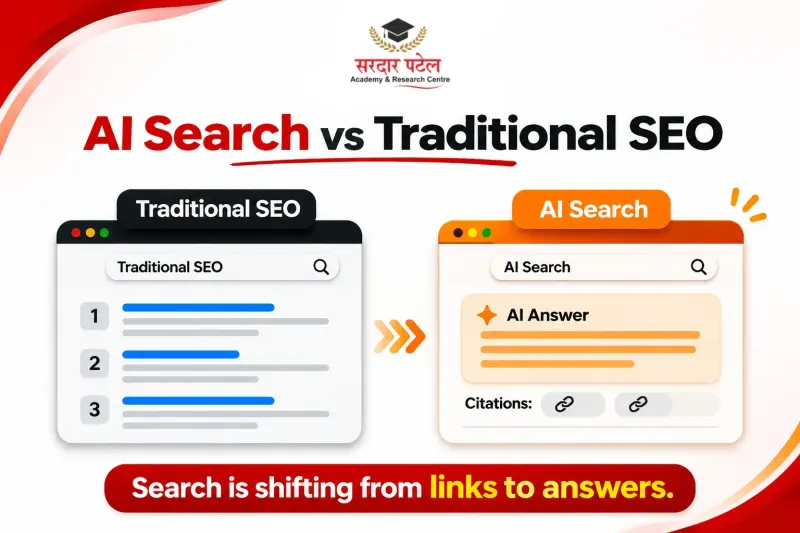
A few years ago, writing for search meant thinking about ten blue links. Today, many answers arrive as AI summaries, chat replies and cited snippets. Whether your page gets quoted depends largely on how easily a system can locate and trust the answer inside it.
If you wonder whether this means the end of SEO, our guide to Google AI Mode and SEO explains why the fundamentals still apply.
This tutorial covers what AI search systems need from a page, an eight-step writing and testing process, a full before-and-after example, and the mistakes that quietly keep good pages out of AI answers.
What Does Content for AI Search Mean?
Content for AI search is written so that a machine can understand its meaning, pull out the relevant part and present it accurately. The reader is still a human. The difference is that a machine often reads first and decides what the human sees.
How AI Search Reads a Page
This is a simplified picture, not a description of any single product. AI search systems look for passages that match a question, judge whether the source seems reliable, and then summarise or quote what they found.
Google's guidance on AI features and your website stresses basics such as letting Google crawl your pages, making content findable through internal links, giving users a good page experience and keeping important information in text form.
Why It Matters Now
More answers now finish on the results page, so the sentence an assistant chooses to quote can matter as much as your ranking. That is why this guide focuses on the writing itself: how each passage is built, so that it can be found, trusted and quoted.
Principles of AI-Friendly Content
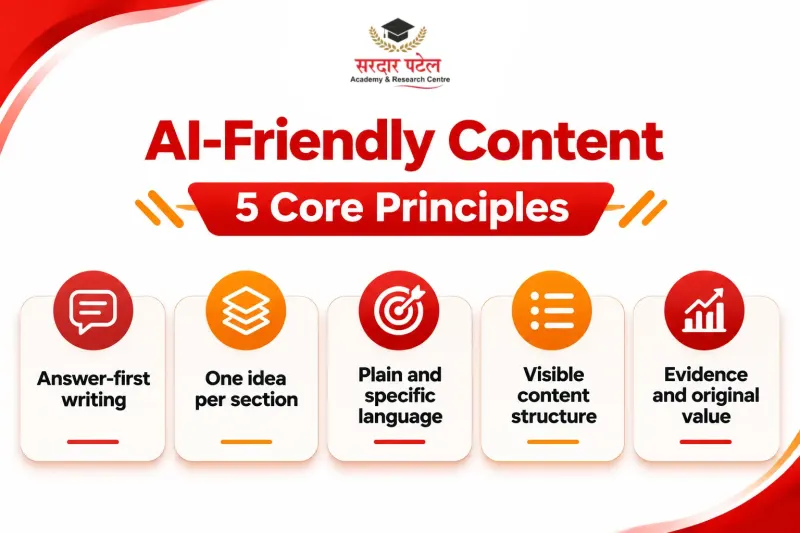
AI-friendly content is not a trick format. It is ordinary good writing, made more explicit. These principles do most of the work:
| Principle |
What to do |
Why it helps |
| Answer first |
Put the direct answer in the opening sentences of each section |
A system can lift a complete answer without rewriting it |
| One idea per section |
Keep each heading focused on a single question |
Passages stay self-contained |
| Plain, specific language |
Name things precisely and define terms once |
Reduces the chance of misinterpretation |
| Visible structure |
Use headings, lists and tables |
Makes relationships between facts obvious |
| Evidence |
Cite sources and name your method |
Builds trust with readers and machines alike |
| Original value |
Add examples, data or experience others lack |
Gives people a reason to visit anyway |
Step-by-Step Tutorial: Write Content for AI Search
Step 1: Start with a real question
Pick one question a real person would ask, and write the page to answer it fully. Phrase the question the way people speak, not the way a keyword tool lists it. If you are new to finding these questions, our keyword research tutorial for beginners shows a simple method.
Step 2: Answer the first lines
Open the page and answer each major section with a two- or three-sentence answer. Then expand with context, steps and evidence. This pattern is the backbone of AI-ready writing: it serves skimming readers and gives systems a clean passage to extract.
Placement matters because being cited is not the same as being clicked. A Pew Research Centre analysis found that links inside AI summaries were clicked in only about 1% of visits. Your wording should therefore make the answer, and your brand, memorable even when no visit follows. For the wider click-through picture, see our zero-click search article.
Step 3: Make every section stand alone
Use descriptive headings that state the topic of the section. Avoid vague labels such as "Overview" or "Things to know". Write short paragraphs, turn sequences into numbered lists and put comparisons in tables. Then run a simple test: if only this passage were shown, would it still make sense?
Step 4: Define entities and keep terms consistent
An entity is a clearly identifiable thing: a person, organisation, product or concept. Name each one in full the first time, then use the same name afterwards. If a page calls one feature "AI Overviews", "AI summaries" and "AI answers" interchangeably, a reader may follow, but a system has to guess.
Keep details consistent across your site too: the same organisation name, author details and descriptions everywhere. Google's introduction to structured data explains how explicit markup gives search engines clues about what a page means. Treat it as support for clear writing, not a shortcut to being cited.
Step 5: Support claims with evidence
State where numbers come from, when they were collected and what they cannot tell you. Link to primary sources. Then add something only you can provide:
- A worked example from your own project.
- A screenshot you captured yourself.
- A short case with a real outcome.
- A template or checklist readers can reuse.
This is the layer an AI summary cannot easily replace, and it lifts your page above generic answers. Original assets also build trust over time.
Step 6: Support the page technically
Good writing still needs to be reachable. Make sure pages can be crawled, load well on mobile, carry accurate titles and descriptions, and link to related pages. Our on-page SEO checklist for beginners walks through these basics one by one.
Step 7: Review, update and re-check
Reread the page as a stranger. Remove filler, check every fact and update figures that have aged. Google's guidance on helpful, reliable, people-first content is a good self-assessment tool. It also cautions against changing dates just to look fresh when the content has not substantially changed. A named author and a genuine "last updated" line give readers another trust signal.
Step 8: Test whether AI tools understand your page
Publishing is not the finish line. Pick three questions your page should answer, and ask each one in several AI assistants and in Google. Then record what happens. You can copy this template into a spreadsheet:
| Question |
Tool |
Named or cited? |
Answer accurate? |
Fix to try |
| (your target question) |
(tool name) |
Yes / No |
Yes / Partly / No |
(e.g. clearer opening answer) |
Results vary between runs, so treat this as a sample, not a verdict. Save dated screenshots and repeat monthly. To see how the main assistants behave differently, read how AI search is changing.
A Before-and-After Example
Here is a full section rewritten. Imagine the page is about this tutorial's own topic.
Before:
"Content for AI search is a topic that many marketers are talking about these days. There are lots of things to consider and it can feel confusing, but with the right approach, it can make a big difference to your results over time."
This opening has no definition, no steps and nothing a system could quote. Now the rewrite:
After:
What is content for AI search? It is written so search engines and AI assistants can find, understand and quote its answers. It has three traits:
- A direct answer in the first two sentences.
- Headings that each cover one question.
- Claims backed by named sources.
For example, a page on "how to write a meta description" would open with the answer, then give a short numbered list of steps, then show a good and a weak example side by side.
What changed:
- The definition now comes first, so the passage is complete on its own.
- The vague promise became three concrete traits a reader can check.
- The example shows the format in action instead of describing it.
Writing for Indian Audiences
We could not find a public study that measures AI search behaviour in India, so treat this section as practical reasoning rather than data. Two habits are worth building.
First, expect mixed-language queries. Many people search in Hindi, English or a blend of both, so explain a term in plain English and, where useful, mention how people commonly say it. Keep the spelling of names and terms consistent so a system can match them. Here are examples of how real questions are often phrased:
| Example query |
Language style |
How to answer it |
| SEO kya hota hai |
Hinglish |
Open with a one-line definition in plain English, then add the Hindi phrase once |
| digital marketing course Delhi fees |
English |
State the duration, what is covered and where to get current fee details |
| GTB Nagar ke paas computer institute |
Hinglish, local |
Name the area, address and nearest metro station in text |
Second, make local details explicit. If your institute or business serves a specific area, state the name, full address and phone number clearly in text, not only in images, and keep them identical to your Google Business Profile and website. For example, SPARC lists its address as 2514, Hudson Lane, Kingsway Camp (opposite Laxmi Dairy), near GTB Nagar Metro Station Gate No. 4, Delhi 110009, phone +91 93129-66129. Local queries often return map results, so your listing and your page should say the same thing.
Spoken questions are growing too. Our piece on the future of voice search SEO in India shows how conversational phrasing changes what you write.
AEO, GEO and LLM Optimisation: Where They Fit
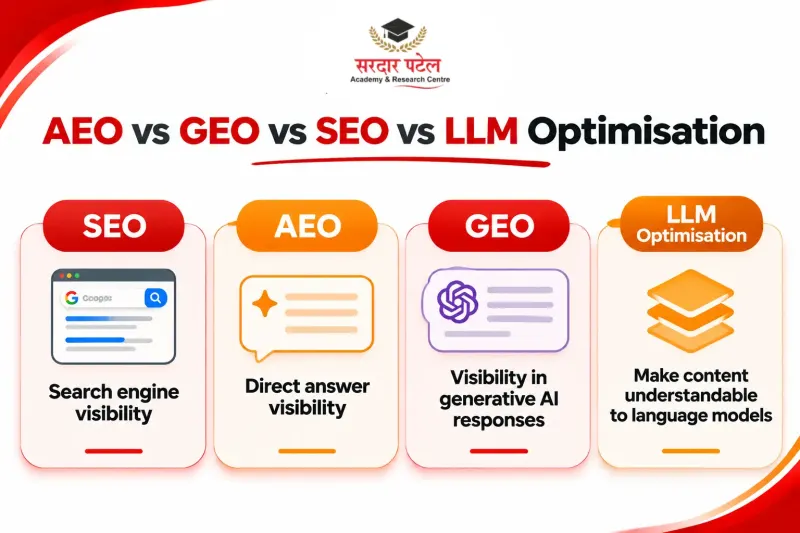
AEO (answer engine optimisation), GEO (generative engine optimisation) and LLM optimisation are overlapping labels for similar work, and the writing steps in this guide apply to all of them. For a full comparison of how they differ from traditional SEO, read our AEO vs SEO guide.
What Changes and What Does Not
What changes is the emphasis. Because AI tools summarise, the passage matters as much as the page. Because they often combine several sources, consistency and verifiable facts matter more. And because users may never visit, brand recall becomes part of the goal.
What does not change is the foundation. Google says its established SEO best practices still apply to its AI features, so there is no separate secret format to learn.
How to Measure Results
Track impressions, click-through rate and branded searches in Search Console, and keep your Step 8 test log for AI mentions. For how to read these signals as AI features change clicking, see our guides to Google AI Mode and SEO and zero-click search. If you are new to the tool, our Google Search Console tutorial for students is a good starting point.
Common Mistakes to Avoid
These slips most often weaken AI-ready content:
- Burying the answer. Long introductions push the useful sentence out of reach.
- Keyword stuffing. Repeating a phrase does not clarify meaning and hurts readability.
- Vague headings. "More information" tells neither readers nor machines anything.
- Unsupported claims. Statistics without a source weaken trust.
- Publishing unedited AI drafts. Errors and generic phrasing scale quickly. Use AI tools as helpers and always edit.
- Chasing a format instead of the reader. Structure should clarify, not decorate. Google's own guide to optimising for generative AI features makes the same point.
- Ignoring updates. Outdated facts can make a good page unusable as a source.
Quick Checklist
Before you publish, confirm that:
- The page answers one clear question.
- Each section opens with a direct answer.
- Headings describe their section.
- Terms and names are consistent.
- Every statistic has a named source.
- There is one original example or asset.
- Title, description and internal links are accurate.
- You have a plan to test and update the page.
Why Students Should Learn This
Content roles increasingly ask for people who can write clearly, structure information, cite sources and explain results when clicks fall. Practising on real briefs builds those habits faster than reading alone. The Digital Marketing Course with AI at SPARC includes 50+ projects, so students rewrite, test and measure real pages as part of the course.
Conclusion
Writing for AI search rewards the same habits that have always marked strong writing: answer the question, organise the page, name things precisely and back claims with evidence. The difference is that each section now has to work on its own, because a machine may be the first and only reader that picks it up.
Start small with your existing pages. Choose three, rewrite their openings as direct answers, tighten the headings, add one original example each and run the Step 8 test. Then watch impressions and branded searches for a month.
Want to build these skills with guidance? The Digital Marketing Course with AI at SPARC covers SEO, social media marketing, Google Ads, AI tools, content marketing and analytics over 7 months, with 50+ projects. Sardar Patel Academy & Research Centre has been running skill-based courses in Delhi since 2003. Call +91 93129-66129 or contact us to ask about a free demo class at the GTB Nagar campus.
FAQs
It is content written so search engines and AI assistants can understand, extract and accurately present it, usually through direct answers, clear structure and reliable sources.
Mostly it is the same discipline with more emphasis on clarity and self-contained passages. Google says its established SEO best practices still apply to AI features.
No. You can improve the eligibility and clarity of your content, but inclusion depends on the system, the query and competing sources.
Long enough to answer the question completely: usually a short direct answer followed by supporting detail. If a section needs more than a few paragraphs, consider splitting it under a new heading.
It means shaping content so large language model based tools can interpret and reuse it. In practice it overlaps with good structure, accuracy and source quality, plus testing how assistants describe you.
You can use it for research and first drafts, but a human should verify every fact, add original insight and edit the tone. Unchecked drafts are the fastest way to publish errors.
They make relationships and sequences explicit, which helps both readers and extraction. Use a table for comparisons and a numbered list for steps, not for decoration.
Answer engine optimisation and generative engine optimisation are overlapping labels for similar work: being the clear, trustworthy source that AI answers draw from. The practical steps in this guide apply to all three.