+91 9312966129
 sparc.enquiry01@gmail.com



How to Build a Career in Income Tax and ITR Filing?
Learn how to build a career in income tax and ITR filing. Explore job roles, essential skills, courses, and career opportunities for beginners.
Table of Contents
- What Is a Career in Income Tax and ITR Filing?
- Why Consider an Income Tax Career?
- What Does an Income Tax Professional Actually Do?
- Tax Jobs in India: Roles You Can Aim For
- Skills You Need for an Income Tax Career
- Technical skills
- Soft skills
- Know the Main ITR Forms
- How to Build a Career in Income Tax and ITR Filing: Step-by-Step Roadmap
- A Practical Example: One Salaried Client, Start to Finish
- What the New Income Tax Act Means for Learners
- Career Paths: Job, Freelancing, or Own Practice?
- Learning Tax and Accounting in GTB Nagar
- Common Mistakes Beginners Make
- Practical Tips from the Field
- Conclusion
Every year around filing season, many people in Delhi NCR look for someone who can file their return correctly. Salaried employees, shop owners, freelancers, landlords, and small companies all need help. That steady demand is why more students and working professionals now ask how to build a career in income tax and ITR filing.
In this guide, you will learn what the work involves, which jobs exist, the skills you need, a step-by-step roadmap, common mistakes, and answers to the questions beginners ask most. It is written in simple language, so you can use it whether you are a commerce student, a fresher, or someone changing careers.
What Is a Career in Income Tax and ITR Filing?
A career in income tax and ITR filing means applying income tax laws to help people and businesses calculate tax, file returns, respond to notices, and plan tax payments correctly.
ITR stands for Income Tax Return. It is the form a taxpayer files to report income, claim deductions, and settle tax with the Income Tax Department. A tax professional prepares this return, checks the numbers, and makes sure it is filed and verified on time.
This is a skill-based field. You don't always need a big degree to start, but you do need accuracy, patience, and a solid understanding of how tax rules work in real life.
Why Consider an Income Tax Career?
Here are some honest reasons why people choose this path:
- Steady need: Everyone who earns above the exemption limit, or needs a return for loans, visas, or refunds, may need to file.
- Multiple routes: You can work in a firm, a company, or on your own.
- Skills that stack: Tax knowledge connects naturally to accounting, GST, and TDS.
- Low startup cost: Freelance ITR work can begin with a laptop, a good internet connection, and strong basics.
A few things to keep in mind. Filing work is seasonal, with a heavy rush before the due date. The law also keeps changing, so you must keep learning. This is an opinion based on how the field generally works, not a promise of income.
What Does an Income Tax Professional Actually Do?
The daily work is more varied than most beginners expect. Typical tasks include:
- Collecting documents such as Form 16, bank statements, rent receipts, and investment proofs
- Checking the Annual Information Statement (AIS) and Form 26AS for income and tax already paid
- Choosing the right ITR form for the client
- Comparing the old and new tax regimes where the choice is available
- Calculating tax, advance tax, and refunds
- Filing the return and helping the client e-verify it. Professionals can use the [Official Income Tax e-Filing Portal] to access return filing services, verify returns, and manage other taxpayer-related activities
- Replying to notices or mismatches raised by the department
- Advising clients on tax-saving and record-keeping
Tax Jobs in India: Roles You Can Aim For
If you search for tax jobs in India, you will see many different titles. This table shows the common ones.
| Role |
Where you work |
Main work |
Good starting point for |
| ITR filing executive |
Tax consultancy, accounting firm |
Prepare and file returns for individuals |
Freshers, commerce students |
| Tax assistant/accounts executive |
CA firms, small companies |
Tax work, TDS, GST, bookkeeping |
Students with Tally skills |
| Tax analyst |
Mid-size and large companies |
Tax computation, reconciliations, reporting |
Graduates with tax knowledge |
| Freelance tax return preparer |
Self-employed |
Handle individual and small business returns |
Experienced learners |
| Tax consultant |
Own practice or firm |
Planning, notices, advisory |
CA, CMA, or experienced professionals |
| Government tax roles |
Income Tax Department |
Assessment, inspection, administration |
Candidates who clear government exams |
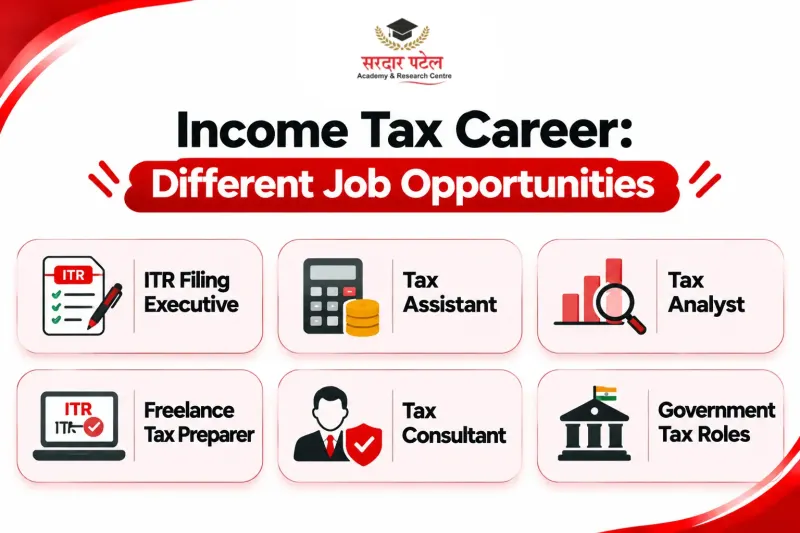
For government posts, eligibility and exam details change from time to time, so always check the official notification of the recruiting body before you plan. Pay in all these roles depends on your skills, city, employer, and experience, so avoid trusting any salary figure that has no clear source.
Skills You Need for an Income Tax Career
Technical skills
- Income tax basics: heads of income (salary, house property, business or profession, capital gains, other sources), deductions, and tax slabs
- ITR form selection: knowing which form fits which taxpayer
- TDS knowledge: how tax deducted at source appears in a return
- GST basics: because many clients need both income tax and GST support.
- Accounting and Tally: to read books of accounts and prepare business returns. Along with accounting software, professionals should also understand other essential tools used in daily accounting work. Explore the [Top Software Skills Every Accountant Should Know] to understand which tools can improve your career opportunities
- Excel: for tax working sheets, reconciliations, and quick checks
- Income tax portal use: login, pre-filled data, e-verification, and responding to notices
Soft skills
- Attention to detail, since one wrong figure can create a notice
- Clear communication, because clients often do not understand tax terms
- Patience while collecting documents from clients
- Honesty, because tax work involves sensitive financial information
Know the Main ITR Forms
This is a quick guide for beginners. Always confirm the latest eligibility rules before filing.
| ITR form |
Generally used by |
| ITR-1 |
Resident individuals with simple income, such as salary and one house property |
| ITR-2 |
Individuals with income like capital gains or more than one house property, but no business income |
| ITR-3 |
Individuals and HUFs with business or professional income |
| ITR-4 |
Eligible taxpayers who opt for presumptive taxation |
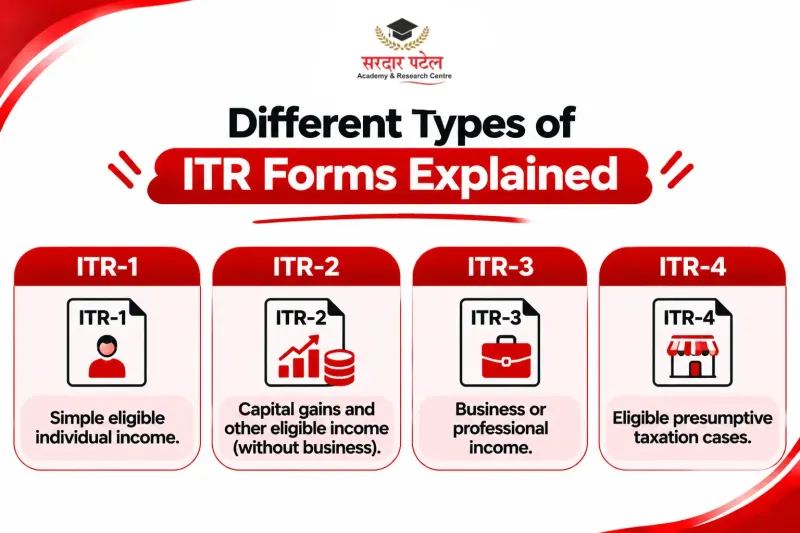
How to Build a Career in Income Tax and ITR Filing: Step-by-Step Roadmap
- Learn the basics of accounting. Understand debit, credit, ledgers, and financial statements first. Tax is easier when you can read accounts.
- Study income tax fundamentals. Start with the five heads of income, exemptions, deductions, and how tax is calculated for individuals.
- Practice on the income tax portal. Read the pre-filled data, check AIS and Form 26AS, and understand how a return is filed and verified.
- Add Tally, GST, and TDS skills. Employers like candidates who can handle more than one task. However, learning Tally alone may not cover every requirement of an accounting role. Read [Is Tally Enough to Get an Accounting Job?] to understand what additional skills employers expect from candidates.
- Practice with real-style cases. Prepare sample returns for a salaried person, a landlord, and a small trader.
- Build experience. Try an internship or entry-level role in a CA firm, tax consultancy, or accounts department.
- Decide your direction. You can grow into a corporate tax role, start a tax practice, or study further for CA, CMA, or similar qualifications.
If you plan to file returns for clients professionally, confirm any registration or authorisation requirements on the Income Tax Department's official website before you start.
Related reading on the Sardar Patel Academy blog: How to Become a TDS and TCS Executive? For the software side, see the Tally Prime & Busy course.
A Practical Example: One Salaried Client, Start to Finish
This is an illustrative example, not a real client case.
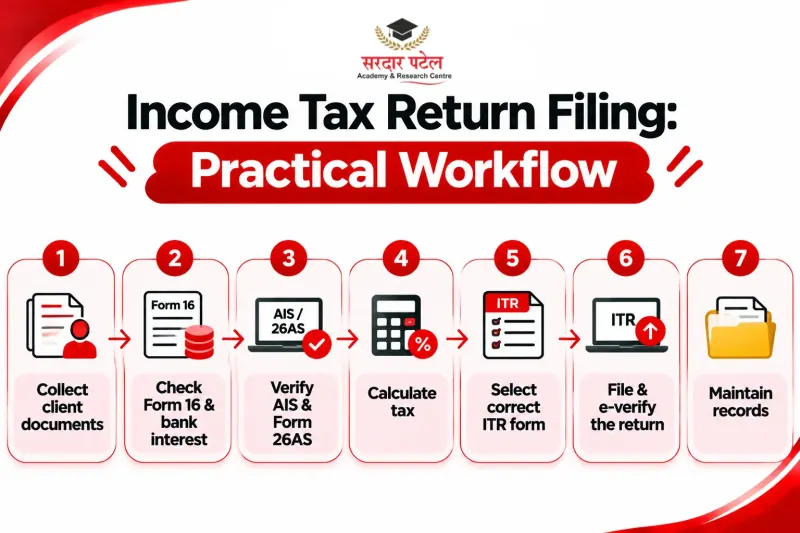
Meera works at a private company and also earns small bank interest. She comes to you in the filing season. Here is how a beginner-friendly process looks:
- Collect her Form 16, bank interest certificate, and tax-saving proofs.
- Match her income with AIS and Form 26AS.
- Calculate tax under both regimes, if she is eligible to choose.
- Select the right ITR form and fill in the details.
- Show her the final tax figure and get her approval.
- File the return and help her e-verify it.
- Keep a copy of all documents for future reference
Notice what is missing: guesswork. Good tax work depends on checking each number against a document.
What the New Income Tax Act Means for Learners
India's new Income-tax Act, 2025, came into effect on 1 April 2026 and replaces the 1961 Act. It simplifies the language and structure of the law, but it did not introduce new tax rates.
For learners, these points matter:
- Filing for FY 2025-26: Income returns earned in FY 2025-26 (AY 2026-27) were still filed under the 1961 Act's framework.
- "Tax year" replaces "previous year" and "assessment year". The "tax year" concept applies from 1 April 2026. Calling FY 2025-26 "Tax Year 2025-26" is only a mapping for convenience. The first true tax year under the new Act is FY 2026-27, that is, Tax Year 2026-27.
- Form names are changing. Under the new Act, Form 130 is expected to replace Form 16, and Form 168 is expected to replace Form 26AS. For FY 2025-26, the old names (Form 16 and Form 26AS) still apply.
- Section numbers have changed too, so older notes and books may need updating. For the latest provisions, rules, forms, and official guidance, learners should refer to the [Official Income-tax Act, 2025 and Rules]
The practical lesson: study the concepts first, then keep checking the latest official forms and rules. Confirm the current position on the Income Tax Department website before filing.
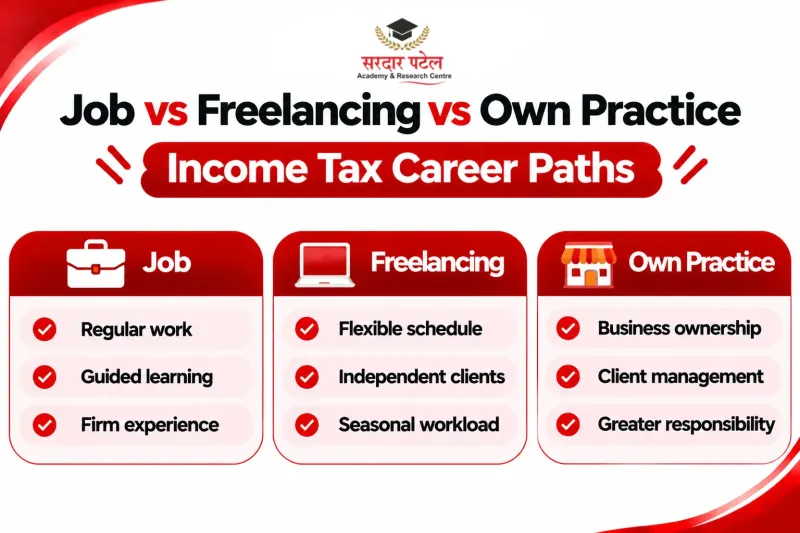
Career Paths: Job, Freelancing, or Own Practice?
| Option |
Advantages |
Challenges |
| Job in a firm or company |
Regular learning, guidance, stable work |
Lower control over your work and schedule |
| Freelance ITR work | Flexible, you choose clients |
Income is seasonal; you must find clients |
Most beginners do well by starting with a job. You learn real client handling, deadlines, and notice replies before taking on full responsibility.
Learning Tax and Accounting in GTB Nagar
Sardar Patel Academy & Research Centre (SPARC) is at 2514, Hudson Lane, Kingsway Camp (opposite Laxmi Dairy), near GTB Nagar Metro Station Gate No. 4, Delhi 110009, so you can reach it directly by metro.
Its 12-month E-Accounting Course (E-DAFA) covers the skills this article describes: basic accounting, Tally Prime and Busy, GST, TDS and Income Tax e-filing (including ITR-1, ITR-3 and ITR-4 practice on the portal), and Webtel software used for TDS and GST compliance. If you want to understand the differences between these two popular accounting tools, read [Tally vs BUSY: Which Accounting Software Is Better for Your Career?] before choosing which software to focus on.
Training is projector-based with practical assignments, and PC practice is available from 8:00 AM to 8:00 PM, so you can practise software and portal work outside class. Batch timing is flexible for working professionals, and Sardar Patel Academy offers placement support, including mock interviews and interview visits. To ask about fees, instalments, or batch availability, use the contact page.
This is general information about learning options. It is not a guarantee of any job or placement.
Common Mistakes Beginners Make
- Memorising sections without practising. Tax is applied knowledge. Practise on sample returns.
- Ignoring AIS and Form 26AS. Mismatches here are a common reason for notices.
- Using outdated notes. Rules, forms, and numbering change, especially after the new Act.
- Skipping accounting basics. Business returns need good bookkeeping knowledge.
- Filing without client confirmation. Always share the computation before filing.
- Overpromising refunds. A refund depends on the facts and the department's processing.
Practical Tips from the Field
- Make a simple document checklist for every client type, and reuse it every season.
- Keep a personal notebook of errors you have seen. It becomes your best learning tool.
- Learn to explain tax in plain words. Clients trust people who make things clear.
- Do not wait for the last week of the due date to learn the portal.
- Treat client data as confidential. Your reputation depends on it.
Conclusion
A career in income tax and ITR filing rewards people who are careful, curious, and consistent. Start with accounting basics, learn income tax step by step, practise on the portal, add Tally, GST, and TDS skills, and gain experience through an entry-level role. Whether you aim for a job, freelancing, or your own practice, strong fundamentals will carry you further than shortcuts.
If you want to become job-ready, tax knowledge works best alongside practical accounting skills. Build practical accounting and tax skills with the 12-month E-Accounting Course (E-DAFA) at Sardar Patel Academy & Research Centre (SPARC), GTB Nagar.
Address: 2514, Ground Floor & First Floor, Hudson Lane, Kingsway Camp (opposite Laxmi Dairy), near GTB Nagar Metro Station Gate No. 4, Delhi 110009
FAQs
Yes, it can be a good starting point if you are willing to learn and practise. Many freshers begin as ITR filing executives or accounts assistants and build skills in tax, TDS, and GST over time. Results depend on your effort, skills, and the opportunities available.
No. You can begin with a commerce background, accounting skills, and practical tax training. A CA qualification opens more senior and advisory roles, but it is not the only route.
Look for a course that covers accounting basics, income tax, TDS, GST, Tally, and hands-on portal practice. Practical assignments matter more than the course name.
Yes, many people prepare returns as freelancers. Start with simple salaried returns, build experience, and confirm any registration or authorisation requirements for the services you offer on the Income Tax Department's official website.
Income tax is levied on income earned by individuals and entities. GST is an indirect tax on the supply of goods and services. Many tax professionals handle both.
The core concepts remain useful, but terms, section numbers, and forms have changed. Keep your knowledge updated through official notifications and current study material.
This depends on your starting point and practice time. A learner with commerce basics can usually become entry-level ready faster than a complete beginner, but there is no fixed timeline.