+91 9312966129
 sparc.enquiry01@gmail.com



AI-Powered Content Strategy: What Should Marketers Automate?
Build an effective AI content strategy. Understand how to identify content tasks suitable for automation, where human creativity is essential, and how to expand AI-driven content marketing responsibly.

Table of Contents
- What Is an AI Content Strategy?
- The Automation Test: Five Questions Before You Automate Anything
- Seven Content Tasks Marketers Should Automate
- What Marketers Should Not Automate
- How to Build a Human-in-the-Loop Workflow
- Common Mistakes in AI Content Marketing
- How to Measure Whether Your Automation Is Working
- Conclusion
Every marketing team is now asking the same question: how much of our content work should we hand over to AI? Automate too little, and you fall behind competitors who publish faster and test more. Automate too much, and your brand starts to sound like everyone else's: generic, forgettable and occasionally wrong.
A strong AI content strategy sits between those two extremes. It does not ask, "Can AI do this?" It asks, "Should AI do this, and who checks the result?" This is a decision framework, not a tool tutorial. In this guide, Our AI content quality checklist shows how to check before publishing.
What Is an AI Content Strategy?
An AI content strategy is a documented plan for how your team uses artificial intelligence across the content lifecycle: research, planning, creation, optimisation, distribution and measurement. It defines which tasks AI handles, which tasks humans own, and which quality checks sit between the two
This is different from simply "using a chatbot to write blog posts." Ad hoc prompting gives individual writers a speed boost, but it does not give the team consistency. An effective approach aligns AI with your business objectives, audience insights, and brand guidelines to deliver meaningful results.
View AI-powered content marketing as a way to enhance productivity and creativity, rather than a substitute for human judgment and strategic thinking. If your positioning is clear and your audience understanding is strong, AI helps you produce more relevant content, faster. If those foundations are weak, AI simply helps you produce more mediocre content, faster.
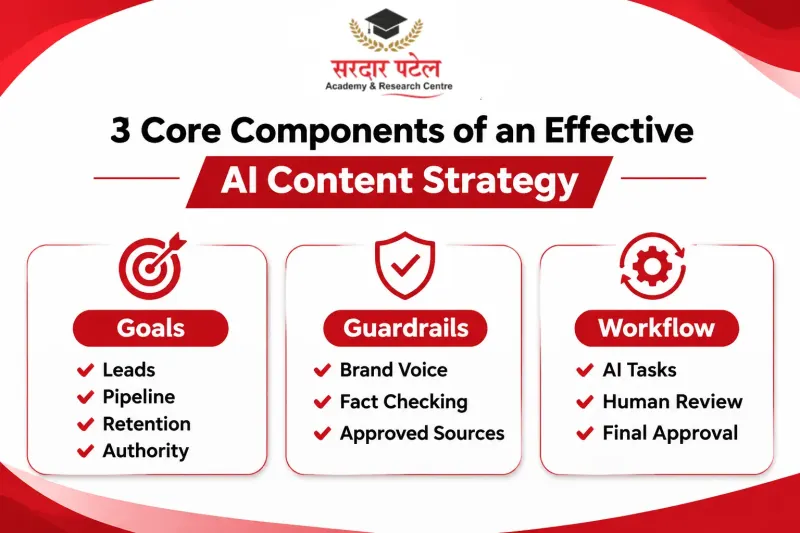
A successful AI-driven content strategy is built around three essential components:
- Goals: What business outcome is content supposed to drive: leads, pipeline, retention, authority?
- Guardrails: Brand voice rules, approved sources, fact-checking standards, disclosure policy and the topics AI must never handle alone.
- Workflow: A step-by-step process that shows where AI contributes, where a human reviews and who signs off.
Without these three parts, content automation becomes a collection of disconnected experiments. With them, it becomes a system.
The Automation Test: Five Questions Before You Automate Anything
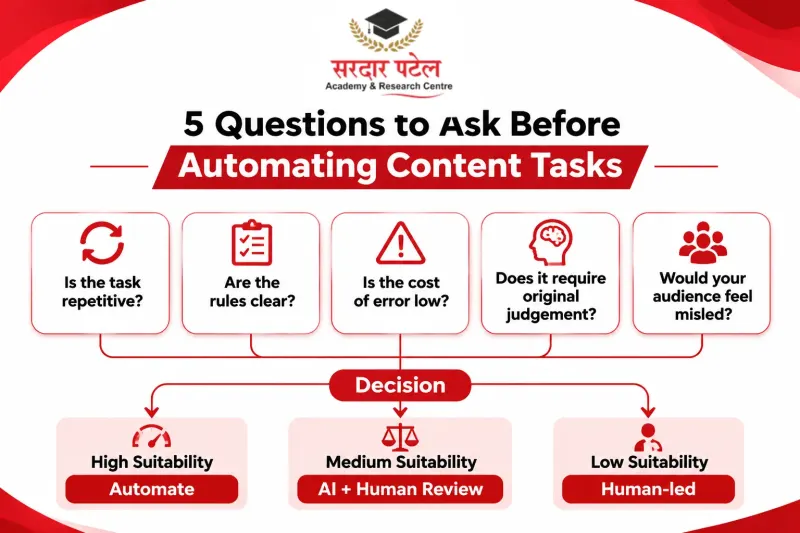
Before you plug AI into a task, run it through these five questions.
- Is the task repetitive? If your team does it weekly or daily in nearly the same way, it is a candidate.
- Are the rules clear? Tasks with clear inputs, formats and success criteria are easier to automate reliably.
- Is the cost of an error low, or easy to catch? A typo in an internal summary is minor. A false claim in a published whitepaper is not.
- Does it need original judgement or lived experience? If the value comes from your opinion, your data or your story, a machine cannot supply it.
- Would your audience feel misled if they knew AI did it? When the answer is yes, ensure that a person remains responsible for overseeing the process.
Tasks that score high on questions one to three and low on four and five are strong candidates for content automation. Tasks that fail the last two belong to people. Most work sits in the middle, and that is where the best teams use a hybrid model: AI drafts or analyses, a human decides and approves. If you are unsure whether a task needs an agent or a simple workflow, this comparison of AI agents and marketing automation can help you decide.
Record the results of this test in your AI content strategy document, so every team member applies the same logic to content automation decisions. Over time, you will build a clear map of which tasks are fully automated, which are AI-assisted and which stay fully human.
Seven Content Tasks Marketers Should Automate
1. Research and Topic Discovery
Research is the biggest time sink in content production, and it is where AI delivers the clearest gains. AI can cluster keywords by intent, summarise what top-ranking pages cover and surface audience questions and gaps your competitors have missed. For the keyword workflow itself, see our guide to AI tools every digital marketer should know .
The key phrase is "surface and summarise." Let AI organise the raw material, then have a strategist decide which topics fit your goals. Always verify any statistic or claim at its source before it goes into a published piece.
2. Content Briefs and Outlines
A good brief aligns writers, editors and SEO specialists before a single paragraph is drafted. Building one manually can take an hour or more. AI can generate a first-pass brief in minutes: target keyword, search intent, suggested headings, questions to answer, internal links and competitor angles.
Your editor then sharpens the angle, removes filler and adds the unique point of view that makes the piece worth reading. The ideal use of automation is to let AI handle the repetitive production work while humans focus on creativity, judgment, and decision-making.
3. First Drafts of Low-Risk, Formulaic Content
Not all content carries the same weight. Product description variants, meta descriptions, FAQ answers, event reminders and internal newsletters follow predictable patterns and carry modest risk. AI can produce first drafts of these quickly, and a human can edit them for accuracy and tone.
For flagship content such as thought-leadership articles, case studies and original research, use AI as an assistant for structure and phrasing, not as the author. The drafts that earn trust almost always contain a fact, example or opinion that only your team could provide. Google's own people-first content guidelines make the same point: content should be created to help readers, not to chase rankings.
4. Repurposing Across Formats and Channels
Repurposing is repetitive by nature, which makes it ideal for automation. One webinar can become a blog post, a LinkedIn carousel script, five short social posts and an email sequence, with AI adapting length and format for each channel. A human then checks that the message stays accurate and the tone fits the platform. For tools and step-by-step setups, see our AI marketing automation tutorial.
5. On-Page SEO and Optimisation Tasks
Many SEO tasks are mechanical: title tag and meta description options, internal link suggestions, schema markup, image alt text and flagging outdated sections in older posts. These are good uses of content automation because the rules are clear and the output is easy to verify, but still review them before publishing, as Google's guidance on AI-generated content asks. For the keyword side of on-page work, see our guide to AI keyword research.
Use AI to speed up the checklist, but do not let it dictate the content. Writing for search engines first and readers second is a quick way to damage both rankings and trust.
6. Distribution and Scheduling
Scheduling social updates, sending newsletters, segmenting email lists, and testing send times can all be automated with tools most marketing teams already own. AI adds value by predicting timing and testing headline variants, much like AI-powered Google Ads campaigns do with bids and budgets. Set clear rules for what goes out automatically and what needs approval, and see our AI marketing automation tutorial for how to set this up.
7. Reporting and Performance Analysis
Pulling numbers into spreadsheets every month is low-value work. Automate dashboards that track traffic, rankings, conversions and engagement by content type, starting with Search Console and Google Analytics data, and let AI summarise the patterns. The analysis still needs a human to interpret it: a traffic drop might be an algorithm change, a seasonal dip or a tracking error. Our AI marketing automation tutorial covers the reporting setup.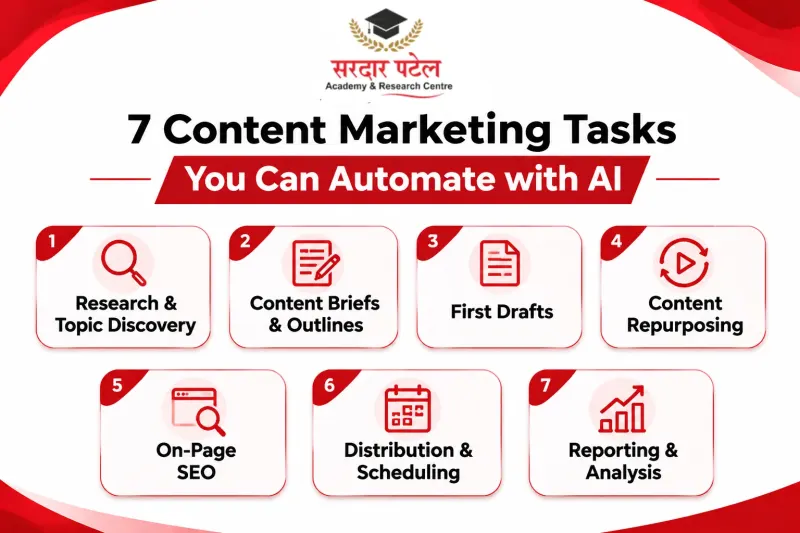
What Marketers Should Not Automate
Knowing what to leave alone matters as much as knowing what to automate. These areas should stay firmly in human hands.
Positioning and strategy. Deciding who you serve, what you stand for and why you are different is the foundation of all content. AI can offer options, but it cannot own the decision or understand your market the way your team does.
Original insight and storytelling. Customer interviews, proprietary data, personal experience and a real point of view are what set content apart. AI trained on existing material tends to reproduce the average of what is already online. Your edge is what is not already there.
Fact-checking and claims. AI tools can state wrong information confidently. Every statistic, quote, legal statement and product claim needs human verification against a trustworthy source. Google's guidance on using generative AI content also stresses reviewing AI output before it is published. In regulated industries such as finance and healthcare, this is not optional.
Final brand voice and quality control. AI can imitate a style, but it does not feel when something is slightly off-brand. A human editor should always have the last word on tone, clarity and taste.
Community and relationships. Replying to a customer's thoughtful comment, engaging with a partner or handling a complaint builds trust that automation cannot. Use AI to draft or triage, but let people do the talking where relationships are at stake.
Sensitive and high-stakes topics. Crisis communication, ethical issues, and anything involving personal data demand human judgement and accountability.
How to Build a Human-in-the-Loop Workflow
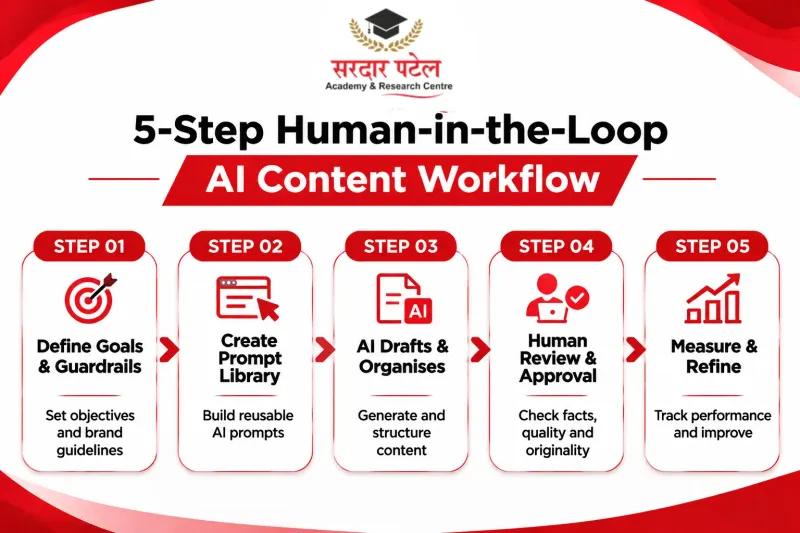
A practical AI content strategy follows a repeatable workflow. Here is a five-step model you can adapt.
Step 1: Define goals and guardrails. Write down your audience, brand voice, approved sources, banned claims and disclosure policy. This becomes the reference document for every prompt and every reviewer.
Step 2: Create a prompt library. Instead of every team member inventing prompts, build tested templates for briefs, outlines, repurposing and SEO tasks. Include your voice rules and examples of good output. A shared library keeps quality consistent and makes onboarding faster.
Step 3: Let AI draft and organise. Use AI for research summaries, outlines, first drafts of low-risk content and format conversions. Keep a record of which tool and prompt produced which output, so you can improve over time.
Step 4: Review with a checklist. Every piece passes through a human reviewer who checks facts, originality, tone and compliance against a written checklist, not a vague instruction to "review it." For a ready-to-use list, including plagiarism checks, see our AI content quality checklist.
Step 5: Measure and refine. Track speed, cost, quality scores and performance. Retire automations that create more editing work than they save, and expand the ones that clearly help.
Common Mistakes in AI Content Marketing
As more teams adopt AI content marketing, the same errors keep appearing.
- Publishing raw AI output. Unedited text tends to be bland, repetitive and sometimes inaccurate. It rarely ranks well and rarely earns trust.
- Automating before defining strategy. Speeding up a poorly designed process only produces more waste. For example, switching on Google AI Max for Search campaigns without clear goals and conversion tracking can waste budget. Fix the plan first.
- Ignoring originality. Search engines and readers reward content that adds something new. Rewriting what already exists with AI adds nothing.
- Skipping source verification. One invented statistic can damage the credibility of an entire article.
- Using AI everywhere at once. Teams that try to automate every task simultaneously overwhelm their reviewers. Start with two or three high-value use cases.
- Neglecting training. Tools are only as good as the people using them. Without skills in prompting, editing and evaluation, results stay inconsistent. A future-ready AI digital marketing curriculum should cover all three.
How to Measure Whether Your Automation Is Working
Automation should improve results, not just speed. Track a balanced set of metrics.
- Efficiency: Hours saved per piece, time from brief to publication, cost per asset.
- Quality: Editor revision rate, factual error rate, reader feedback and brand-voice scores.
- Performance: Organic traffic, rankings, engagement, conversions and assisted revenue for AI-supported content versus fully human content.
- Risk: Number of corrections after publication, compliance flags and originality-check failures.
Review these monthly. If efficiency rises while quality or performance falls, you are automating the wrong things or reviewing too lightly.
Share these results with writers, editors and stakeholders as well. A transparent scorecard helps everyone see how your AI content strategy is performing and where it needs adjustment.
Conclusion
The most effective AI content strategy does not try to automate everything. It automates the repetitive, rule-based work that drains time: research, briefs, repurposing, SEO checklists, scheduling and reporting. It protects what makes content valuable: strategy, original insight, accuracy and voice.
The teams that win with AI content marketing will not be the ones that publish the most. They will be the ones that combine fast, well-governed content automation with human judgement that readers can feel. That combination depends on skill: knowing how to prompt, how to evaluate, how to edit and how to build workflows that last. If you work in search, see how ChatGPT is changing SEO careers and which skills are gaining value.
Ready to put this into practice? Build AI Content Skills with the Digital Marketing Course with AI at SPARC, GTB Nagar, Delhi. You will work on SEO, content marketing and AI tools through hands-on projects and real-world case studies. Not sure yet? Book a free demo class or call +91 93129 66129.
FAQs
No. AI replaces tasks, not strategic roles. See how ChatGPT is changing SEO careers for the skills gaining value.
Not by itself. Search engines reward helpful, accurate content however it is produced, and low-quality mass-produced pages perform poorly regardless of the tool.
Base each piece on your own data, experience and examples, not a rewrite of existing articles, and cite your sources.
Begin with research, briefs and repurposing. They save the most time with the least risk, and they give your team practice in reviewing AI output.
Consistency at scale. A documented AI content strategy lets a team publish more without lowering its standards, because every task has an owner, a tested prompt and a review step.