+91 9312966129
 sparc.enquiry01@gmail.com


How ChatGPT is Changing SEO Careers
Discover how ChatGPT is changing SEO careers and the real AI impact on digital marketing jobs — what's automated, what's not, and how to adapt.

Table of Contents
- Has Actually Automated in SEO Work
- The Real Shift: From Content Creator to Content Strategist
- Where AI Genuinely Struggles (And Why That Matters for Your Career)
- AI Impact on Digital Marketing Jobs: What Employers in Delhi NCR Are Actually Looking For
- Common Mistakes People Make When Adapting to AI in SEO
- Practical Tips: How to Future-Proof an SEO Career Alongside AI
- Pros and Cons of AI Tools in SEO Careers
- Conclusion: Adapting, Not Competing
A few years ago, if you told an SEO executive in Delhi that a chatbot would be writing meta descriptions, generating keyword clusters, and drafting content briefs, most people would have laughed it off. Today, that's just Tuesday.
How ChatGPT is changing SEO careers isn't a hypothetical question anymore — it's something every content writer, SEO analyst, and digital marketing student in GTB Nagar and across Delhi NCR is quietly asking themselves. Is the job disappearing? Is it evolving? Or is it just getting more interesting?
This article breaks down what's actually changing on the ground — not the hype, not the panic — and what it means if you're building (or rebuilding) a career in SEO right now.What ChatGPT
What ChatGPT Has Actually Automated in SEO Work
Let's start with what's genuinely different. ChatGPT and similar AI tools have taken over a chunk of the repetitive, time-consuming parts of SEO work:
- First-draft content generation — outlines, intros, and rough drafts that used to eat up hours
- Keyword clustering and topic mapping — grouping related search terms faster than manual spreadsheet work
- Meta title and description variations — generating multiple options to A/B test
- Basic on-page audits — flagging missing alt text, thin content, or header structure issues
- FAQ and schema markup drafting — turning a list of questions into structured, publish-ready answers
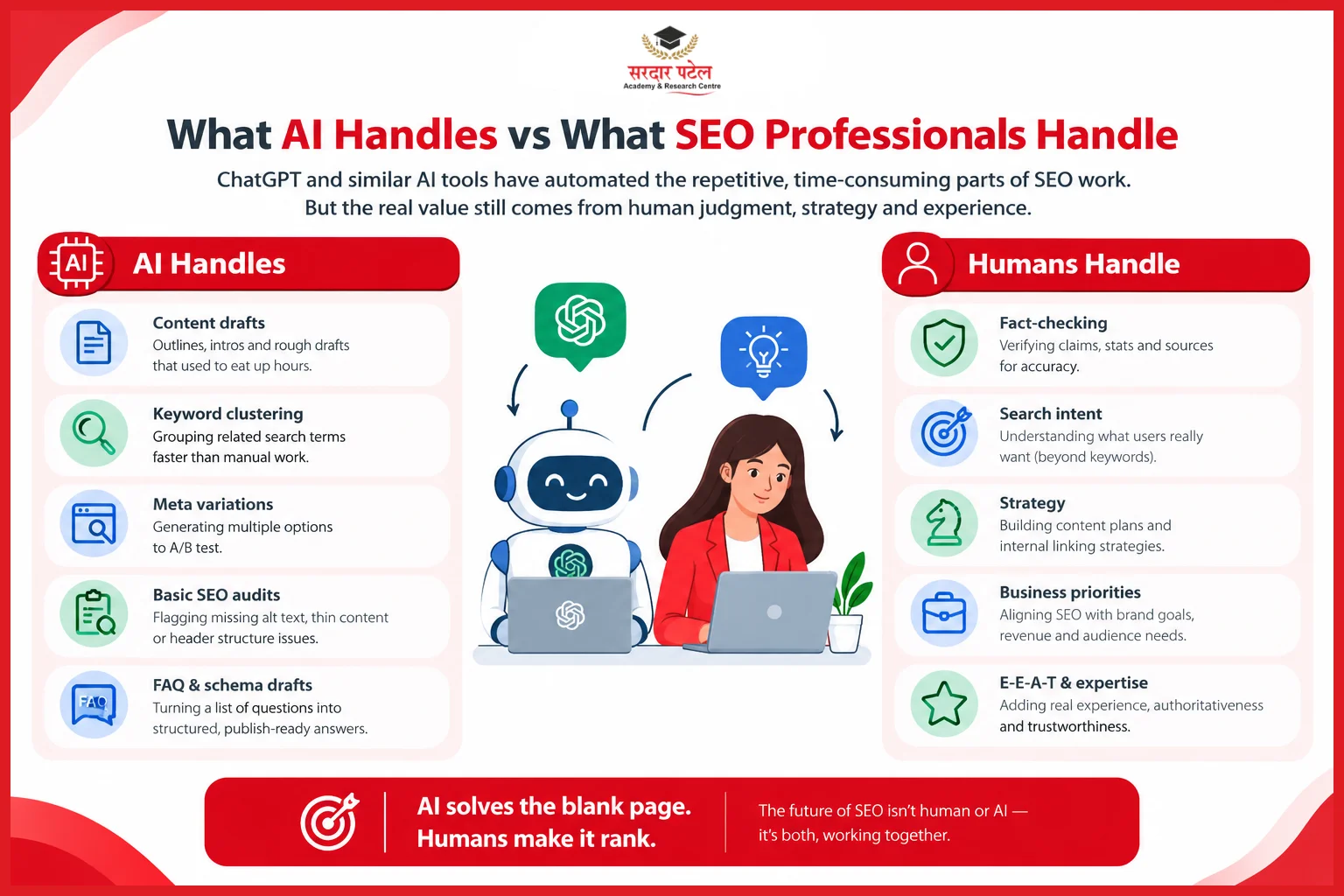
None of this means SEO professionals are obsolete. It means the blank-page problem — staring at an empty doc trying to figure out where to start — is mostly solved. What's left is judgment, strategy, and quality control, and that's exactly where human SEO professionals are becoming more valuable, not less.
The Real Shift: From Content Creator to Content Strategist
This is probably the most important part of understanding how ChatGPT is changing SEO careers. The job title might stay the same, but the day-to-day work is moving up a level.
Five years ago, a junior SEO executive might spend most of their week writing blogs. Now, that same person is more likely to spend their week:
- Reviewing and fact-checking AI-generated drafts
- Deciding search intent before any writing begins
- Building internal linking strategies
- Interpreting Google Search Console data to find content gaps
- Editing AI output so it doesn't sound robotic or repetitive
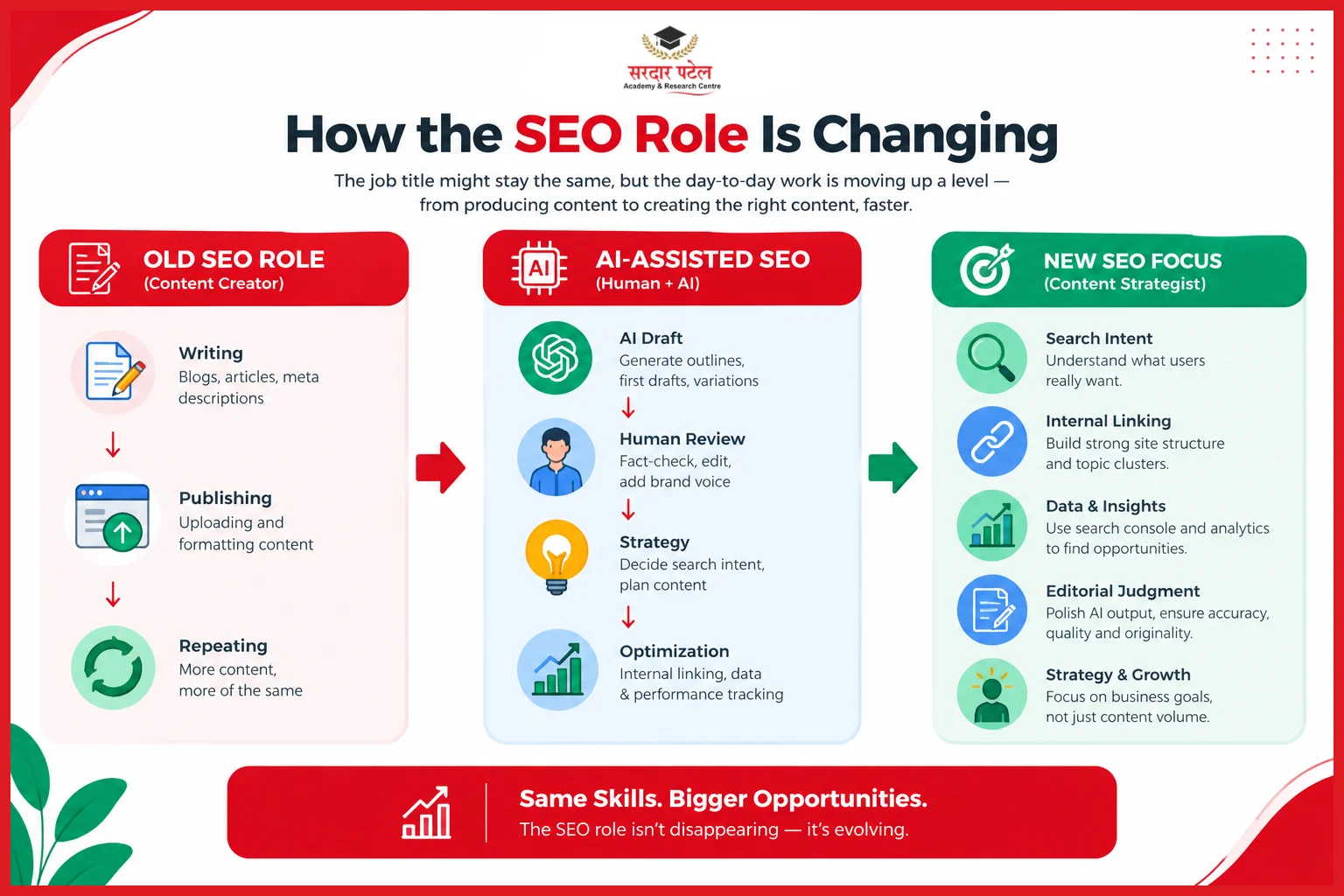
In other words, the work is shifting from "produce more content" to "produce the right content, faster." That's a strategic skill, not a typing skill — and it's harder for AI to replace.
Where AI Genuinely Struggles (And Why That Matters for Your Career)
E-E-A-T stands for Experience, Expertise, Authoritativeness, and Trustworthiness — the framework Google uses to judge whether content deserves to rank.
Google's ranking systems increasingly reward E-E-A-T. AI tools, by design, don't have personal experience. This creates a real gap that human professionals are stepping into.
| SEO Task |
AI Can Do This Well |
Still Needs a Human |
| Generating content drafts |
Yes |
Editing for accuracy, tone, and brand voice |
| Keyword research |
Yes (basic clustering) |
Interpreting search intent and local nuance |
| Technical SEO audits |
Partial (flagging issues) |
Prioritizing fixes based on business impact |
| Writing FAQs |
Yes |
Verifying claims, avoiding fabricated stats |
| Building author authority (E-E-A-T) |
No |
Requires real credentials, case studies, experience |
| Local SEO for Delhi NCR businesses |
Weak |
Local market knowledge, on-ground context |
This table is really the crux of it: AI is a strong first-draft engine, but it can't verify facts, can't cite real experience, and can't understand hyper-local context — like knowing which areas around GTB Nagar have the highest demand for digital marketing training, or what local job seekers actually ask during counselling calls.
AI Impact on Digital Marketing Jobs: What Employers in Delhi NCR Are Actually Looking For
AI impact on digital marketing jobs isn't limited to SEO. Across content, PPC, and social media roles, hiring patterns in Delhi NCR are shifting toward candidates who can work with AI tools rather than compete against them.
Recruiters and training institutes across the region increasingly look for:
- Comfort using AI tools like ChatGPT, Canva AI, and Google's AI-powered search tools (see our guide on AI tools like Canva and ChatGPT for marketers).
- Prompt-writing skills — knowing how to brief an AI tool to get usable output
- Editorial judgment — the ability to spot when AI-generated content is inaccurate or generic
- Data interpretation — reading analytics dashboards, not just generating content
- Adaptability — willingness to keep learning as tools change every few months
If you're wondering how these skills fit into a broader learning path, this connects closely to the trends covered in our piece on social media marketing fundamentals, since content and SEO strategy increasingly overlap with social discovery.
Common Mistakes People Make When Adapting to AI in SEO
Mistake 1: Publishing AI content without fact-checking. ChatGPT can generate confident-sounding but incorrect information. Publishing unverified claims — especially statistics — damages trust and can hurt rankings if Google flags inaccurate content.
Mistake 2: Ignoring search intent. AI tools will happily write 1,500 words on a topic without understanding whether the searcher wants a definition, a comparison, or a how-to guide. That judgment call still belongs to the strategist.
Mistake 3: Treating AI literacy as optional. Some professionals assume this is a passing trend. Given how fast AI Overviews and AI-powered search results are reshaping Google's SERPs, that's a risky assumption for anyone building a long-term SEO career.
Mistake 4: Losing the human voice. Over-relying on AI drafts often produces generic, repetitive phrasing. Readers — and increasingly, Google's helpful content systems — can tell.
Practical Tips: How to Future-Proof an SEO Career Alongside AI
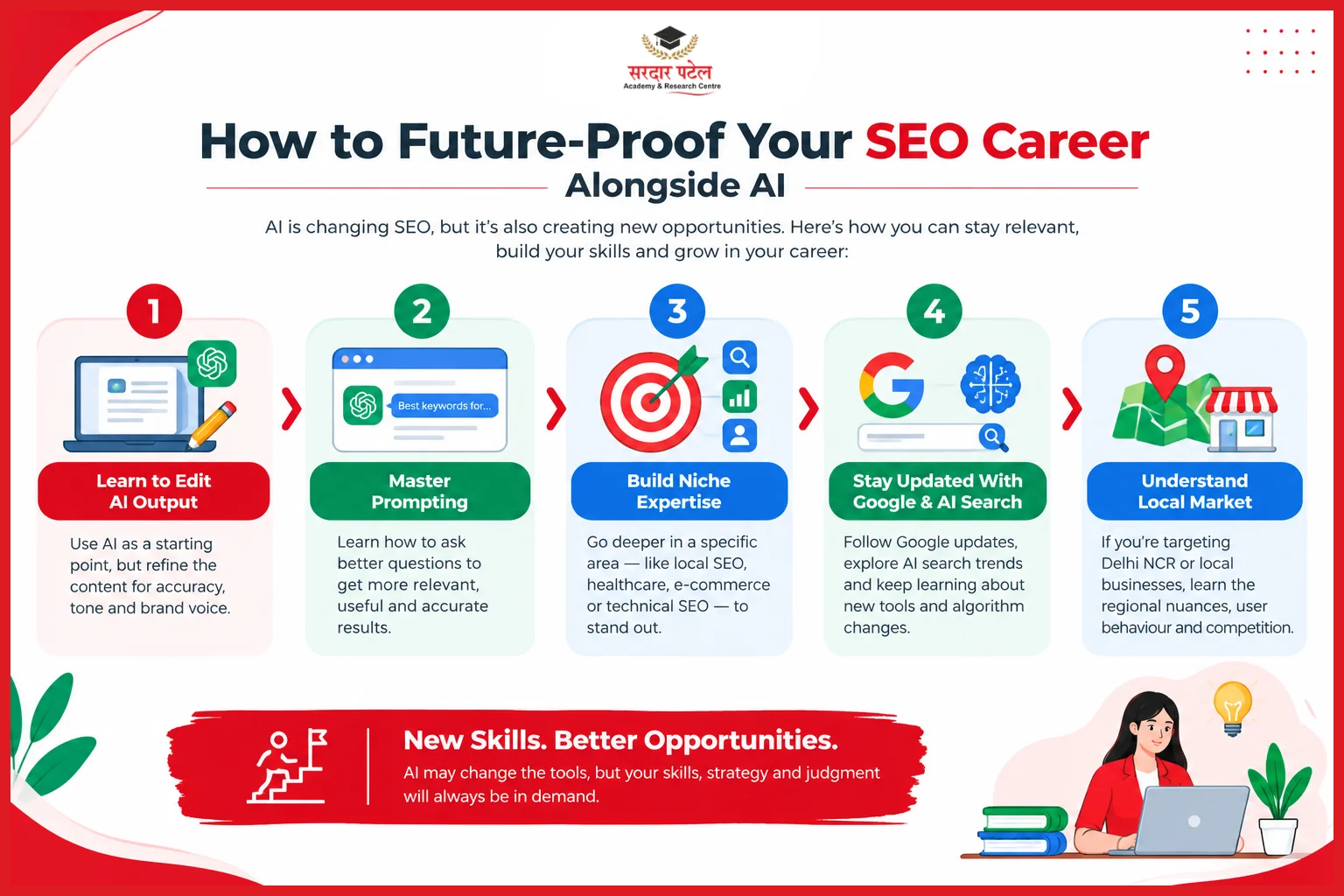
- Learn to edit, not just write. The ability to spot weak AI output and fix it is now a core SEO skill.
- Get hands-on with prompt engineering. Knowing how to ask AI tools for specific formats, tones, and structures saves hours.
- Build real expertise in one niche. Whether it's local SEO, e-commerce, or B2B content, deep knowledge is what AI can't replicate.
- Stay current with Google algorithm updates and changes to AI-powered search features such as AI Overviews.
- Understand the local market. For Delhi NCR businesses and learners, knowing regional search behaviour gives you an edge no chatbot has.
If you're wondering how these skills fit into a broader learning path, this connects closely to the trends covered in our piece on social media marketing fundamentals, since content and SEO strategy increasingly overlap with social discovery.
Pros and Cons of AI Tools in SEO Careers
Pros:
- Speeds up repetitive tasks (drafts, meta tags, outlines)Frees up time for strategy and analysis
- Lowers the entry barrier for beginners to start producing content
- Helps with idea generation when facing writer's block
Cons:
- Can produce factually incorrect or generic content if unchecked
- Doesn't understand local context or brand voice out of the box
- Risk of over-reliance leading to weaker editorial skills over time
- Cannot build genuine E-E-A-T signals on its own
Conclusion: Adapting, Not Competing
How ChatGPT is changing SEO careers ultimately comes down to this: the tools are automating tasks, not judgment. The professionals who'll do well over the next few years aren't the ones avoiding AI — they're the ones learning to direct it, question it, and combine it with real local and industry expertise.
If you're a student or working professional in Delhi NCR looking to build these skills properly, exploring a structured digital marketing course — one that treats AI literacy as core, not optional — is a practical next step.
Learn Future Ready SEO
Sardar Patel Academy & Research Centre (SPARC) — GTB Nagar, Delhi
Website: sparc.org.in | Phone: +91 93129-66129
Get in touch with our team.
FAQs
No. ChatGPT automates specific tasks like drafting and basic keyword grouping, but strategy, fact-checking, and local market understanding still require human professionals.
Search intent analysis, technical SEO audits, editorial judgment, internal linking strategy, and building E-E-A-T through real expertise remain firmly human-driven skills.
Yes. Beginners who understand SEO fundamentals can use AI tools far more effectively than those who rely on AI without foundational knowledge.
Roles in content, PPC, and social media are increasingly expecting comfort with AI tools, prompt writing, and data interpretation, rather than purely manual execution.
It can, but only when it's accurate, well-edited, and demonstrates real expertise. Google's systems are designed to reward helpful, trustworthy content regardless of how it was drafted.
Look for a curriculum that actively teaches AI-tool usage, prompt writing, and editorial skills, not just traditional SEO theory.