+91 9312966129
 sparc.enquiry01@gmail.com



What Does a GST Accountant Do? Complete Career Guide
What Does a GST Accountant Do? Explore daily responsibilities, GST filing, ITC, required skills, job profile and career opportunities in India.
Table of Contents
- What Does a GST Accountant Do? A Quick Answer
- GST Accountant Job Profile at a Glance
- GST Accountant Responsibilities in Detail
- 1. Checking invoices and tax treatment
- 2. Recording GST in accounting software
- 3. Managing input tax credit
- 4. Preparing and filing returns
- 5. Supporting e-invoicing and e-way bills
- 6. Reconciling books with GST data
- 7. Handling notices and department queries
- 8. Keeping records and following updates
- A Realistic Month in GST Work
- GST Accountant vs General Accountant
- Where GST Work Goes Wrong
- Records a GST Accountant Keeps Ready
- Skills Employers Expect in GST Roles
- How GST Fits with Tally and TDS
- Starting a Career in GST Work
- Conclusion: What Does a GST Accountant Do, and Is It a Good Fit?
If you have seen job listings asking for “GST experience” and wondered what that actually involves, you are not alone. Many students and freshers know GST as a tax printed on bills, but not as a full-time job.
So, what does a GST accountant do? In simple terms, a GST accountant makes sure a business records GST correctly on every sale and purchase, claims the tax credit it is entitled to, files returns on time and keeps its GST records ready for any check or notice.
This guide explains the daily work, the main GST accountant responsibilities, a realistic monthly routine, the places where GST work most often goes wrong, and the skills employers look for. It is written for students, job seekers, working accountants and small business owners.
What Does a GST Accountant Do? A Quick Answer
A GST accountant is an accounting professional who handles a business’s Goods and Services Tax work: invoice details, tax calculation, input tax credit, return preparation, reconciliation and compliance records.
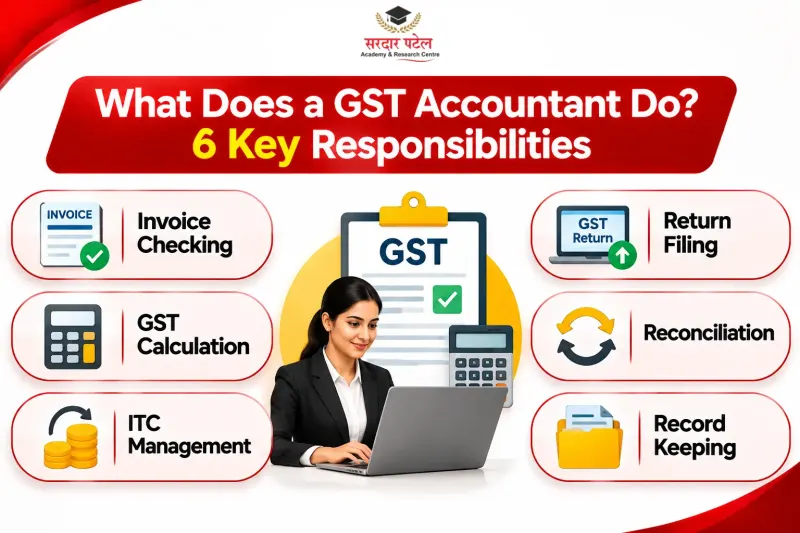
The usual GST work includes:
- Checking that invoices carry the correct GSTIN, tax rate and place of supply
- Recording sales and purchases with the right GST ledgers in accounting software
- Reconciling purchase data with what suppliers have reported
- Compiling financial data for monthly and quarterly GST return filing
- Tracking input tax credit and tax payable
- Supporting e-invoicing and e-way bill requirements where applicable
- Keeping records ready for audit, assessment or notices
Rates, thresholds and due dates change from time to time, so a good GST accountant always confirms current rules on the official GST portal before acting. That portal is also where the current late fee and interest rules for delayed returns are published.
GST Accountant Job Profile at a Glance
| Area |
Details |
| Main purpose |
Keep a business accurate and compliant under GST rules |
| Typical tasks |
Invoice checks, GST entries, ITC reconciliation, return data, notice support |
| Tools used |
Tally or similar software, Excel, GST portal, e-invoice and e-way bill systems |
| Works with |
Owner, accounts head, purchase and sales teams, CA or tax consultant |
| Common workplaces |
Traders, distributors, manufacturers, service firms, CA and tax offices |
| Common job titles |
GST executive, GST accountant, accounts and GST executive, tax assistant |
Titles vary a lot. In a small firm, the “accounts executive” may also be the GST person, while larger companies keep a separate indirect tax team.
GST Accountant Responsibilities in Detail
1. Checking invoices and tax treatment
Most GST problems start with a wrong invoice. The accountant checks the customer or supplier GSTIN, the HSN or SAC code, the tax rate, and whether the transaction is within the state or between states.
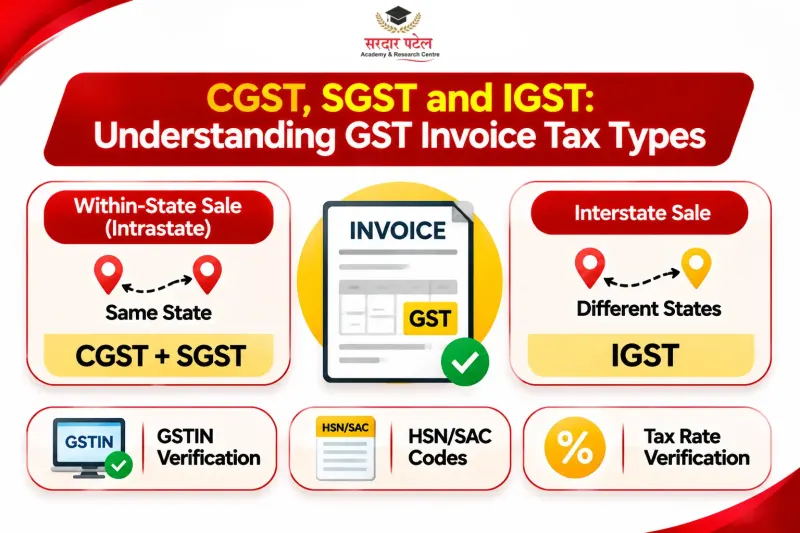
Example: A Delhi trader sells goods to a customer in Haryana. The accountant makes sure the invoice shows the right tax type for an interstate sale, not the one used for a local sale.
2. Recording GST in accounting software
Once the invoice is verified, the entry goes into software such as Tally with the correct GST ledgers. A clean entry now saves hours when returns are prepared. Purchases that attract reverse charge need special handling here, because the liability sits with the buyer and is easy to miss.
3. Managing input tax credit
Input tax credit lets a business reduce its GST payable by the tax it paid on eligible purchases. The GST accountant tracks this credit, checks eligibility, and compares the books with the supplier-reported data available on the GST portal.
A common finding: a supplier has not filed their return, so a purchase bill does not appear in the data. The accountant flags it and follows up before claiming the credit.
4. Preparing and filing returns
Depending on the business, the accountant prepares return data covering outward sales and tax liability, and records the tax paid. Some offices file directly; others prepare the data and the CA or consultant files it.
| Return or form |
General purpose |
Note |
| GSTR-1 |
Details of outward supplies (sales) |
Frequency depends on the taxpayer |
| GSTR-3B |
Summary return with tax payment |
Usually monthly; confirm current rules on the portal |
| GSTR-2B |
Auto-generated input credit statement |
Used to check ITC |
| GSTR-9 |
Annual return |
Taxpayers with aggregate turnover up to ₹2 crore are exempt from FY 2024-25 onwards (Notification 15/2025-Central Tax); larger taxpayers still file it |
| Composition scheme returns |
For eligible small taxpayers |
Different forms and rules apply |
The GSTR-9 exemption comes from a notification issued by the tax department. Since limits can be revised, confirm the latest position on the CBIC GST website before advising a client.
5. Supporting e-invoicing and e-way bills
For businesses covered by e-invoicing, the accountant ensures invoice details are ready for generating the invoice reference number. Under current notifications, e-invoicing applies to businesses whose aggregate turnover has crossed ₹5 crore in any year since 2017-18. For goods movement, they may also prepare e-way bill details. Because this limit has been lowered in stages before, check the e-invoice portal for the position that applies today.
6. Reconciling books with GST data
Before filing, the accountant compares sales and purchase totals in the books with the return figures. Small differences are common, such as timing gaps or missed bills, and it is better to find them before the department does.
7. Handling notices and department queries
If the GST department asks for clarification, the accountant gathers invoices, ledgers and proof of payment. Complex replies usually go through a CA or tax professional, but organised records make that process far smoother.
8. Keeping records and following updates
GST rules, notifications and due dates change. A reliable GST accountant keeps documents organised and tracks updates from official sources rather than relying on WhatsApp forwards.
A Realistic Month in GST Work
GST work follows a monthly rhythm built around return dates. Here is an illustrative cycle for an accounts and GST executive in a small trading firm.
| Period |
Typical work |
| Throughout the month |
Verify invoices and record sales, purchases, credit notes and debit notes |
| Before return dates |
Reconcile sales, check ITC against portal data, follow up on missing supplier bills |
| Return week |
Prepare return data, calculate tax payable, arrange payment, file or hand over to the CA |
| After filing |
Save acknowledgements, update records, note issues to fix next month |
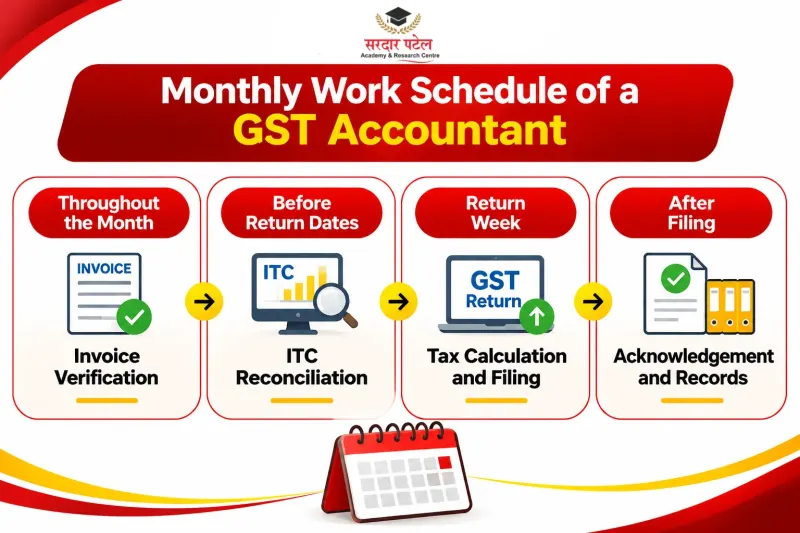
The busiest days fall around return deadlines. Weekly purchase reconciliation and a shared GST calendar keep those weeks manageable.
GST Accountant vs General Accountant
| Aspect |
GST accountant |
General accountant |
| Focus |
Indirect tax compliance and credit |
Overall books, reporting and finance support |
| Key outputs |
Return data, ITC reconciliation, tax records |
Ledgers, financial statements, bank and party reconciliations |
| Tools |
Tally, Excel, GST portal |
Tally, Excel, bank and tax portals |
| Overlap |
Often handles basic accounting too |
Often handles GST data in small firms |
In small firms, one person often does both, which is why employers like candidates who understand accounting and GST together. For the wider picture of accounting roles beyond tax, read what an accountant does across different roles.
Where GST Work Goes Wrong
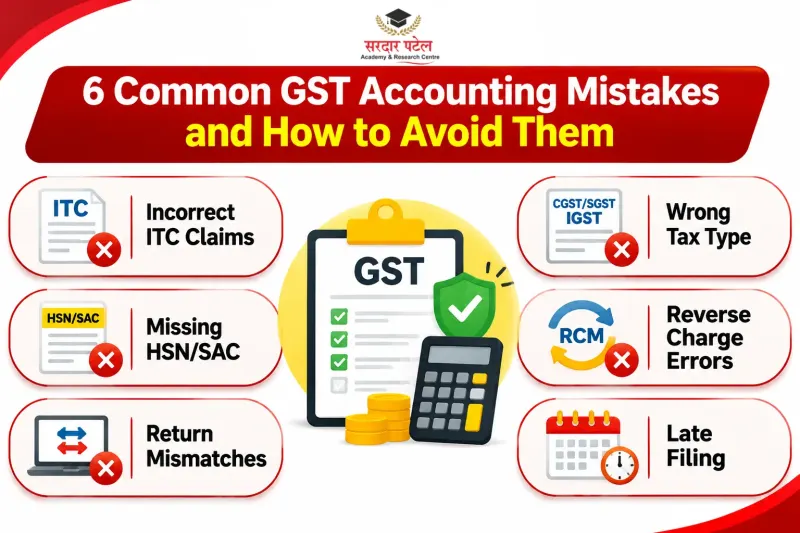
GST errors usually trace back to a handful of situations. Knowing them in advance is the fastest way to become useful in a GST role.
| Situation |
What goes wrong |
How a careful accountant prevents it |
| Credit claimed without checking |
ITC is taken on a bill the supplier never reported, and the credit is later disputed |
Match every purchase bill with the GSTR-2B statement before claiming |
| Local vs interstate confusion |
The invoice charges the wrong tax type because place of supply was misread |
Check the customer’s state and the supply location before the invoice is issued |
| Wrong or missing HSN/SAC |
The rate applied is incorrect and the return reporting is off |
Keep a master list of item codes and rates, reviewed whenever notifications change |
| Reverse charge missed |
Tax payable on certain purchases never reaches the return |
Flag such purchases at entry time instead of at return time |
| Books and returns disagree |
Sales in the ledger differ from sales reported, which invites questions |
Reconcile before filing and note the reason for every difference |
| Late filing |
Delay can bring fees and interest, and may block the next return |
Work back from the due date and keep payment funds ready early |
Records a GST Accountant Keeps Ready
A notice or assessment can arrive months after a return is filed, so records need to be easy to retrieve. A tidy GST file usually holds:
- Sales and purchase invoices with credit and debit notes
- Return acknowledgements and tax payment challans
- Monthly reconciliation sheets showing books versus portal data
- E-invoice and e-way bill details where they apply
- A short log of supplier follow-ups and corrections
When a reply needs legal interpretation, the file goes to a CA or tax professional. Having it ready is what makes their work faster. If tax advisory work interests you more than daily compliance, this guide on how to become a tax accountant in India shows how that path differs.
Skills Employers Expect in GST Roles
- GST fundamentals: registration, tax types, place of supply, ITC and return types
- Accounting basics: ledgers, vouchers, trial balance and reconciliation
- Software and Excel: entering GST correctly and checking data with lookups and filters
- Portal familiarity: logging in, downloading statements and reading return status
- Attention to detail: one wrong GSTIN or rate can trigger a mismatch
- Follow-up skills: chasing suppliers for missing filings or corrected invoices
- Ethics: reporting accurately even when a deadline is tight
These GST-specific skills sit on top of the general ones fresher candidates are expected to show. The broader checklist is covered in accounting skills employers look for in freshers.
How GST Fits with Tally and TDS
GST rarely appears alone in a job description. Most employers want someone who can record transactions in software, handle GST data and also understand tax deducted at source. This is why many job seekers study the three together, a point explored in Tally + GST + TDS: the best skill combination for accounting jobs.
If your day-to-day work will be mostly data entry, this guide stays on tax compliance. Larger companies sometimes ask about ERP tools as well, and Tally vs. SAP: which is better for an accounting career helps you decide where to invest your time.
Starting a Career in GST Work
The route is straightforward: build accounting basics, practise GST entries in software, learn the return types, and rehearse reconciliation on sample data before touching live filings.
Delhi NCR has a mix of traders, distributors, small factories, service firms and CA offices, all of which need GST support. Employers tend to favour candidates who can demonstrate hands-on skills over theory alone. Pay depends on the role, employer and your skills, so compare current listings before negotiating.
Conclusion: What Does a GST Accountant Do, and Is It a Good Fit?
To sum up what a GST accountant does: they verify invoices, record tax correctly, manage input credit, prepare return data, reconcile books with GST records and keep a business ready for scrutiny. It is careful, rule-based work that suits people who like accuracy and structure.
If you want to move in this direction, build your accounting base, practise Tally and Excel, learn GST concepts properly, and work on sample data until reconciliation feels natural. Employers want to see what you can actually do.
| Ready to build job-ready skills? Learn GST filing, Tally Prime, TDS and more with hands-on training at Sardar Patel Academy & Research Centre through the E-Accounting Course (E-DAFA), a 12-month programme that includes a dedicated GST e-filing module. |
FAQs
A GST accountant checks invoices, records GST in the books, tracks input credit, reconciles purchases with portal data and prepares return information. Near deadlines, they also calculate tax payable and arrange payment.
The main ones are invoice verification, GST entries, ITC reconciliation, return preparation, e-invoice and e-way bill support, record keeping and help with notices or audits.
No. Many accounts executives and tax assistants handle day-to-day GST work. CAs and tax professionals usually take over advisory matters, complex disputes and certain formal work.
Not always. Some offices use Tally, others use Busy or another package, so check what the listing asks for. Knowing how to record and report GST in at least one accounting package is a strong advantage.
Yes. Freshers often start as accounts assistants or junior GST executives. Practical training in accounting, Tally and GST, plus clear fundamentals, helps you stand out.
GST deals with indirect tax on supply of goods and services, with regular returns and credit tracking. Income tax work deals with tax on income, with annual computations and different rules and forms.
It can be around return deadlines, but good planning, monthly reconciliation and organized records reduce last-minute pressure.