+91 9312966129
 sparc.enquiry01@gmail.com


Why AI + Digital Marketing Professionals Are in Demand
Discover why AI digital marketing jobs are rising fast, what skills employers want, and how to prepare for AI-driven marketing careers.
Table of Contents
- What's Actually Changing in Digital Marketing?
- Why AI Digital Marketing Jobs Are Growing
- Businesses Want Speed Without Losing Quality
- Budgets Are Shifting Toward Performance Marketing
- Content Volume Has Exploded
- Data Analysis Has Become Non-Negotiable
- Skills That Actually Matter Right Now
- Common Mistakes People Make While Trying to Break Into This Field
- AI Skills vs. Traditional Marketing Skills: Where Do You Start?
- What This Means If You're in Delhi NCR
- How to Prepare for AI-Driven Marketing Roles
- Conclusion
If you've been scrolling job portals lately, you've probably noticed something: almost every digital marketing listing now mentions AI tools somewhere in the requirements. That's not a coincidence. AI digital marketing jobs have moved from a niche specialization to something recruiters actively search for, and the shift has happened faster than most people expected.
This isn't about AI replacing marketers — it's about a new kind of marketer emerging: one who understands strategy and knows how to work alongside AI tools to execute faster and smarter. Whether you're a student picking a career path, a working professional wondering if you need to upskill, or a business owner trying to make sense of your hiring plan, this article breaks down why this shift is happening, what skills actually matter, and how to position yourself for it.
What's Actually Changing in Digital Marketing?
Digital marketing has always evolved — from SEO to social media to programmatic ads. What's different this time is the speed. AI tools have compressed tasks that used to take days into hours: drafting ad copy, analyzing campaign data, generating content briefs, or building audience segments.
Beyond individual tasks, businesses are also using AI more strategically to improve their marketing and use AI to grow their brand across content, campaigns, and customer engagement.
This has created two effects at once:
- Routine, repetitive tasks are being automated — basic reporting, first-draft copywriting, keyword clustering.
- Strategic, judgment-heavy roles are becoming more valuable — campaign strategy, brand positioning, and interpreting what the data actually means for the business.
The result is a hiring pattern where companies want fewer generalists doing manual work and more professionals who can direct AI tools toward business outcomes.
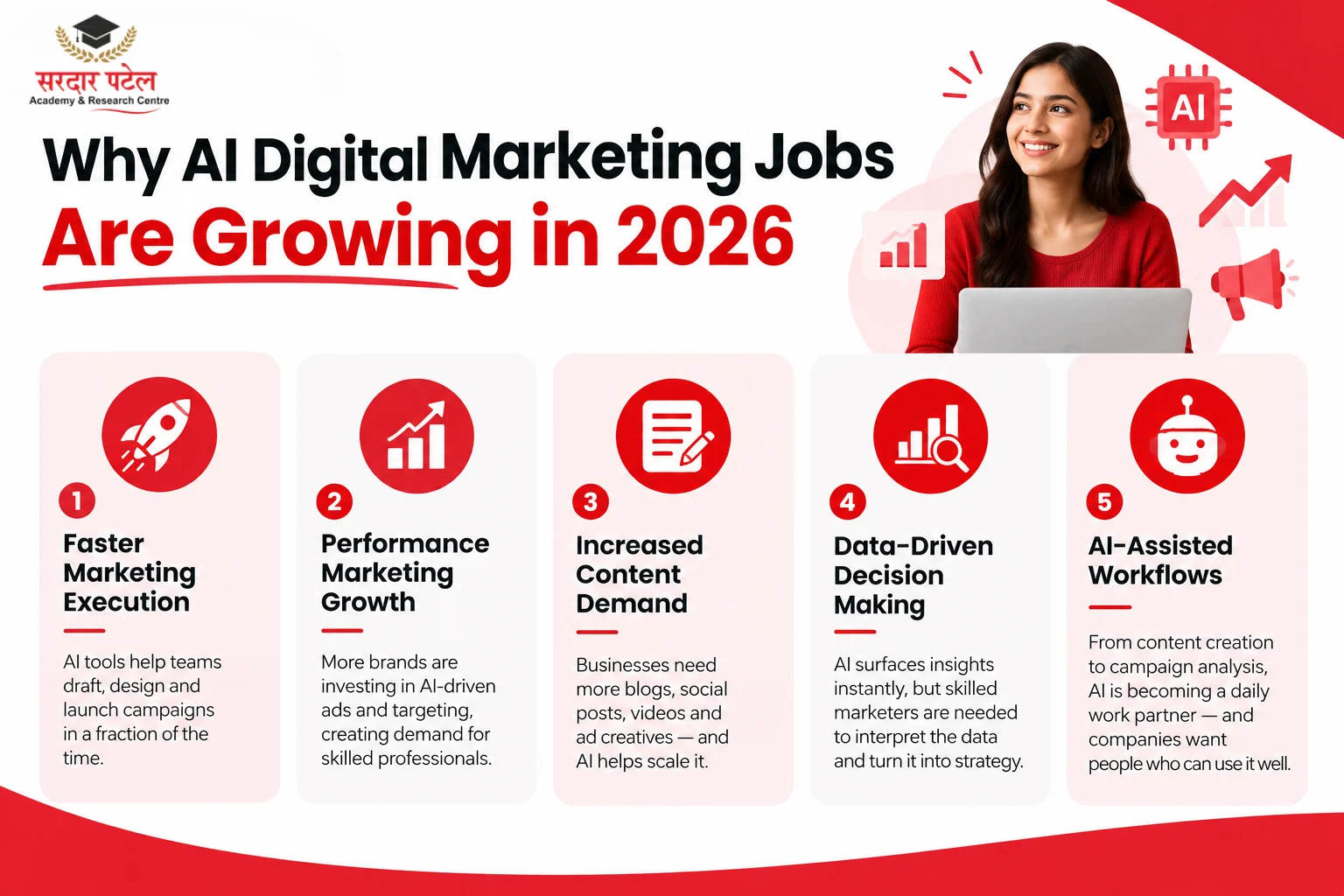
Why AI Digital Marketing Jobs Are Growing
Businesses Want Speed Without Losing Quality
Marketing teams are under pressure to produce more content, more ad variations, and more campaigns — without proportionally increasing headcount. AI tools help teams move faster on execution, but someone still needs to review, refine, and strategically direct that output. That's where trained professionals come in.
Budgets Are Shifting Toward Performance Marketing
Paid channels like Google Ads and Meta Ads increasingly rely on AI-driven bidding, targeting, and creative testing. Professionals who understand how these systems work — not just how to click "publish" — are better equipped to manage budgets effectively and explain results to clients or leadership.
Content Volume Has Exploded
Blogs, social posts, email sequences, video scripts — brands need more content than ever to stay visible. AI tools in digital marketing career paths now commonly include using generative tools for first drafts, then applying human editing, SEO judgment, and brand voice on top. Companies are hiring for that hybrid skill, not pure manual writing.
If you're exploring where these skills can lead professionally, understanding the different digital marketing job roles can help you choose a career direction.
Data Analysis Has Become Non-Negotiable
Reading a dashboard is not the same as knowing what action to take from it. AI tools can surface patterns in customer behaviour or campaign performance almost instantly, but interpreting those patterns for a specific business context still needs a trained professional.
Skills That Actually Matter Right Now
Instead of chasing every new AI tool that launches, focus on skills that stay relevant no matter which tool becomes popular next.
For beginners building a foundation, it also helps to understand the core digital marketing skills typically developed through structured training.
| Skill Area |
Why It Matters |
Example Application |
| Prompt writing & AI tool literacy |
Getting useful output from AI tools requires clear, structured input |
Drafting a content brief that an AI tool can turn into a usable first draft |
| SEO fundamentals |
AI-generated content still needs to rank; SEO judgment doesn't get automated away |
Structuring headings, internal links, and search intent alignment |
| Campaign data interpretation |
Tools generate reports; humans decide what to do next |
Adjusting targeting after spotting a drop in click-through rate |
| Ad platform management (Google Ads, Meta Ads) |
Automation handles bidding, but strategy and budget decisions are still manual |
Setting campaign goals that align automated bidding with business targets |
| Content editing & brand voice |
AI drafts need refinement to sound human and on-brand |
Rewriting AI-generated copy to match a specific tone of voice |
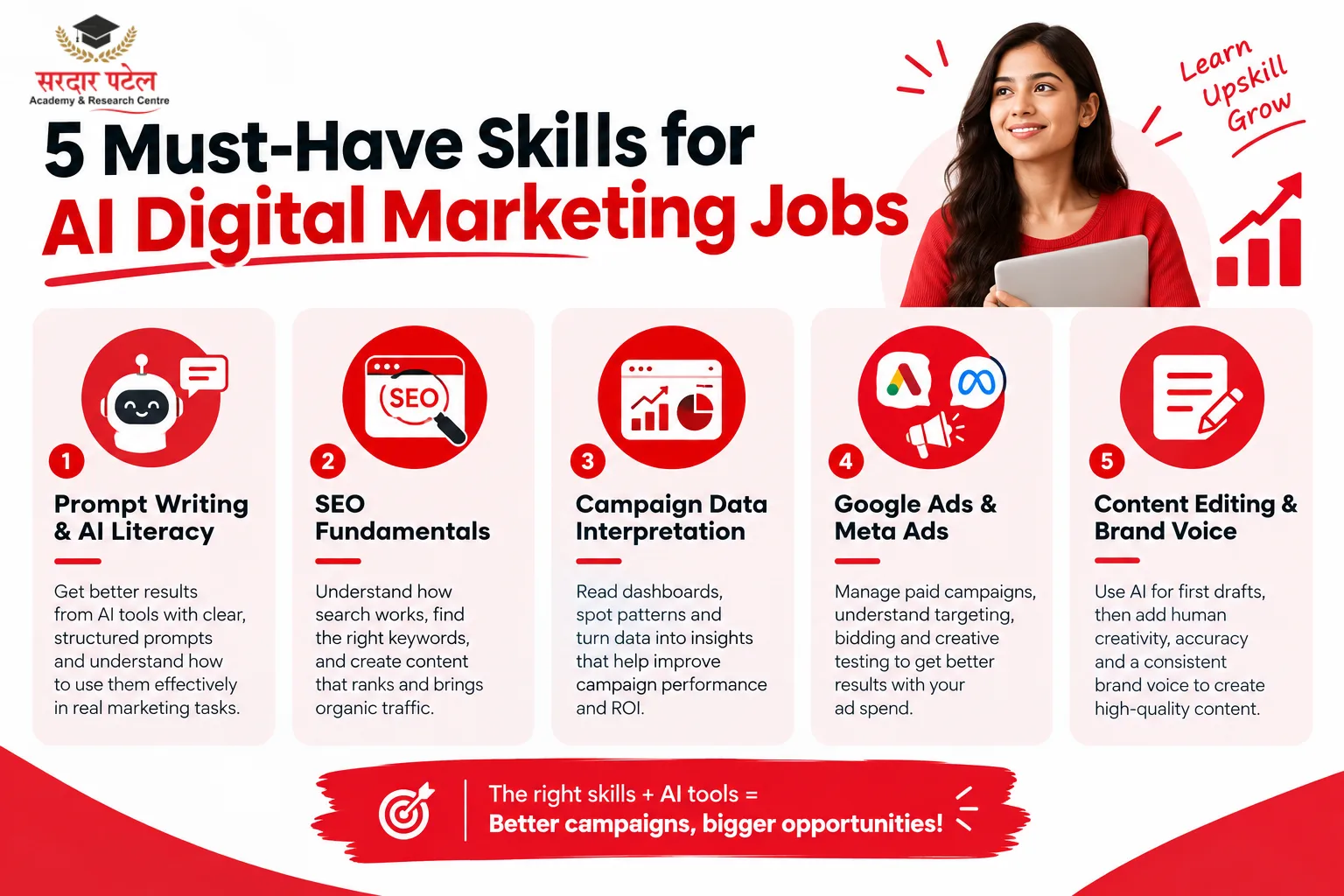
Future marketing skills aren't about becoming a programmer or data scientist overnight. They're about becoming comfortable enough with AI-assisted workflows that you can supervise, correct, and improve on what the tools produce.
Common Mistakes People Make While Trying to Break Into This Field
- Only learning tool operation, not strategy. Knowing which buttons to click in a tool has a short shelf life — tools change, strategy thinking doesn't.
- Ignoring the basics of SEO and analytics while chasing every new AI tool. Fundamentals still decide whether a campaign or piece of content actually works.
- Assuming AI replaces the need to write well. Editing AI output still requires strong writing and language judgment.
- Not building a portfolio. Employers want to see applied work — a mock campaign, a content audit, or a small SEO project — not just a list of tools you've used.
AI Skills vs. Traditional Marketing Skills: Where Do You Start?
| Traditional Marketing Skills |
AI-Augmented Marketing Skills | |
| Focus |
Manual execution (writing, scheduling, reporting) |
Directing AI tools + reviewing output |
| Learning curve |
Slower to see results, deeper foundational knowledge |
Faster execution, but needs strategic oversight |
| Risk if skipped |
Missed foundational understanding |
Slower output, higher manual workload |
| Best approach |
Learn both together |
Learn both together |
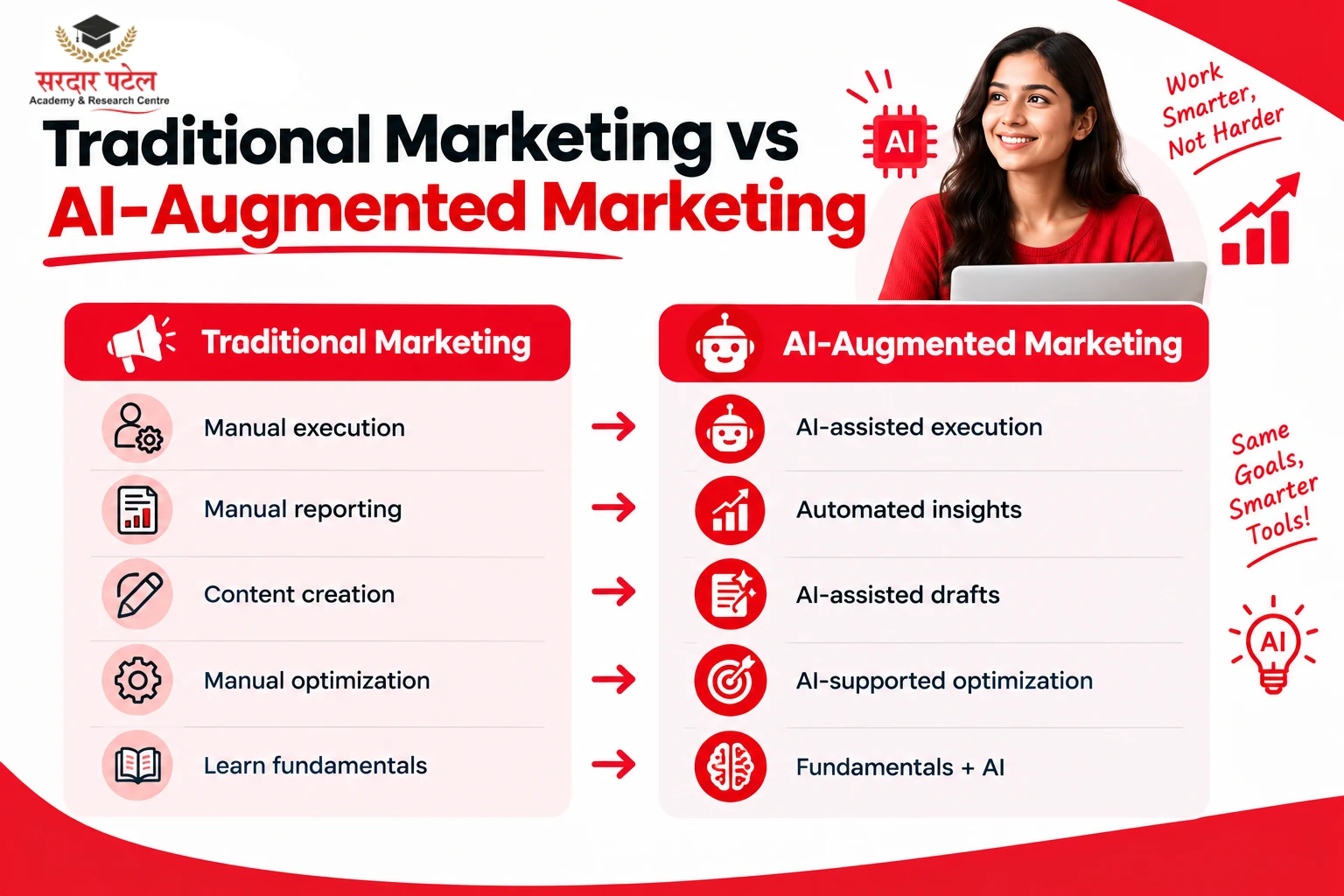
The honest answer is that you don't need to choose one over the other. Employers are looking for professionals who combine solid marketing fundamentals with comfort using AI tools — not people who've replaced one skill set with the other.
What This Means If You're in Delhi NCR
The Delhi NCR job market for digital marketing has always been active, thanks to the density of startups, agencies, and D2C brands headquartered in and around the city. What's changed recently is that job descriptions from these companies increasingly mention "AI tools," "automation familiarity," or "prompt-based content workflows" alongside standard requirements like SEO or Google Ads.
For students and early professionals based in areas like GTB Nagar or elsewhere in Delhi, this is a practical signal: structured training that combines core digital marketing skills with AI tool literacy is becoming more directly tied to employability, rather than being an optional add-on.
If you're exploring how to build this combination of skills, SPARC's digital marketing course focuses on practical, tool-integrated learning rather than theory alone.
How to Prepare for AI-Driven Marketing Roles
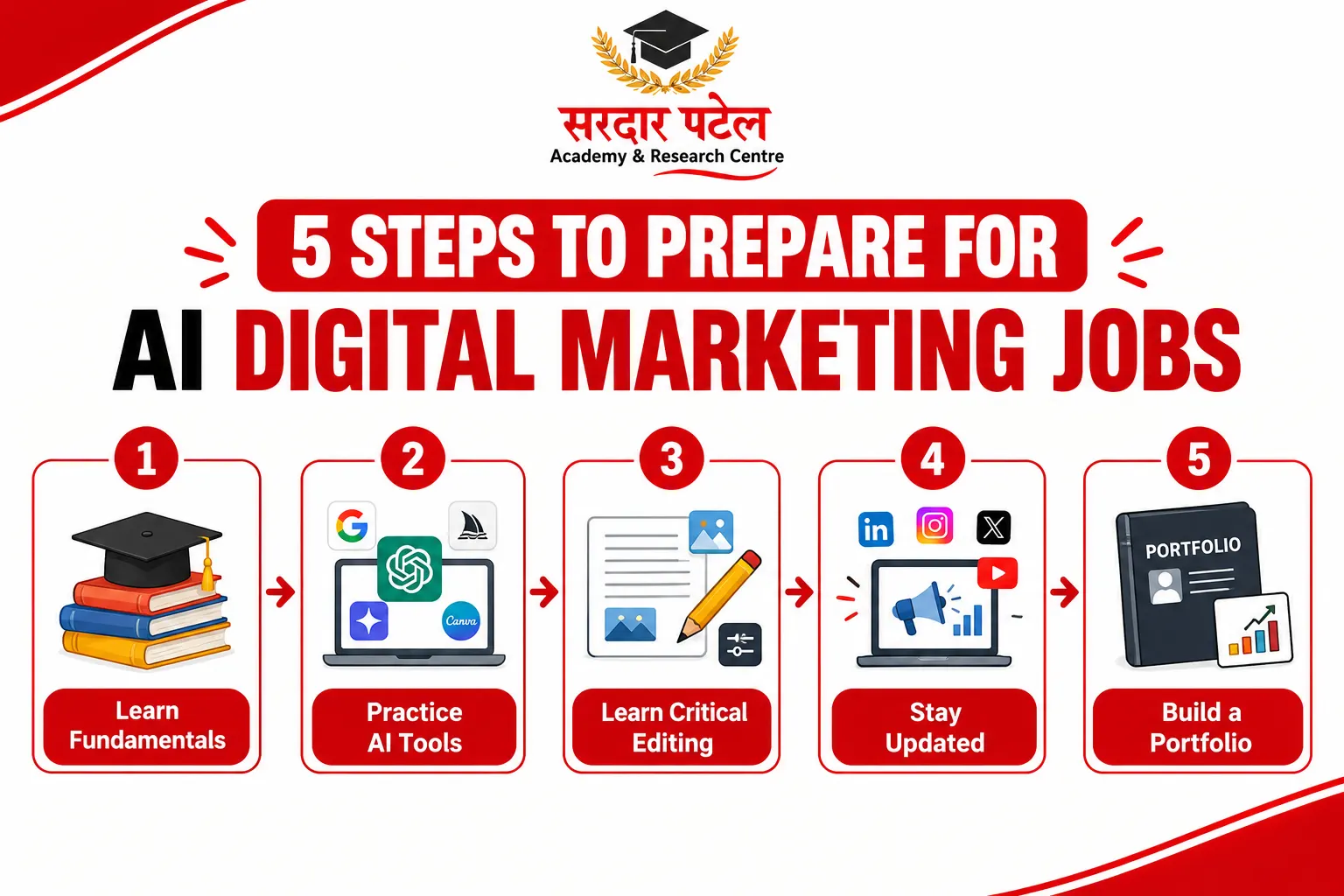
- Start with fundamentals — SEO, content structure, ad platform basics — before layering AI tools on top.
- Practice with real tools on small projects: write a content brief, run a mock ad campaign, do a basic SEO audit.
You can also explore practical AI tools for marketers such as Canva and ChatGPT to understand how they fit into everyday marketing workflows. - Learn to edit critically. Treat AI output as a first draft, not a finished product.
- Stay current — this space changes quickly, so following industry updates matters more here than in many other career paths.
- Build a portfolio that shows applied skills, not just certificates.
You might also find it useful to explore related topics such as social media trends, Google Ads automation, and the future of voice search SEO, since these shifts are connected to the same underlying pattern.
Conclusion
The demand for AI digital marketing jobs isn't a passing trend — it reflects a genuine shift in how marketing work gets done. Businesses need people who can combine solid fundamentals with comfort using AI tools, rather than choosing one over the other. If you're building your career in this space, the smartest move is to strengthen your core marketing skills first, then layer AI tool literacy on top through hands-on practice.
If you'd like structured, practical guidance on building both skill sets together, you can explore SPARC's training programs to learn AI-powered marketing in a hands-on setting.
Learn AI Powered Marketing at Sardar Patel Academy & Research Centre (SPARC) | GTB Nagar, Delhi
sparc.org.in | +91 93129-6612
FAQs
These are roles — such as SEO specialist, content marketer, or performance marketing executive — where professionals use AI tools alongside traditional marketing skills to plan, create, and optimize campaigns more efficiently.
No. Most AI tools used in marketing are built for non-technical users. What matters more is understanding marketing strategy and being able to direct tools effectively.
Unlikely in the near term. AI is automating specific tasks, not entire roles. Professionals who can supervise, edit, and strategise around AI output remain in demand.
Rather than focusing on one specific tool, beginners benefit more from understanding categories: content generation tools, ad automation features within platforms like Google Ads and Meta Ads, and basic analytics tools.
No. Small businesses and startups often adopt AI tools faster than larger companies because of limited budgets and smaller teams, making these skills valuable across company sizes.
This varies by individual and prior experience. The timeline depends on the specific training program, the skills being learned, and how consistently you practise applying them in real-world marketing tasks.
Certifications can support your profile, but employers generally place more weight on demonstrated, practical skills and portfolio work.
Yes. Most successful digital marketers come from varied academic backgrounds; what matters more is willingness to learn tools and apply marketing fundamentals consistently.