+91 9312966129
 sparc.enquiry01@gmail.com



AEO vs SEO: What Is the Difference and Which Matters More in 2027?
AEO vs SEO explained: Learn the key differences, how AI search is changing SEO, and which strategy matters more for better visibility in 2027.
Table of Contents
Ask any marketing team what changed in search this year, and you will hear one story: people get answers without clicking- the so-called zero-click search. Google’s AI Overviews and AI Mode, ChatGPT’s search feature and Microsoft Copilot now write a reply instead of listing ten links. So the AEO vs SEO question has moved from conference slides to real budget meetings. Voice search is another part of this shift. Explore how the future of voice search SEO in India may influence the way businesses optimise their websites.
This AEO vs SEO comparison covers what each approach does, where the two overlap, and how to split your effort as 2027 approaches. Platform claims are linked and were checked in October 2026.
What SEO and AEO Each Mean
SEO in plain terms
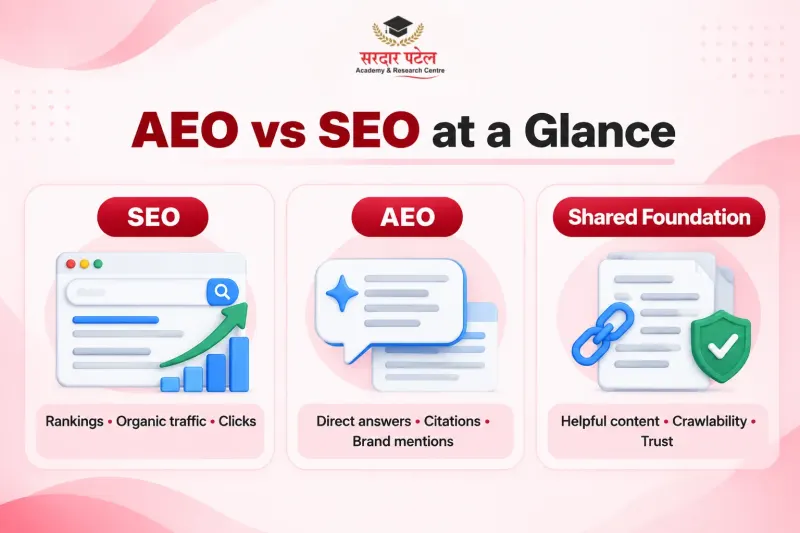
Search engine optimisation is the work of making pages easy to crawl, understand and rank, so people land on them after typing a query. It covers technical health, content quality, internal links and trust signals. Success is counted in rankings, organic visits and conversions.
AEO in plain terms
Answer engine optimisation, or AEO, shapes content so that a system giving direct answers can lift your explanation and, ideally, credit you. That system might be an AI summary, a voice assistant or a chatbot with live search. Success looks different: being cited or named, not only being ranked.
None of this began with chatbots. Featured snippets have long pulled a short answer to the top of a results page. Generative AI made that behaviour the main event.
Where AI search optimisation fits
AI search optimisation is the wider umbrella: work aimed at being found and cited in AI-generated answers. This approach is also known as Generative Engine Optimisation (GEO). AEO is the answer-focused part.
AEO vs SEO: Side-by-Side Comparison
Here is how AEO vs. SEO looks across the factors that matter most.
| Factor |
SEO |
AEO |
| Main goal |
Rank pages and earn clicks |
Be the source behind a direct answer |
| Typical query |
Short or mid-length keywords |
Full questions, comparisons, follow-ups |
| Success signals |
Rankings, organic sessions, conversions |
Citations, brand mentions, referral visits |
| Technical focus |
Crawlability, speed, internal links |
The same base, plus access for each platform’s crawler |
| main goal | Rank pages and earn clicks | Be the source behind a direct answer |
| Typical query | Short or mid-length keywords | Full questions, comparisons, follow-ups |
| Success signals | Rankings, organic sessions, conversions | Citations, brand mentions, referral visits |
| Google’s own view |
The core of how Search works |
Still SEO, in Google’s words |
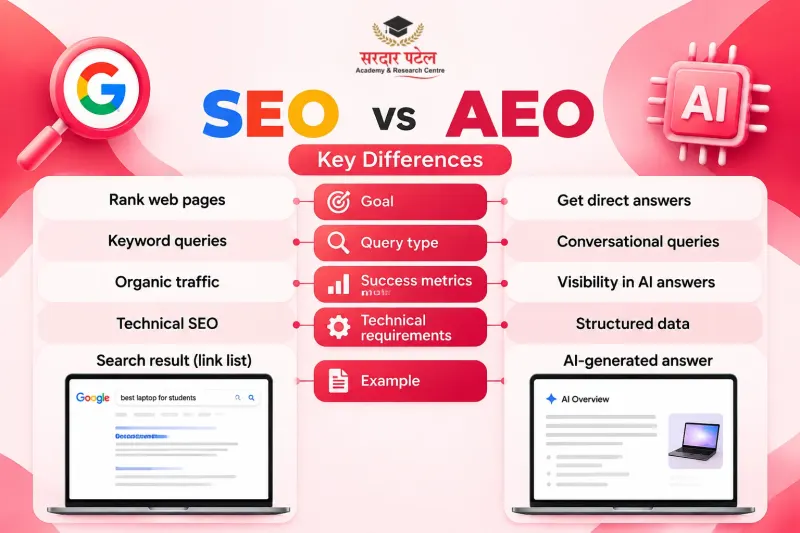
Most of the AEO column depends on the SEO column. That is the first lesson in the SEO vs AEO debate: they are layers of one job, not rival departments fighting over one budget.
Google’s generative AI guide goes further than many people expect. From Search’s perspective, optimising for generative AI search means optimising the search experience, so it is still SEO. Its AI features page adds that pages need only be indexed and snippet-eligible to appear as supporting links.
How AI Search Changes the Picture
Google says its AI features use “query fan-out”, issuing several related searches before composing a reply. In Google’s example, a weedy-lawn question spins off searches on herbicides, chemical-free removal and prevention. A page covering those neighbouring questions has more ways to be retrieved. This shift extends beyond Google, as ChatGPT, Gemini and Perplexity are changing online search by helping users discover information through conversational answers.
The AEO vs SEO conversation gets interesting because platforms do not fully agree on structure. Google says you do not need to break content into tiny pieces for AI. Microsoft’s advertising blog recommends clear headings, direct questions with plain answers, and keeping key details out of tabs and expandable menus, since AI systems may not render hidden content. Clean sections with an answer under each heading satisfy both camps.
Access matters too. OpenAI’s documentation names OAI-SearchBot as the crawler that surfaces sites in ChatGPT search. Sites that opt out will not be shown in its answers, though they can still appear as plain links. It is separate from GPTBot, which concerns model training. A robots.txt file written years ago can quietly decide your AI search optimisation results.
To improve your website’s chances of appearing in AI-generated answers, learn how to make your website visible in AI search results through crawlability, useful content and clear page structure.
Which One Matters More in 2027?
Nobody can responsibly promise a split for 2027, and exact percentages are guesswork. The evidence supports a division of roles instead. SEO decides whether you are eligible and trusted. AEO decides whether you become the answer rather than one result among many. In the AEO vs SEO choice, the better question is which layer is weaker on your site today. For businesses adapting to AI-powered search, an important question remains: does traditional SEO still matter in the age of AI search? Understanding the role of technical SEO and content quality helps answer it.
- New site with little traffic: start with SEO. Unindexed or untrusted pages give an answer engine nothing to use.
- Ranking well but clicks are flat: add AEO effort to your best pages: clearer answers, more original detail.
- Audience on several assistants: check that Googlebot, OAI-SearchBot and Bing can all reach your pages.
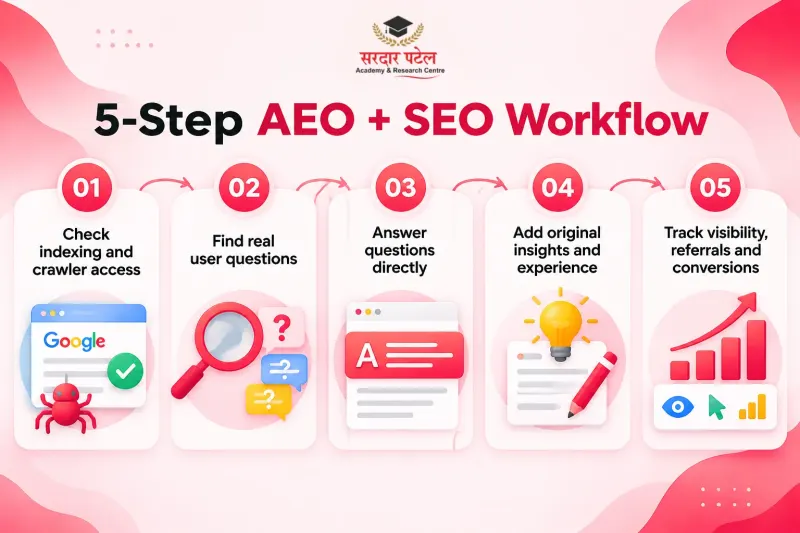
A Practical Workflow for AEO vs SEO
- Confirm the basics. In any AEO vs SEO plan, key pages must be indexed, snippet-eligible, and not blocked from wanted crawlers by robots.txt, a CDN or a firewall.
- Collect real questions. List the what, why, how much and X-versus-Y questions behind your keywords, using sales calls and support emails. Understanding how AI is changing keyword research in 2027 can also help you identify conversational queries and related search intents.
- Answer first, explain after. For “Is AEO different from SEO?”, a weak opener says: “There are many views, and the landscape keeps changing.” A stronger one says: “Mostly in emphasis, not foundations. Both need helpful, indexable pages; AEO adds weight to being quotable.” Then add depth.
- Add something only you can say. Google’s people-first content guidance and its AI guide both favour original, experience-based work over restated common knowledge. Students and aspiring SEO professionals should also stay informed about the latest Google SEO updates. Students must learn to understand how search guidelines and optimisation practices evolve.
- Measure beyond rankings. Google’s guide points to the Generative AI performance report in Search Console. Pair it with branded searches and referral data. Reading that well is a skill of its own, which is why many marketers pair SEO with data analytics training.
Independent marketers may also like our piece on the future of freelancing in digital marketing.
Common Mistakes to Avoid
- Treating AEO as a replacement. The most common AEO vs SEO error is dropping SEO, the foundation answer engines rely on.
- Publishing a page per question variation. Google warns that doing this mainly to manipulate AI answers breaches its scaled content abuse policy.
- Chasing “hacks.” Many AEO vs SEO shortcuts are noise: for Google Search, its guide says llms.txt files, tiny content chunks and inauthentic mentions can be ignored.
- Blocking crawlers by accident. A broad robots.txt rule meant for scrapers can also shut out search crawlers, and a citation that builds brand recall never shows up as a session.
Conclusion
The AEO vs SEO debate gets easier once you stop treating it as a contest. SEO makes your pages findable and credible. AEO makes their best answers easy to quote. In 2027, the sites that do well will most likely be those that do both, with original substance behind every answer. Start by checking your basics, then rewrite your five key pages so each question gets a direct answer. As SEO continues to evolve with AI-powered search, learners may also want to explore whether digital marketing is a good career in 2026 and which skills employers value.
If you want a structured way to build these skills, you can learn Modern SEO with Sardar Patel Academy & Research Centre.
FAQs
SEO aims to rank your pages and earn visits. AEO aims to make your content the source of a direct answer.
No. Google describes optimizing for its AI search as still SEO, and indexing is a prerequisite.
Google says no special schema.org markup is required. Accurate structured data can still help with rich results.
Not really. Use SEO to be findable and trusted, then AEO to make key pages easy to quote.
SEO usually comes first, because a small site must be indexed and trusted before answer engines can use it.