+91 9312966129
 sparc.enquiry01@gmail.com



What Is Answer Engine Optimization (AEO)? Complete Guide for 2027
Learn what answer engine optimization (AEO) means, how it differs from SEO, and a step-by-step AEO strategy to get cited in AI answers. Read the 2027 guide.
Table of Contents
- What Is Answer Engine Optimisation (AEO)?
- How Answer Engines Produce an Answer
- AEO vs SEO vs GEO: What Is the Difference
- Why AEO Matters for Learners and Businesses in Delhi NCR
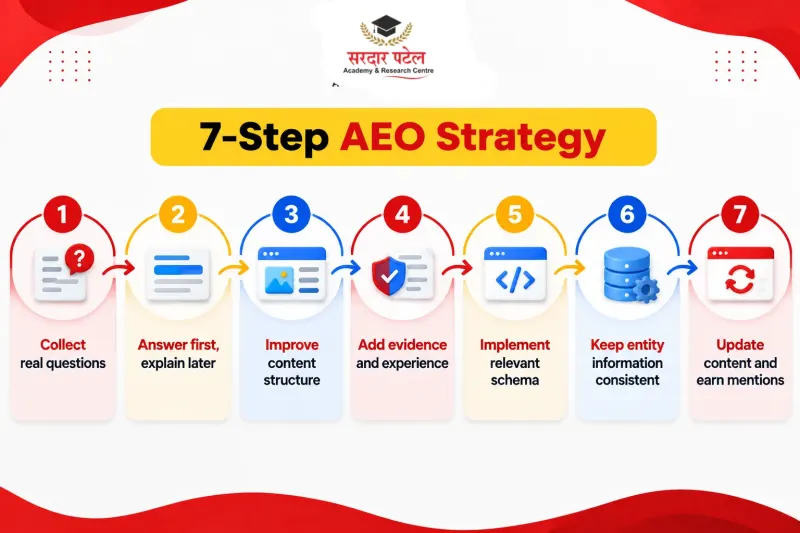
- A Practical 7-Step Approach to Answer Engine Optimisation
- Step 1: Collect the real questions
- Step 2: Answer first, explain after
- Step 3: Structure the page for extraction
- Step 4: Show evidence and real experience
- Step 5: Add structured data where it fits
- Step 6: Make your entity clear and consistent
- Step 7: Keep it fresh and earn mentions
- Worked Example: Rewriting a Page for Answer Engines
- Content Formats That Work Well for AEO
- Technical Basics You Should Not Skip
- Common AEO Mistakes to Avoid
- How to Measure AEO Progress Honestly
- AEO Pros and Cons
- Skills Worth Building if You Want an AEO Career
- Final Thoughts on Answer Engine Optimisation
Ask a question on your phone today, and you often get a written answer before you see a single blue link. Google’s AI Overviews, ChatGPT, Perplexity, Microsoft Copilot and voice assistants all work this way. They read, compress and respond.
If you create content, run a business or are learning digital marketing, that shift raises an uncomfortable question. When the answer appears above the results, who gets the credit, and who gets the click?
This guide explains answer engine optimisation from the ground up. You will learn what it means, how it differs from traditional SEO, a practical seven-step approach, the mistakes that waste effort, and how to track progress honestly. It is written for beginners, students and working professionals, with examples that make sense in Delhi NCR.
What Is Answer Engine Optimisation (AEO)?
In one line: AEO is the practice of shaping your content so that search engines, AI assistants and voice tools can understand it, trust it and use it as the direct answer to a question.
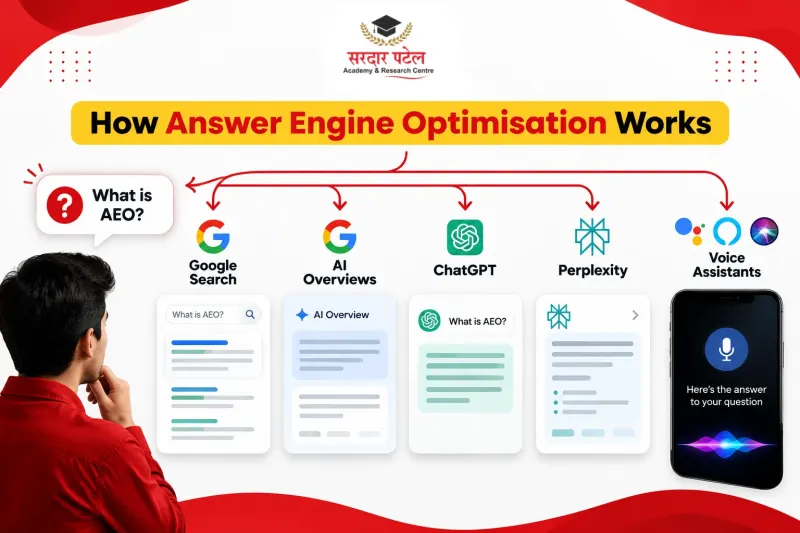
An “answer engine” is any system that responds to a question with an answer instead of only a list of pages. Common examples include:
- Google featured snippets, AI Overviews and AI Mode
- AI chat tools with web access, such as ChatGPT and Perplexity
- Microsoft Copilot
- Voice assistants on phones and smart speakers
Traditional SEO asks, “How do I get my page to rank?” AEO asks, “How do I get my explanation chosen?” This shift also makes it important to understand how voice search SEO could evolve in India, especially as people increasingly ask questions in natural, conversational language.
The idea is not entirely new. Featured snippets and voice search pushed marketers toward short, direct answers years ago. What changed is that generative AI made answers longer, more conversational and far more common.
One note on terminology: you will see “AEO” and “GEO” (generative engine optimisation) used almost interchangeably. People draw the line in different places, so check how a source defines each term before you compare advice.
How Answer Engines Produce an Answer
The exact systems differ by product, but the broad flow looks like this:
- Understand the question. The engine works out intent, which is often phrased as a full conversational sentence.
- Find candidate sources. It pulls pages, structured data and knowledge sources that might help.
- Extract relevant passages. It looks for the specific lines that address the question.
- Compose the response. It writes a summary, sometimes with citations or links.
Nobody outside these companies knows the precise selection signals, and they change often. You can observe that clear, well-organised, consistent, and credible pages are easier to extract from. To keep your strategy aligned with search changes, review the latest Google SEO updates that digital marketing students should understand.
AEO vs SEO vs GEO: What Is the Difference
| - | SEO |
AEO |
GEO |
| Main goal |
Rank pages in results |
Be chosen as the answer |
Be included in AI-generated responses |
| Typical win |
A click from a ranking |
A snippet, citation or mention |
A mention inside an AI summary |
| Content style |
Comprehensive pages |
Direct answer first, depth after |
Clear, quotable, evidence-backed |
| Unit that matters |
The page |
The passage |
The brand or entity |
| Usually measured by |
Rankings, organic traffic |
Answer-feature visibility, branded searches |
Mentions across AI tools |
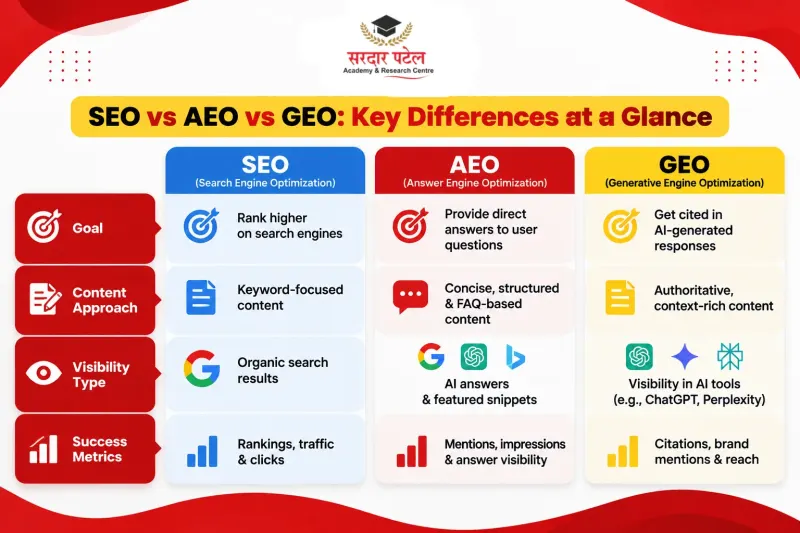
AEO builds on traditional SEO rather than replacing it. If you are wondering whether traditional SEO still matters as AI-powered search grows, the answer is yes: crawlability, relevance and credibility remain important foundations for search visibility. If you are still learning the basics, begin with our beginner-friendly guide to understanding SEO and how it works, written for students who want to build a strong foundation before exploring AEO.
Why AEO Matters for Learners and Businesses in Delhi NCR
Think about how people around GTB Nagar, Kamla Nagar and Mukherjee Nagar actually search. A student types a long, specific question into their phone between classes. A shop owner in North Delhi asks a voice assistant how to get more reviews. A fresher compares career paths on the metro ride home.
All of these are question-shaped searches. They are exactly the kind that answer engines handle first. To understand the bigger shift, explore how ChatGPT, Gemini and Perplexity are reshaping the way people discover information online.
For businesses, this changes what visibility means. Being the page that gets quoted can build trust even when the user never scrolls further. For learners, understanding this shift is becoming part of the job. If you want context on how AI skills are reshaping marketing roles, read [why AI-skilled digital marketing professionals are in demand].
Discovery also happens outside search engines. Platform algorithms decide what gets surfaced too, as we covered in [our note on Instagram’s algorithm changes]. The principle is the same: make your content easy to understand and worth recommending.
A Practical 7-Step Approach to Answer Engine Optimisation
Here is a working SEO strategy you can apply to a new article or an existing page.
Step 1: Collect the real questions
Start with questions people genuinely ask, not guesses. Good sources include Google Search Console queries, the “People also ask” box, enquiry calls, WhatsApp messages and comments on your posts.
Example: A training centre lists 30 questions that prospective students asked on calls last month, then groups them by topic. That list becomes the content plan.
Step 2: Answer first, explain after
Place a direct answer of roughly 40–60 words right under a question-style heading. Then add the depth: context, steps, examples and exceptions.
This helps human readers get answers quickly and gives answer engines a clear passage to extract. For a broader optimisation plan, learn how to improve your website’s visibility across AI-powered search results.
Step 3: Structure the page for extraction
Use descriptive H2 and H3 headings, short paragraphs, bullet lists for options and numbered lists for processes. Keep one idea per paragraph. Use a table when comparing two or more things.
Step 4: Show evidence and real experience
Name the author. Add dates. Cite sources for any figure. Include first-hand details that a generic summary could not produce, such as what you tested, what failed and what you changed.
If you cannot verify a number, leave it out or flag it for checking. An invented statistic damages trust faster than a missing one.
Step 5: Add structured data where it fits
Schema markup (such as Article, FAQPage, Organisation, LocalBusiness and Person) helps machines understand what a page is about. It is useful, but it is not a switch that forces your content into an AI answer. Google says you don't need to add any special schema to appear in its AI features.
One note on FAQPage: it no longer earns a Google rich result. Google stopped showing FAQ rich results on 7 May 2026, as recorded in its documentation changelog. The markup is still a valid schema.org type, so you can keep it where it accurately describes questions visible on the page. For current guidance, see Google’s introduction to structured data.
Step 6: Make your entity clear and consistent
Use your institute or business name, address and phone number the same way across your website, Google Business Profile and directory listings. Consistency helps systems connect the dots about who you are.
Step 7: Keep it fresh and earn mentions
Review important pages regularly and update anything outdated. Beyond your own site, mentions in credible third-party places, such as industry articles, community discussions and partner pages, support your authority.
We review this guide once a year and update it as platforms change, so check the date at the top of the page for the latest review. The tactics that age badly are the tricks.
Worked Example: Rewriting a Page for Answer Engines
Imagine a local-services page titled “What Is a Google Business Profile?”
Before: In the fast-moving world of online business, visibility is more important than ever. Many owners wonder how they can stand out. Let’s explore the different ways technology can help…
It takes three sentences to say nothing. An engine looking for a definition has nothing to extract.
After: A Google Business Profile is a free listing that shows your business name, address, hours, reviews and photos on Google Search and Maps. Owners can manage it directly, which makes it one of the most practical local visibility tools for shops, clinics and training centres.
The second version answers the question in two sentences. The rest of the page can then cover setup steps, photo tips and review handling, each under its own clear heading.
Notice what did not change: the topic and the audience. Only the order and clarity improved.
Content Formats That Work Well for AEO
| Format |
Best for |
Example question |
| Short definition |
“What is” queries |
What is AEO? |
| Numbered steps |
Process questions |
How do I set up a business listing? |
| Comparison table |
“X vs Y” queries |
AEO vs SEO: what’s different? |
| Bullet list |
Options and checklists |
Which tools help with keyword research? |
| FAQ block |
Follow-up questions |
Can small businesses do this? |
| Original case notes |
Trust and experience |
What happened when we tested it? |
Do not force every page into every format. Use the one that matches the question.
Technical Basics You Should Not Skip
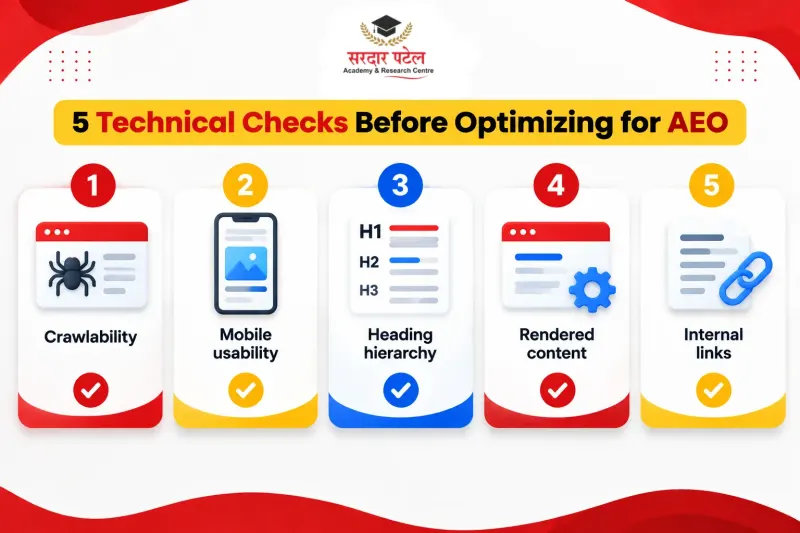
AEO fails quietly when the basics are broken. Check these first:
- Crawlability. Make sure important pages are not blocked by robots.txt or a stray noindex tag.
- Page speed and mobile usability. Many searches happen on phones.
- Clean heading structure. One H1, logical H2S and H3S, no skipped levels.
- Rendered content. Some crawlers may not run JavaScript, so test how your key pages render. Google explains how it processes JavaScript in its JavaScript SEO basics guide.
- Working internal links. Link related pages so both users and crawlers understand how your content connects. For a wider view of how search, social and AI fit together, see our guide to [digital marketing in 2027].
Common AEO Mistakes to Avoid
- Assuming AI search has made SEO obsolete. AEO extends existing SEO practices; it does not eliminate the need for them. If you are asking whether SEO is really dead in the age of AI search, understanding how search engines discover, evaluate and rank content will help you separate real changes from industry hype.
- Writing only for the snippet. A 50-word answer on top of a thin page earns little trust.
- Question stuffing. Forty near-identical FAQs on one page read as filler, to people and to machines.Using unsourced numbers. Statistics without a source are a credibility risk.
- Hiding authorship. Anonymous pages give engines and readers fewer reasons to trust you.
- Accidentally blocking crawlers. It happens more often than people admit, especially after a site redesign.
- Chasing guarantees. Anyone who promises a place in AI answers is overselling. No one controls those outputs.
How to Measure AEO Progress Honestly
Measurement is the weakest part of AEO right now. The tools are young, and AI answers can vary by user, location and day. Use several signals together:
- Search Console. Track impressions and clicks for question-style queries.
- A fixed question set. Pick 20 questions that matter, test them monthly in the main assistants, and log whether you are cited. Record the date, tool and exact prompt.
- Analytics referrals. Look for traffic coming from AI tools and assistants.
- Branded search trends. A rise in searches for your name can reflect growing recognition.
- Enquiry notes. Ask new leads how they found you. “I saw you mentioned in an AI answer” is a real signal.
None of these is perfect on its own. Together they give you a reasonable picture.
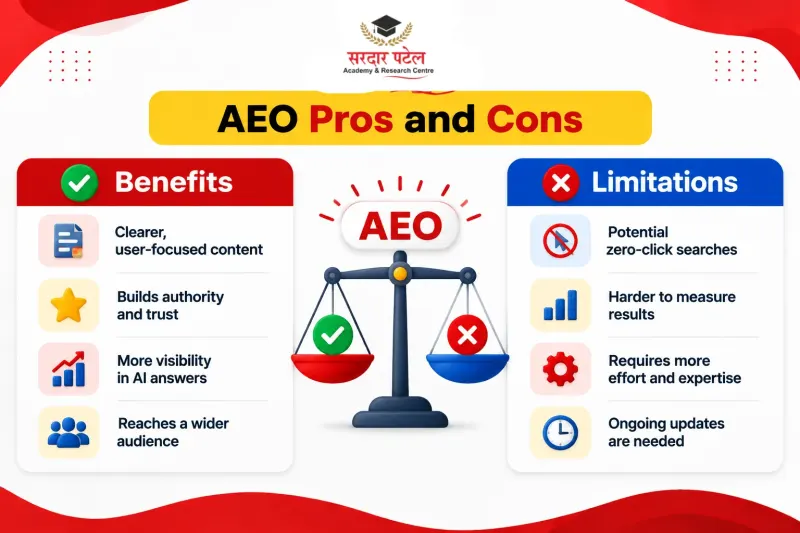
AEO Pros and Cons
| Advantages |
Limitations |
| Clearer writing helps human readers too |
Fewer clicks are possible when answers appear on-screen |
| Builds on existing SEO work |
Measurement is still immature |
| Strengthens authority and trust |
Platform behaviour changes without notice |
| Useful for voice and local searches |
Needs regular content updates |
Skills Worth Building if You Want an AEO Career
You do not need to be a developer. The useful skills are practical:
- Researching real user questions
- Writing clear, structured answers
- Understanding basic schema and technical SEO
- Reading analytics and Search Console data
- Testing AI tools critically instead of trusting them blindly
Final Thoughts on Answer Engine Optimisation
Answer engine optimisation comes down to a simple habit: understand what people actually ask, answer it clearly, and prove you are worth trusting. The tools and platforms will keep changing, but that habit will not.
Here is a practical way to begin this week:
- Write down 10 real questions your audience asks.
- Rewrite the opening of one important page so the answer comes first.
- Check that your name, address and phone number match everywhere online.
- Test your 10 questions in two or three AI tools and note the results.
- Repeat monthly and adjust.
If you want structured, hands-on guidance on the SEO and content foundations that AEO builds on, [explore the Digital Marketing Course] at Sardar Patel Academy & Research Centre (SPARC) in GTB Nagar. If you have questions about batches or what suits your background, [contact the team] or call +91 93129-66129.
FAQs
Answer engine optimization means writing and structuring your content so search engines and AI assistants can pick it as the direct answer to a question. You lead with a clear answer, support it with evidence, and organise the page so machines can easily extract the key passage.
No. AEO builds on SEO. Pages still need to be crawlable, relevant and trustworthy before an engine will consider them. Think of SEO as getting into the library and AEO as being the book that gets pulled off the shelf when someone asks a question.
The terms overlap heavily. AEO usually focuses on being the direct answer in snippets, voice results and AI summaries, while GEO focuses on appearing inside generative AI responses. Many practitioners treat them as one discipline, so always check how a given article defines each.
No. Schema helps machines understand your content, but it does not force inclusion in any answer. Use it where it accurately describes your page, and treat it as one signal among many, alongside content quality, authority and technical health.
There is no reliable timeline. Results depend on competition, your site’s authority, how often engines recrawl your pages and how the answer platforms behave. Expect to work in months rather than days, and track progress using a fixed question set instead of a single metric.
Yes. Local businesses often have an advantage because their questions are specific, such as hours, pricing, service areas and how a process works. A complete Google Business Profile, consistent contact details and clear service pages are a strong starting point.
A useful rule is 40–60 words for the lead answer under a heading, followed by supporting detail. The goal is clarity, not a word count. If the question needs a longer explanation, give the short answer first and expand below it.
Not for most of the work. Research, clear writing, page structure and analytics matter most. Basic familiarity with HTML headings and schema helps, and you can learn it alongside the rest. A developer can help with advanced implementation if needed.