+91 9312966129
 sparc.enquiry01@gmail.com



How to Become a Tally Accountant? Skills, Jobs and Career Path
Learn how to become a Tally accountant with essential skills, TallyPrime courses, GST knowledge, certifications, job opportunities, salary factors and career growth tips.

Table of Contents
- What Is a Tally Accountant?
- Why an Accounting Career With Tally Makes Sense
- Step-by-Step: How to Become a Tally Accountant
- Skills You Need as a Tally Accountant
- Core accounting skills
- Tally skills
- GST and compliance skills
- Supporting skills
- Tally Accountant Course: What Should It Include?
- Online vs classroom learning
- Tally Certification: Does It Help?
- Tally Accounting Jobs and Roles
- Tally jobs for freshers
- Tally Accountant Salary
- Career Path for a Tally Accountant
- A simple example
- Common Mistakes Beginners Make
- Tips to Get Hired Faster
- Is This Career Right for You?
- Conclusion
You have probably seen job ads asking for Tally knowledge and wondered how to get it. Maybe you are a commerce student, a fresher looking for a first job, or someone working in another field who wants to move into accounts. This guide walks you through how to become a Tally accountant, from the first skill you need to the roles you can grow into.
By the end, you will know what a Tally accountant does, which skills matter, how long learning takes, what jobs to apply for, and how to choose a course.
What Is a Tally Accountant?
A Tally accountant is an accounting professional who uses Tally software to record and manage a business's financial data. The current version is TallyPrime. TallyPrime supports accounting, inventory management, payroll and financial reporting, making it useful for managing routine business accounts. Explore the official TallyPrime features and capabilities to learn more.
In short: a Tally accountant enters daily transactions, manages invoices and payments, tracks stock, prepares GST details, and produces reports like the balance sheet and profit and loss statement. To understand the daily work and responsibilities of a Tally accountant, including routine accounting tasks and reporting, read our detailed guide.
Think of a small trading shop in Delhi. Every day it makes sales, buys stock, pays rent, and collects money from customers. Someone has to record all of this correctly. That person, working in Tally, is the Tally accountant.
Why an Accounting Career With Tally Makes Sense
Tally is widely used by small and medium businesses across India. Traders, wholesalers, retailers, manufacturers, and CA offices commonly use it.
Here is why many beginners choose it:
- Low entry barrier – You can start after 12th commerce, and you do not need a professional qualification like a CA to begin.
- Practical skill – Employers can see quickly whether you can actually do the work.
- Many types of employers – shops, factories, CA firms, distributors, and service companies – all need accounts staff.
- A base for growth – You can add GST, Excel, and payroll skills and move up.
One honest point: Tally alone will not make you a senior finance professional. It is a strong starting point, and your growth depends on what you add to it. If you are wondering how far Tally alone can take you, read Is Tally Enough for an Accounting Job?.
Step-by-Step: How to Become a Tally Accountant
If you want the short version, follow these steps.
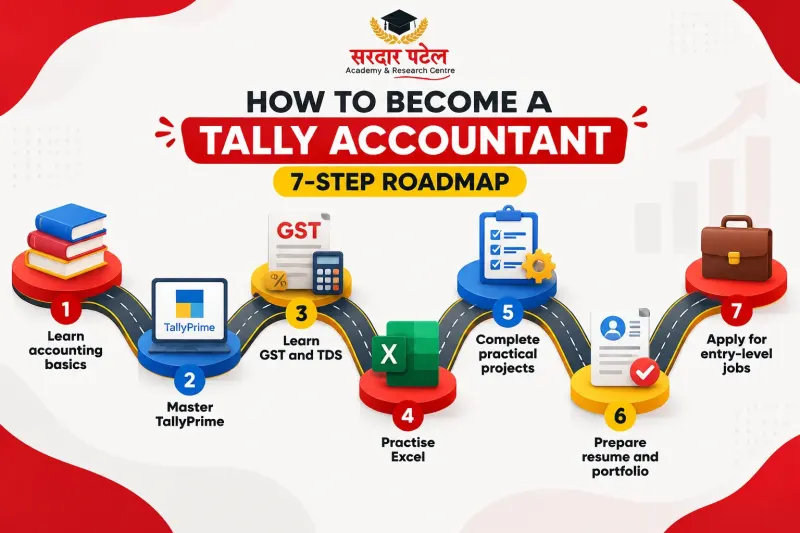
- Learn basic accounting first. Understand debit and credit, ledgers, journal entries, and the basic financial statements.
- Learn TallyPrime – Practise creating companies, ledgers, vouchers, and reports. Beginners can also use the official TallyPrime video tutorials to practise company creation, ledger setup, GST configuration and transaction entries.
- Add GST knowledge – Most jobs expect you to handle GST entries and returns data.
- Learn Excel basics – Many accounting roles use Tally and Excel together.
- Practise with real-style data – Work through full-year exercises, not just single entries.
- Build a simple resume – List your Tally skills, projects, and any certificates.
- Apply for entry-level roles – Start with accounts assistant or data entry accountant positions.
Let us look at each part in more detail.
Skills You Need as a Tally Accountant
Good Tally skills go beyond clicking buttons in software. The software only works well if the accounting behind it is correct.
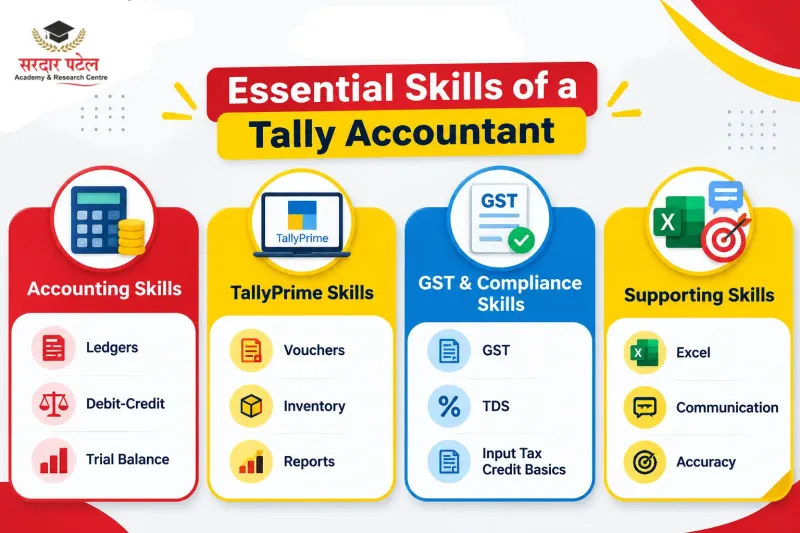
Core accounting skills
- Understanding of debit and credit rules
- Ledgers, trial balance, and final accounts
- Bank reconciliation
- Depreciation and basic adjustments
Tally skills
- Creating and managing a company in TallyPrime
- Ledger and group creation
- Voucher entry (sales, purchase, payment, receipt, journal, contra)
- Inventory and stock management
- Bill-wise tracking of receivables and payables
- Generating and reading reports
For a detailed checklist of Tally Prime skills every fresher should learn before applying for jobs, explore our guide to essential TallyPrime skills.
GST and compliance skills
- Entering GST on sales and purchases
- Understanding input tax credit at a basic level
- Preparing data for GST return filing For accurate information about GST return procedures, beginners can refer to the official GST portal return filing guide.
- Basic TDS entries
Learn how combining Tally, GST and TDS skills for accounting jobs can help you prepare for a wider range of accounting responsibilities.
Supporting skills
- Excel (VLOOKUP, XLOOKUP, pivot tables, basic formulas)
- Typing speed and accuracy
- Attention to detail
- Clear communication with managers and clients
Practical tip: Most beginner mistakes come from wrong ledger selection, not from software problems. If you choose the wrong ledger, every report that follows will be off.
Tally Accountant Course: What Should It Include?
A good Tally accountant course should teach accounting and software together. Here is a simple way to judge one.
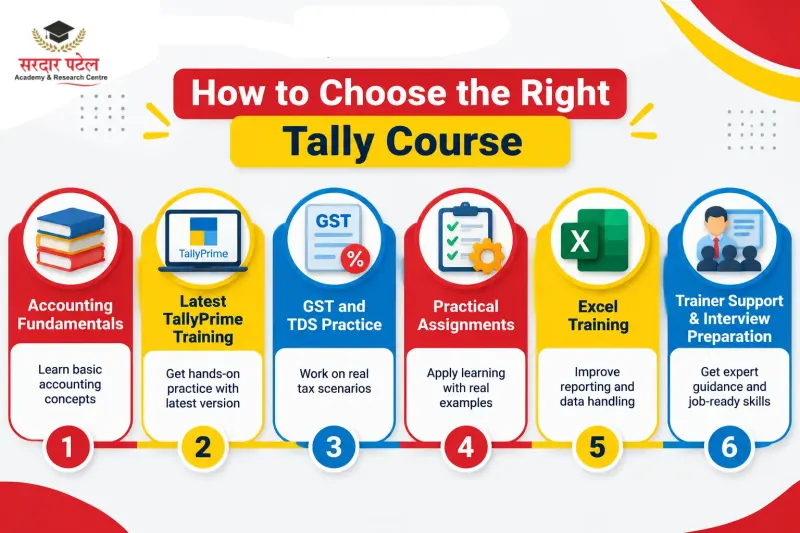
| What to check |
Why it matters |
| Accounting Basics Included |
Software without concepts leads to confusion |
| Latest Tally Prime Version |
Employers expect current software |
| GST and TDS practice |
Needed in almost every account job To understand how GST details are configured in the software, refer to the official guide to setting up GST in TallyPrime. |
| Practical assignments |
You learn by doing, not just watching |
| Excel Included |
Very common in real jobs |
| Doubt support and small batches |
Helps beginners avoid getting stuck |
| Interview and resume guidance |
Useful for freshers |
How long does a TallyPrime course take? Durations vary by institute. Many courses run for a few months, depending on whether you study accounting, GST, and Excel along with Tally. You can see what is covered in our Tally course.
Online vs classroom learning
| Basics |
Classroom |
Online |
| Doubt solving |
Quick, face-to-face |
Depends on the platform |
| Discipline |
Fixed schedule helps |
Needs self-motivation |
| Practice |
Lab access |
You need your own setup |
| Best for |
Beginners, students |
Working professionals with limited time |
For a complete beginner, classroom or live guided practice is usually easier. Accounting has a lot of small details, and getting a mistake corrected on the spot saves weeks.
Tally Certification: Does It Help?
A Tally certification shows that you have completed structured training and cleared an assessment. It can help a fresher, because a resume with no experience needs some proof of skill.
However, a certificate is not a substitute for ability. In interviews, employers often ask you to pass entries or explain a report. Someone who can do that will usually be preferred over someone who only holds a certificate.
If you want an official credential, check Tally's current certification options directly on Tally's website.
Tally Accounting Jobs and Roles
Here are common roles where Tally is a core skill.
| Role |
What to do |
Level |
| Accounts assistant |
Daily entries, bills, filing |
Entry |
| Data entry accountant |
Voucher entry, record maintenance |
Entry |
| Billing executive |
Invoices, bills, customer payments |
Entry |
| GST assistant |
GST data, return preparation support |
Entry to mid |
| Junior accountant |
Ledgers, reconciliations, reports |
Entry to mid |
| Accounts executive |
Wider accounts responsibility |
Mid |
| Senior accountant |
Reviews, compliance, team support |
Senior |
Tally jobs for freshers
Freshers usually start as an accounts assistant, billing executive, or data entry accountant. These roles are common in trading firms, distributor offices, small factories, CA offices, and retail businesses.
In Delhi NCR, business clusters like Karol Bagh, Nehru Place, Okhla, Narela, Noida, and Gurugram have many small and mid-sized businesses that hire for accounting work. At SPARC in GTB Nagar, students can reach the institute easily from GTB Nagar Metro Station (Gate 4), so attending regular practice sessions alongside college or a job is practical.
Your first role will likely feel repetitive. That is normal. Entering hundreds of vouchers is how you build speed and pattern recognition.
If you studied Arts, you can still build this path. See Accounting Career Options After 12th Arts.
Tally Accountant Salary
Salary depends on the city, company size, your skills, and your experience. Because pay changes often, we will not quote a single number here.
What usually pushes salary up:
- Solid GST knowledge
- Good Excel skills
- Experience with inventory and multi-branch accounting
- Ability to work independently and close books on time
- Adding related skills like payroll and TDS
A fresher who only knows voucher entry generally earns less than one who can also handle GST data and reconciliations. If you are deciding between these career options, compare Tally accountant vs GST accountant roles to understand their responsibilities, skill requirements and career prospects.
Career Path for a Tally Accountant
Here is how many people progress.
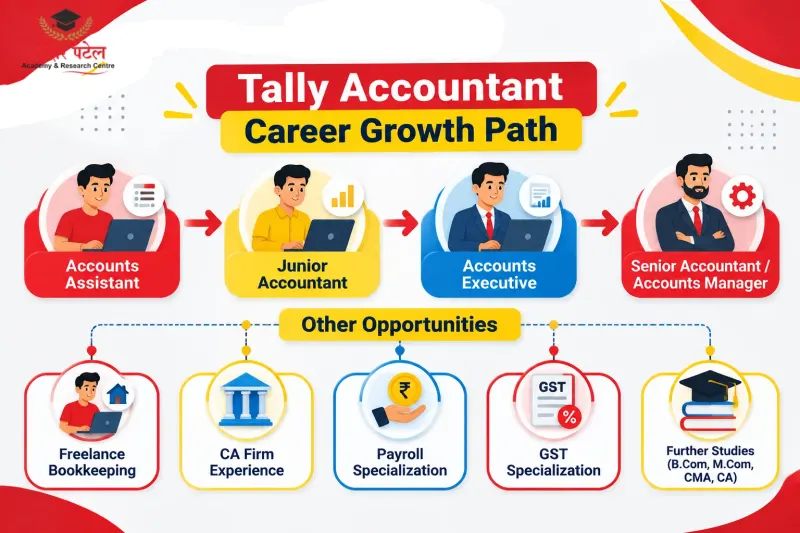
- Entry: Accounts assistant or billing executive
- Junior level: Junior accountant, handling ledgers and reconciliations
- Mid-level: Accounts executive with GST and TDS responsibility
- Senior level: Senior accountant or accounts manager
- Other directions: freelance bookkeeping, working with a CA firm, or handling accounts for your own business
Some people also study further, such as B.Com, M.Com, CMA, or CA, alongside working. Tally experience gives you a real-world advantage while studying because you see how theory applies in practice.
A simple example
Riya finishes 12th commerce and joins a Tally course. In three to four months, she learns accounting basics, TallyPrime, GST entries, and Excel. She applies to trading firms and a small CA office, and she joins as an accounts assistant. After a year, she handles bank reconciliations and GST data herself. That is a realistic path, though timelines differ from person to person.
Common Mistakes Beginners Make
- Learning software without accounting basics – you end up copying steps without understanding them.
- Skipping GST – Many employers see it as essential.
- Ignoring Excel – It is used alongside Tally in most offices.
- Only watching, never practising – Skill comes from repetition.
- Not checking reports – Always look at the trial balance after entering data. If it does not tally, find the error.
- Applying with a weak resume – list what you can actually do in Tally, not just “knowledge of Tally”.
Tips to Get Hired Faster
- Make a small practice portfolio, such as a sample company with a month of entries and reports.
- Learn the common shortcuts in TallyPrime to work faster.
- Prepare to explain basic entries in interviews, like recording a credit sale or a purchase return.
- Keep your resume to one page.
- Apply to a mix of small and mid-sized firms, not only large companies.
Is This Career Right for You?
It suits you if you:
- Like working with numbers and details
- Prefer structured, practical work
- Want a quick way into the job market
It may not suit you if you:
- Dislike repetitive tasks
- Want fast promotions without building greater skills
This is an opinion, not a rule. Many people grow well by pairing Tally with GST, Excel, and communication skills.
Conclusion
Knowing how to become a Tally accountant comes down to a clear path: learn accounting basics, master TallyPrime, add GST and Excel, practise on realistic data, and apply for entry-level roles. It is a practical accounting career with Tally that can start quickly and grow as you build skills.
If you want structured, hands-on guidance, learn Tally through Sardar Patel Academy & Research Centre practical accounting training and develop the skills needed for entry-level accounting roles. To ask about batches, course details, and next steps, contact SPARC here.
FAQs
Start with basic accounting, then learn TallyPrime, GST entries, and Excel. Practise with sample company data and apply for accounts assistant or billing roles.
Yes. Commerce students often join right after 12th. Students from other streams can also learn, though they may need a bit more time on accounting basics.
It can get you an entry-level role. For a full answer, read Is Tally Enough for an Accounting Job?.
It depends on your starting point and the course. Basic use can be learned in weeks, but becoming job-ready with accounting, GST, and practice usually takes a few months.
Not always, but it helps freshers show proof of training. Employers usually test practical skills as well.
Manual accounting records entries in books by hand. Tally does this digitally, speeds up reporting, and reduces calculation errors, but you still need accounting knowledge.
Yes. Evening, weekend, and online options suit people with jobs, and many use Tally to shift into accounts.
Check that it covers accounting basics, current TallyPrime, GST, Excel, and lots of hands-on practice. Also ask about batch size, trainer support, and career guidance.