+91 9312966129
 sparc.enquiry01@gmail.com


AI vs Data Analytics Career Comparison
Compare AI vs Data Analytics career opportunities, salaries, skills, future scope, and job roles. Find the best career path for beginners in 2026.
Table of Contents
- What is Artificial Intelligence?
- What is Data Analytics?
- Why Are AI and Data Analytics So Popular in 2026?
- Why Compare AI vs Data Analytics Career?
- Quick Overview
- AI vs Data Analytics: A Detailed Career Comparison
- Skills Required for an AI Career
- Skills Required for a Data Analytics Career
- Educational Background
- AI
- DATA ANALYTICS
- Salary Comparison in India (2026)
- Job Roles in AI
- Job Roles in Data Analytics
- Industries Hiring AI Professionals
- Industries Hiring Data Analysts
- Future Job Market: Analytics vs AI Future Jobs
- AI Future Jobs
- Data Analytics Future Jobs
- Learning Time Comparison
- Pros and Cons
- Artificial Intelligence
- Data Analytics
- Which Career Should You Choose?
- Choose AI if You:
- Choose Data Analytics if You:
- Can You Learn Both?
- Why Students Are Choosing Data Analytics First
Artificial Intelligence (AI) and Data Analytics are among the fastest-growing technology careers today. As businesses continue to embrace digital transformation, professionals with expertise in data and intelligent technologies are becoming increasingly valuable. This has created an important question for students, graduates, and career changers: Should you choose AI or Data Analytics as your career?
Although these fields are closely connected, they focus on different goals. Artificial Intelligence is about building systems that can learn, automate tasks, and make predictions. Data Analytics, on the other hand, focuses on collecting, cleaning, analysing, and interpreting data to help organisations make smarter business decisions.
If you're just starting your journey in this field, begin by learning the fundamentals of Data Analytics to build a strong foundation before comparing it with Artificial Intelligence. A strong foundation makes it much easier to understand how both careers fit into today's technology landscape.
Both career paths provide strong earning potential, promising employment opportunities, and excellent long-term professional growth. However, they differ in learning difficulty, required skills, educational background, job responsibilities, and career progression. Choosing the right path depends on your interests, strengths, and future goals.
Whether you're a college student planning your first career, a graduate exploring technology jobs, or a working professional considering a career switch, this comprehensive comparison will help you understand the differences between AI and Data Analytics so you can make an informed decision.
What is Artificial Intelligence?
Artificial Intelligence (AI) is a field of technology that focuses on creating systems capable of learning, reasoning, and performing tasks that normally require human intelligence. Instead of following fixed instructions, AI systems can learn from data, recognise patterns, make predictions, understand language, and improve their performance over time.
Today, artificial intelligence is integrated into countless everyday technologies, making daily life more convenient, efficient, and connected.
- Virtual assistants like Siri and Google Assistant
- AI chatbots
- Recommendation systems on Netflix and Amazon
- Fraud detection in banking
- Self-driving vehicle technologies
- Medical diagnosis systems
- Image and speech recognition
Artificial Intelligence combines several advanced technologies, including:
- Machine Learning
- Deep Learning
- Natural Language Processing (NLP)
- Computer Vision
- Robotics
AI professionals develop intelligent systems that can analyse data, automate routine tasks, solve complex challenges, and support better decision-making.
What is Data Analytics?
Data Analytics is the process of collecting, organising, cleaning, analysing, and interpreting data to discover meaningful insights that support business decisions.
Every organisation generates large volumes of data from customers, sales, websites, marketing campaigns, financial transactions, and operations. Data Analytics helps convert this raw information into valuable insights that improve efficiency, increase profitability, and support strategic planning.
For example, a Data Analyst can help a company answer questions such as:
- Which products generate the highest revenue?
- Why are customers leaving?
- Which marketing campaign performs best?
- Which city has the highest sales?
- How can operational costs be reduced?
Unlike AI, Data Analytics focuses more on understanding existing data rather than building intelligent systems.
Common tools used by Data Analysts include:
- Microsoft Excel
- SQL
- Power BI
- Tableau
- Python
- Google BigQuery
If you're beginning a career in data and technology, learning these tools is a valuable first step — see our guide to Data Analytics Tools You Must Know, which walks through SQL and the rest of this stack as the essential foundation for modern data analysis, business intelligence, and reporting.
Why Are AI and Data Analytics So Popular in 2026?
The rapid growth of digital technologies has made both AI and Data Analytics essential across industries. Organisations are investing heavily in data-driven strategies, automation, and intelligent systems to stay competitive.
Several key factors are driving the growing demand for AI, including:
- Increasing digital transformation across industries
- Growing adoption of cloud computing
- Expansion of AI-powered business applications
- Rising demand for data-driven decision-making
- Growth of e-commerce and online services
- Increased investment in business intelligence
- Higher demand for automation and predictive analytics
As a result, companies are actively hiring professionals who can either build AI solutions or analyse business data to improve performance. To understand the key factors behind this growing demand, read our detailed guide on Top Freelance Platforms for Data Analysts
Why Compare AI vs Data Analytics Career?
Many beginners assume Artificial Intelligence and Data Analytics are the same because both involve working with data. In reality, they require different skills and lead to different career paths.
Understanding the differences can help you:
- Choose a career aligned with your interests
- Select the right learning roadmap
- Avoid investing time in the wrong skill set
- Understand salary expectations
- Explore future job opportunities
- Make better educational decisions
If you're planning to build a successful career in analytics, it's also important to understand the eligibility requirements, learning path, and career opportunities before choosing your specialisation. If you're still unsure whether this field is right for you, explore our detailed article on Is Data Analytics a Good Career in 2026?
Quick Overview
AI vs Data Analytics: A Detailed Career Comparison
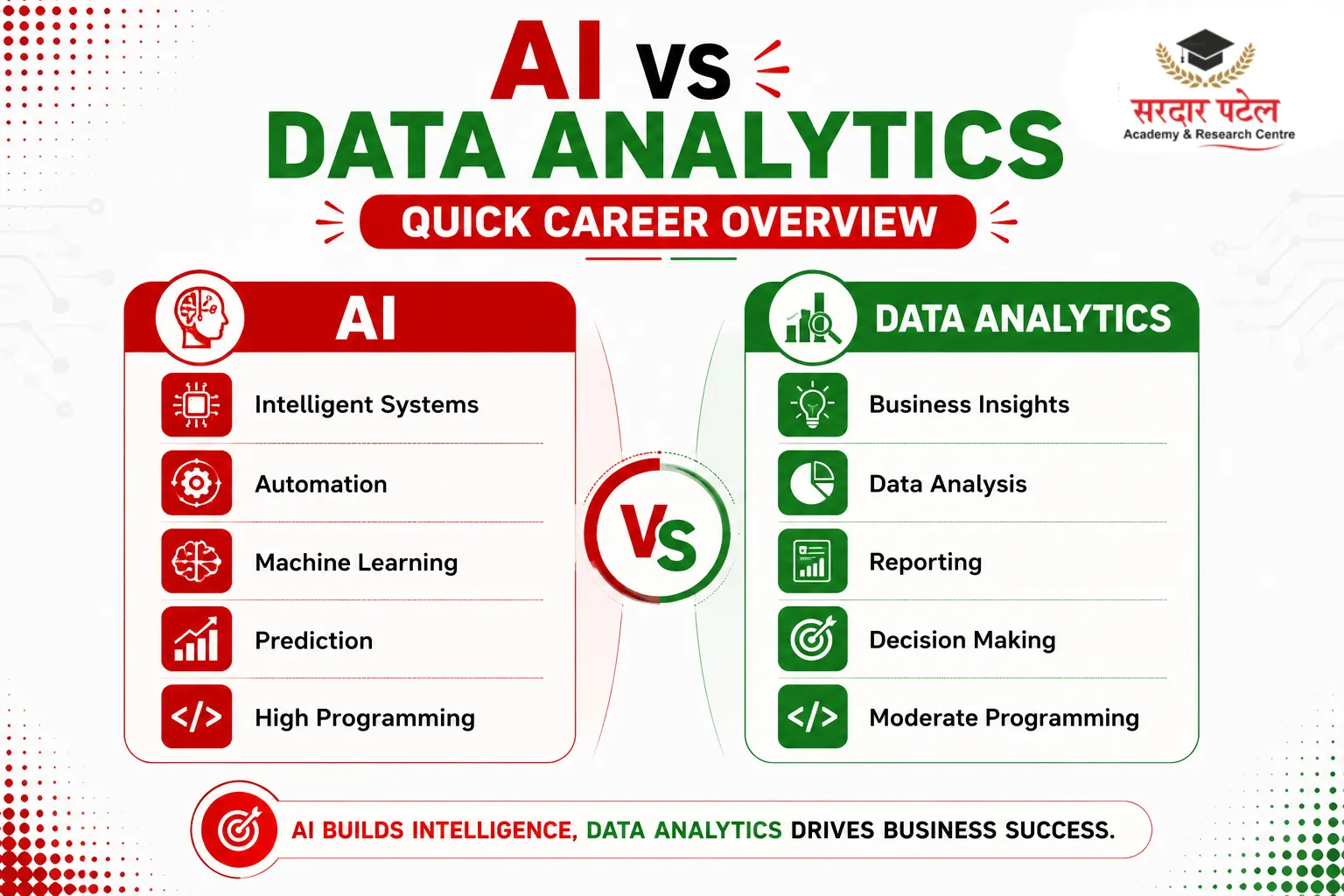
Although Artificial Intelligence and Data Analytics both rely heavily on data, they are built to serve different purposes. Artificial Intelligence is primarily concerned with developing systems that can learn from data, recognise patterns, and make intelligent decisions with minimal human intervention. In contrast, Data Analytics focuses on examining and interpreting data to uncover meaningful insights that help organisations make informed business decisions, improve performance, and identify growth opportunities.
The table below compares the key differences between these two career paths.
Skills Required for an AI Career
Artificial Intelligence combines programming, mathematics, and machine learning to create systems capable of solving complex problems.
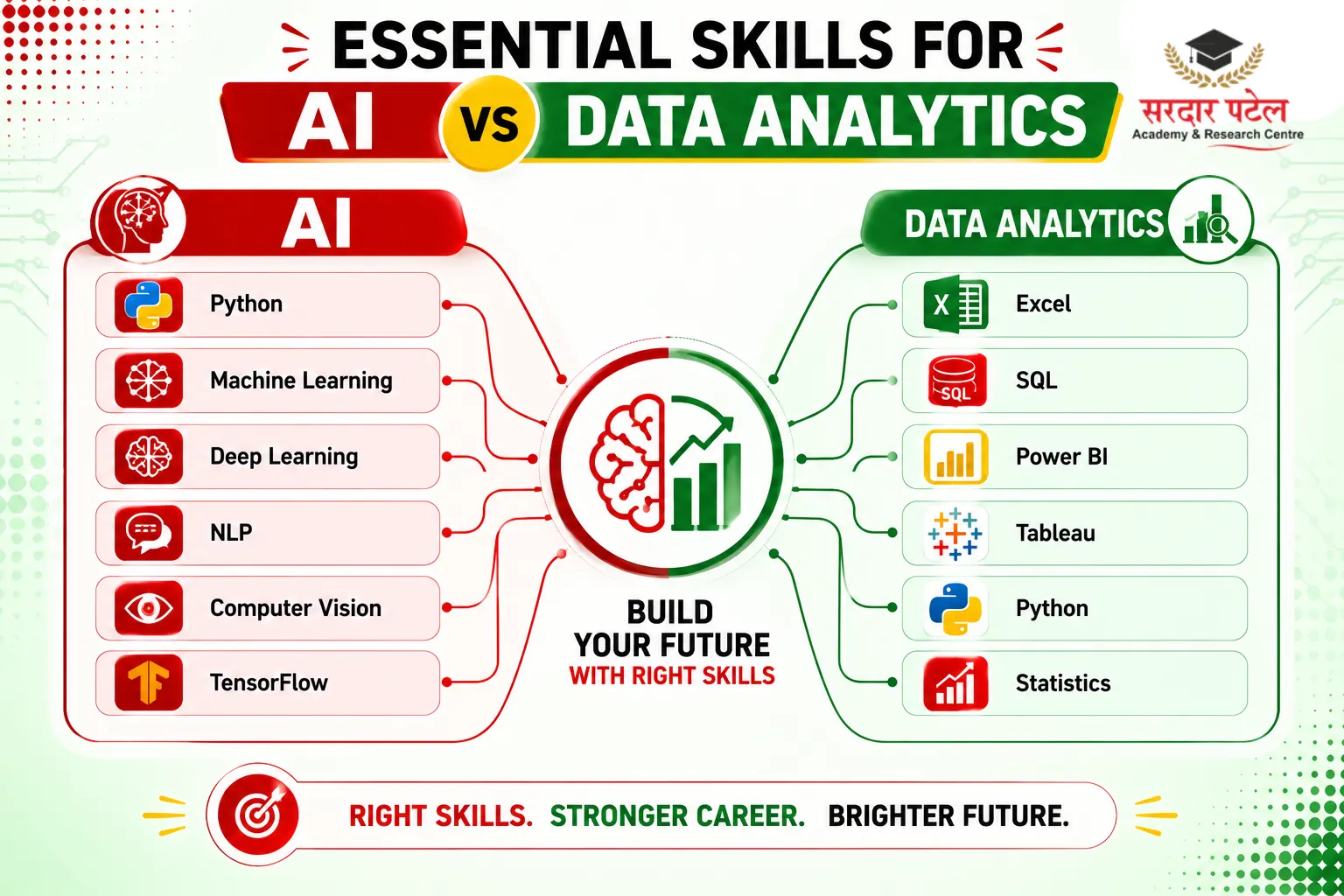
If you want to pursue an AI career, you'll typically need the following skills:
- Python Programming
- Machine Learning
- Deep Learning
- Neural Networks
- Data Structures & Algorithms
- Mathematics (Linear Algebra, Calculus, Probability)
- TensorFlow or PyTorch
- Natural Language Processing (NLP)
- Computer Vision
- Model Deployment
These skills usually require consistent practice and a strong technical foundation.
Skills Required for a Data Analytics Career
Data Analytics focuses on understanding business data rather than building intelligent systems.
Essential skills include:
- Microsoft Excel
- SQL
- Power BI or Tableau
- Data Visualisation
- Statistics
- Python (Basic to Intermediate)
- Data Cleaning
- Dashboard Development
- Business Communication
- Problem Solving
Compared to AI, Data Analytics has a more approachable learning curve, making it an excellent choice for beginners.
Educational Background
One of the biggest differences between AI and Data Analytics is the educational requirement.
AI
Most AI professionals come from backgrounds such as:
- Computer Science
- Information Technology
- Artificial Intelligence
- Electronics Engineering
- Mathematics
Although non-technical learners can enter AI, they often need extra time to master programming and advanced mathematics.
DATA ANALYTICS
Data Analytics welcomes candidates from diverse educational backgrounds, including:
- Commerce
- Science
- Arts
- Management
- Economics
- Engineering
This makes it one of the most accessible technology careers for fresh graduates and career changers.
Salary Comparison in India (2026)
Salary varies based on skills, experience, location, and company size. The figures below represent typical ranges for professionals in India.
Source: Indicative ranges compiled from AmbitionBox, Glassdoor India, and Naukri salary data (2026). Actual offers vary by city, company, and skill stack — verify current figures directly on these platforms before citing exact numbers.
Note: Professionals with specialised skills, certifications, or experience at leading companies may earn significantly higher salaries.
Job Roles in AI
An AI career offers opportunities across multiple specialisations.
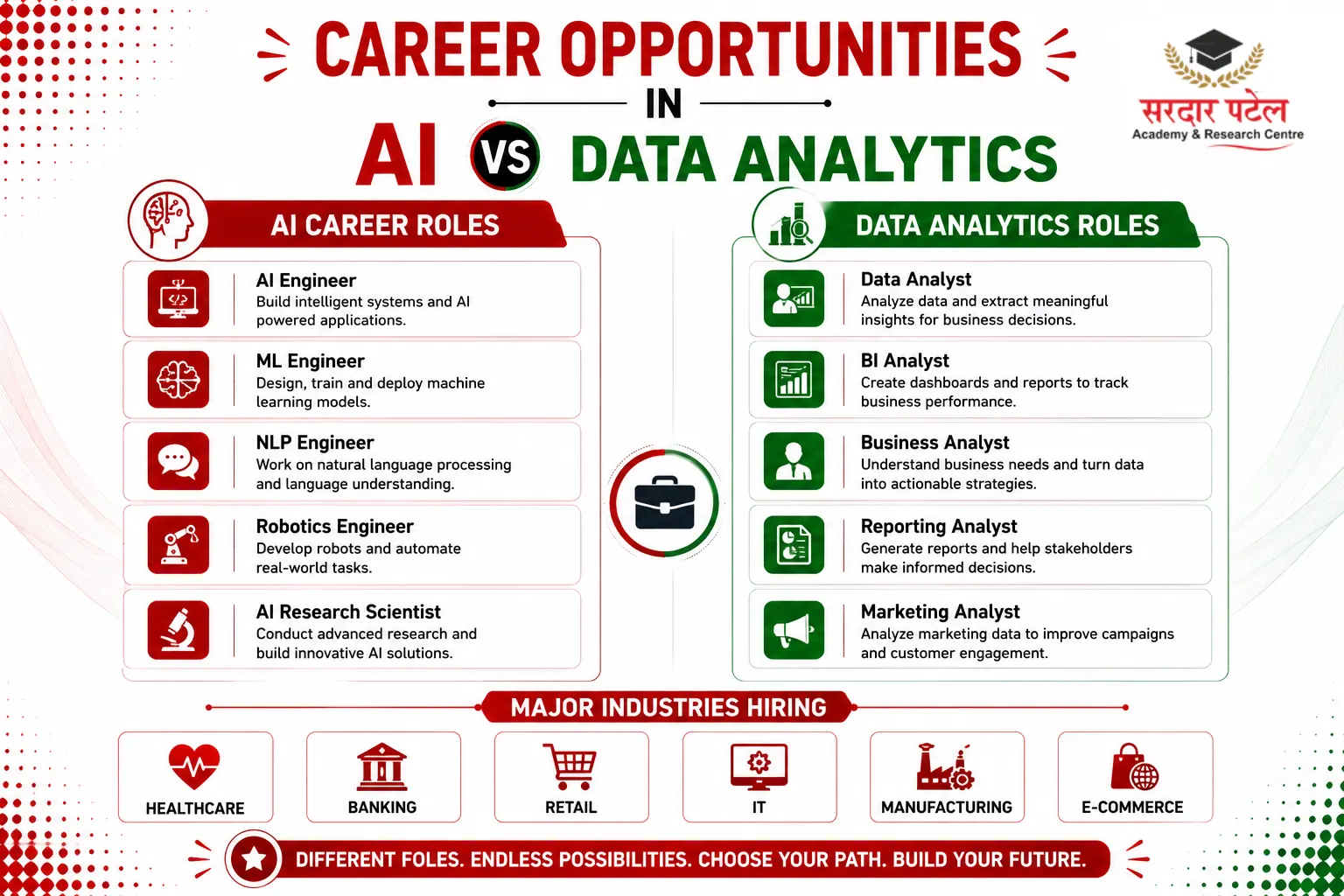
Popular roles include:
- AI Engineer
- Machine Learning Engineer
- Deep Learning Engineer
- NLP Engineer
- Computer Vision Engineer
- Robotics Engineer
- AI Research Scientist
- AI Solutions Architect
- Generative AI Engineer
These positions typically involve designing intelligent applications, training machine learning models, and solving complex technical challenges.
Job Roles in Data Analytics
Data Analytics professionals help organisations transform raw data into meaningful insights.
Popular job roles include:
- Data Analyst
- Business Analyst
- Business Intelligence Analyst
- Reporting Analyst
- Operations Analyst
- Marketing Analyst
- Financial Analyst
- Product Analyst
- Data Visualisation Specialist
These roles focus on analysing trends, preparing dashboards, and supporting business decisions.
Industries Hiring AI Professionals
Artificial Intelligence is rapidly expanding across industries that require automation, prediction, and intelligent decision-making.
Major hiring sectors include:
- Healthcare
- Banking & Finance
- Cybersecurity
- Manufacturing
- Automotive
- Robotics
- E-commerce
- TelecommunicationS
- Education Technology
- Government Research
Industries Hiring Data Analysts
Data Analytics professionals are needed wherever organisations generate and use data.
Top hiring industries include:
- Banking
- Healthcare
- RetailE-commerce
- Insurance
- Logistics
- Manufacturing
- Digital Marketing
- Education
- Information Technology
Because every business relies on data, demand for skilled analysts continues to grow across almost every sector.
Future Job Market: Analytics vs AI Future Jobs
Both Artificial Intelligence and Data Analytics are shaping the future of technology. However, their roles in the workforce are different.
Read more : Future of Data Analytics Jobs in India
AI Future Jobs
AI professionals will increasingly work on:
- Intelligent Automation
- Self-learning Systems
- Robotics
- Autonomous Vehicles
- Medical Diagnostics
- AI-powered Software
- Generative AI Applications
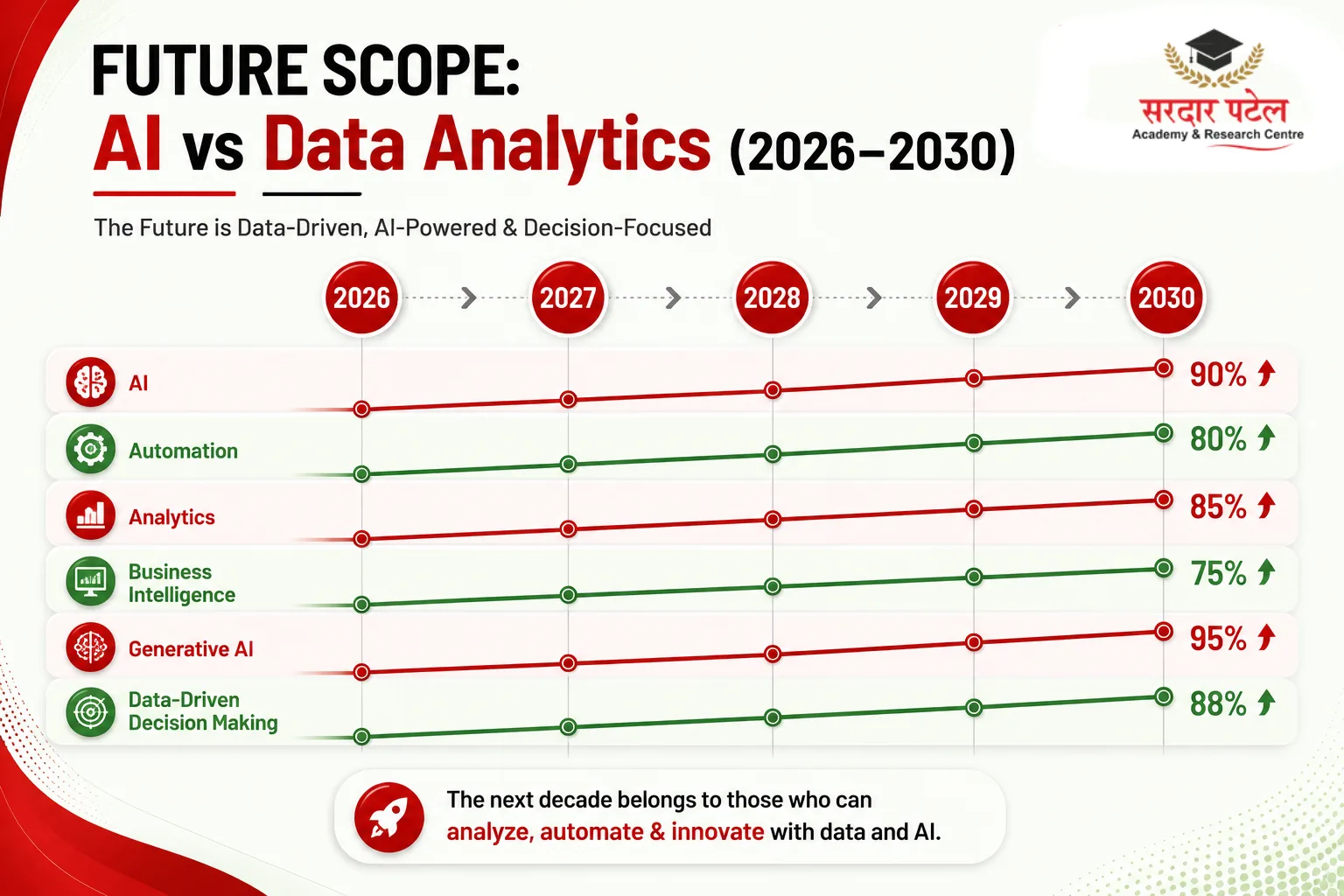
The field is expected to grow rapidly as organisations invest more in automation and advanced technologies.
Data Analytics Future Jobs
Data Analytics professionals will continue to support organisations by:
- Interpreting business data
- Identifying customer trends
- Improving operational efficiency
- Creating business dashboards
- Supporting strategic decision-making
As businesses become more data-driven, analytics professionals will remain essential across industries.
Learning Time Comparison
How quickly can you become job-ready?
Source: The salary ranges are indicative and may vary based on experience, location, company, and skill set. For updated estimates, explore the AI Engineer salary in India and Data Analyst salary in India data.
For students looking to start their careers quickly, Data Analytics often provides a faster path to employment.
Which Career Should You Choose?
Choosing between Artificial Intelligence (AI) and Data Analytics depends on your interests, strengths, and long-term career goals. See also our related breakdown of Data Analytics Career Scope, Skills & Salaries for a deeper look at that path specifically. Both fields offer excellent opportunities, but they are designed for different types of professionals.
Choose AI if You:
- Enjoy programming and software development.
- Love solving complex mathematical problems.
- Want to build intelligent systems and machine learning models.
- Are interested in robotics, automation, or generative AI.
- Plan to work on cutting-edge technologies.
Choose Data Analytics if You:
- Enjoy working with numbers and business data.
- Like finding patterns and solving business problems.
- Prefer creating dashboards and reports over building algorithms.
- Want a faster path into the IT industry.
- Are interested in business intelligence and decision-making.
For beginners, Data Analytics is generally easier to learn, while AI requires a stronger technical foundation in mathematics, programming, and machine learning.
Can You Learn Both?
Absolutely.
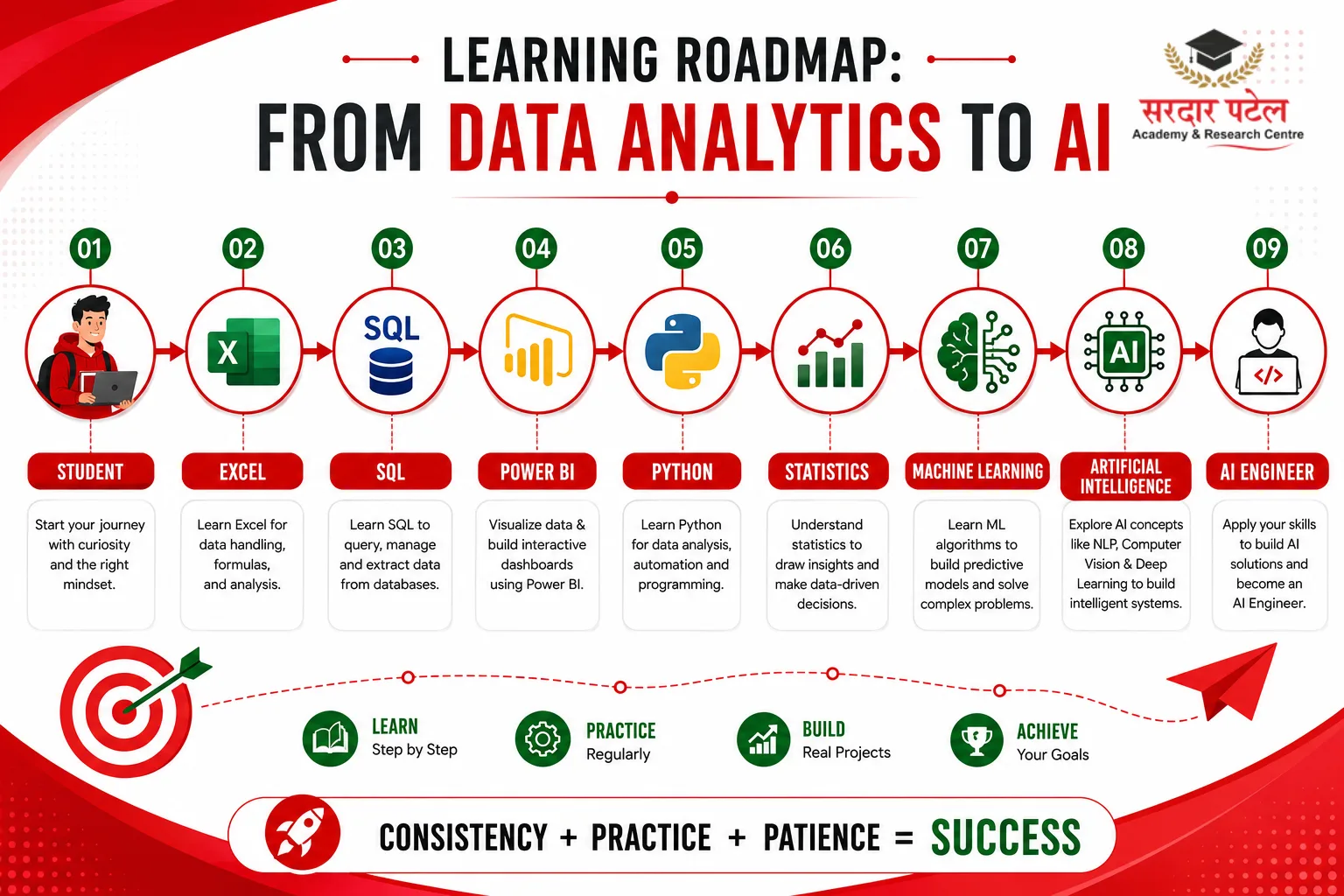
Many professionals begin their careers in Data Analytics and later transition into AI after gaining experience with data.
A practical learning path looks like this:
- Learn Excel
- Master SQL
- Learn Power BI or Tableau
- Understand Statistics
- Learn Python
- Explore Machine Learning
- Move into Artificial Intelligence
This roadmap allows you to develop strong analytical skills before diving into advanced AI concepts — our Complete Data Analytics Learning Guide walks through each of these steps in more detail.
According to the World Economic Forum, AI and big data are among the fastest-growing skills, highlighting the increasing importance of technology and data expertise in the future job market. Want to explore hiring trends, salaries, and future opportunities? Read our complete guide on Future of Data Analytics Jobs in India.
Conclusion
When comparing AI vs Data Analytics careers, there is no single winner because both careers offer outstanding opportunities in today's technology-driven world.
Artificial Intelligence is best suited for individuals passionate about programming, algorithms, and building intelligent systems. It offers exciting opportunities in machine learning, robotics, automation, and advanced software development.
On the other hand, Data Analytics is an excellent choice for students and beginners who want a practical, business-focused career with a faster learning path and abundant job opportunities. Organisations across industries rely on data analysts to transform raw information into meaningful business insights, making this field both stable and rewarding.
If you're just beginning your career journey, Data Analytics can provide a strong foundation while keeping the door open to transition into AI as your skills grow. Ultimately, the best choice depends on your interests, strengths, and long-term career aspirations.
Ready to build a successful career in Data Analytics?
At Sardar Patel Academy & Research Centre (SPARC), you'll learn industry-rel
FAQs
Neither is universally better. AI is ideal for those interested in programming and intelligent systems, while Data Analytics is better suited for individuals who enjoy analyzing data to solve business problems.
Yes. Data Analytics has a lower learning curve and typically requires less advanced mathematics and programming than Artificial Intelligence.
Yes. Many professionals begin with Data Analytics and later move into AI after learning Python, Machine Learning, and Deep Learning.
Currently, Data Analytics offers a larger number of entry-level positions because organizations across all industries require professionals who can analyze business data.
Senior AI Engineers often earn higher salaries due to the specialized nature of their work. However, experienced Data Analytics professionals also enjoy competitive salaries and strong career growth.
Basic programming knowledge, particularly Python and SQL, is beneficial. However, beginners can start with Excel and Power BI before moving to coding.
Yes. Students from commerce, arts, science, or management backgrounds can successfully learn Data Analytics with structured training and consistent practice.
Both fields have excellent long-term prospects. AI focuses on developing intelligent technologies, while Data Analytics supports data-driven decision-making across industries.