+91 9312966129
 sparc.enquiry01@gmail.com


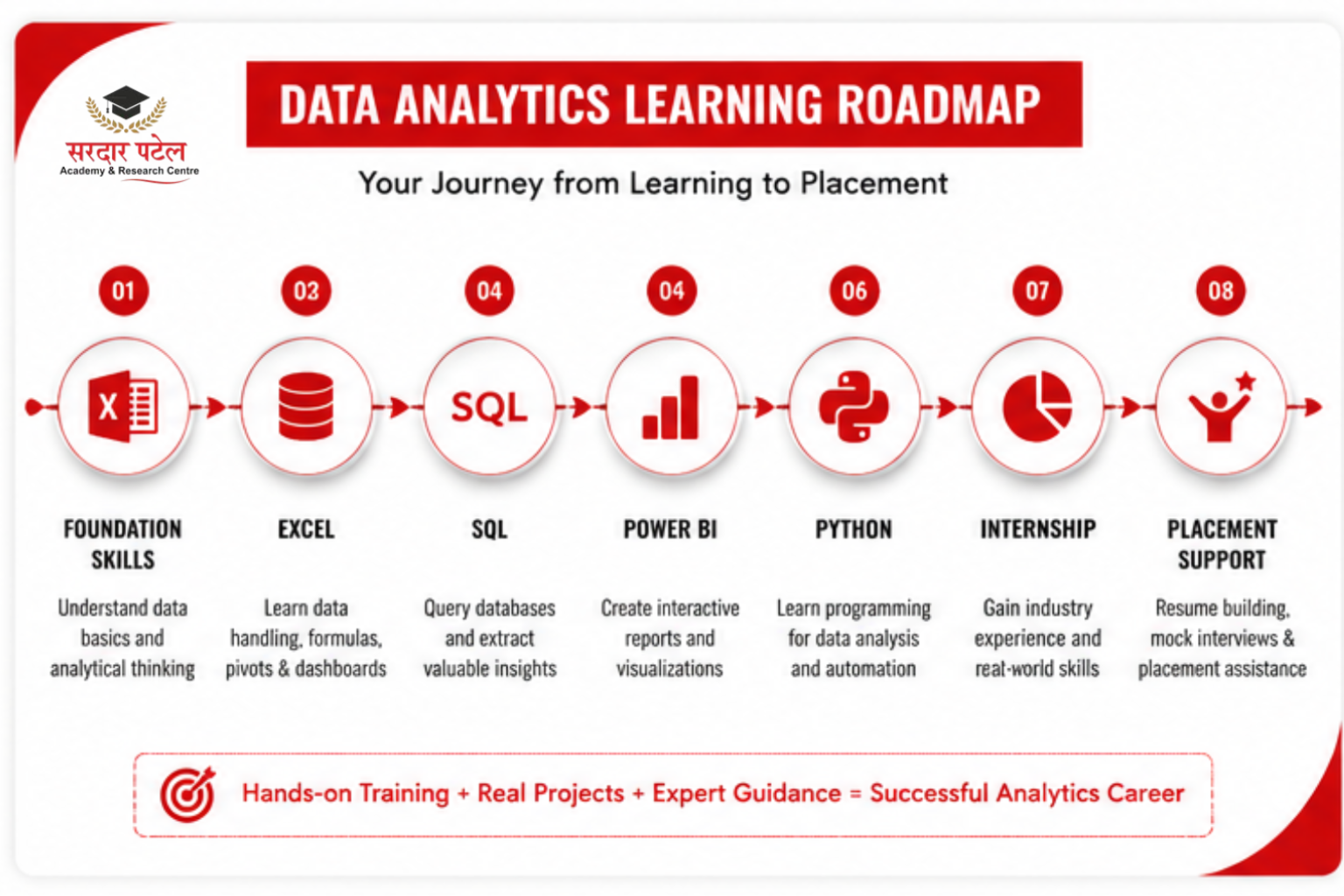
Job-Oriented Data Analytics Course in Delhi
Looking for a job-oriented data analytics course in Delhi? Sardar Patel Academy – SPARC offers hands-on training in Excel, SQL, Power BI & Python with internship and placement support. Enrol today.

The demand for skilled data professionals has grown significantly over the past few years. Businesses across industries are collecting vast amounts of information and need trained professionals who can transform raw data into meaningful insights. This growing demand has made data analytics one of the most promising career choices for students, graduates, and working professionals.
If you are searching for a job-oriented data analytics course in Delhi, it is important to choose a program that focuses not only on theory but also on practical skills, industry projects, and career preparation. Sardar Patel Academy – SPARC, one of Delhi's recognised training institutes, has been helping aspirants build job-ready analytics skills through a curriculum designed around real industry needs.
This guide will help you understand what makes a data analytics course job-oriented, the skills you should learn, career opportunities available after training, and how to choose the right institute in Delhi.
Why Data Analytics Has Become a Preferred Career Path for Aspirants
Imagine a company launching a new product. Before investing millions in marketing and production, the company wants answers:
• Who are the target customers?
• What products are trending?
• Which marketing channels generate the best results?
• What pricing strategy should be adopted?
Data provides the insights needed to answer these questions.
Organisations today rely on data analytics to make informed business decisions. As a result, companies actively hire professionals who can analyse data and provide actionable insights.
Industries hiring data analysts include:
• Information Technology
• Banking and Finance
• Healthcare
• Retail and E-commerce
• Manufacturing
• Telecommunications
• Digital Marketing
• Education
This increasing demand has created numerous opportunities for trained professionals with the right analytical skills.
What is a Job-Oriented Data Analytics Course?
A job-oriented course focuses on practical industry requirements rather than only academic concepts.
The primary goal of a job-oriented data analytics course in Delhi is to prepare students for real-world job roles by providing:
• Industry-relevant curriculum
• Hands-on training
• Live projects
• Internship opportunities
• Portfolio development
• Interview preparation
• Placement assistance
Unlike traditional programs, job-oriented training helps students develop the skills employers actually look for during recruitment. At Sardar Patel Academy – SPARC, the curriculum is regularly updated to reflect what hiring managers across Delhi and NCR are actively looking for, ensuring that every student is trained on tools and techniques that are currently in demand.
Real Student Experience at Sardar Patel Academy – SPARC
Rahul S. (name changed for privacy), a commerce graduate from Delhi, had no prior technical background when he joined SPARC’s data analytics program. Within six months of completing the course — which included live projects on sales analysis and a Power BI dashboard assignment for a simulated retail business — he secured a role as a Junior Data Analyst at a mid-sized e-commerce company in Noida. His advice to new students: “Focus on the projects. The hands-on work at SPARC is what made the difference in my interviews.”
Stories like this are common at SPARC because the institute prioritises practical exposure over rote learning from day one.
Key Skills You Should Learn in a Data Analytics Course
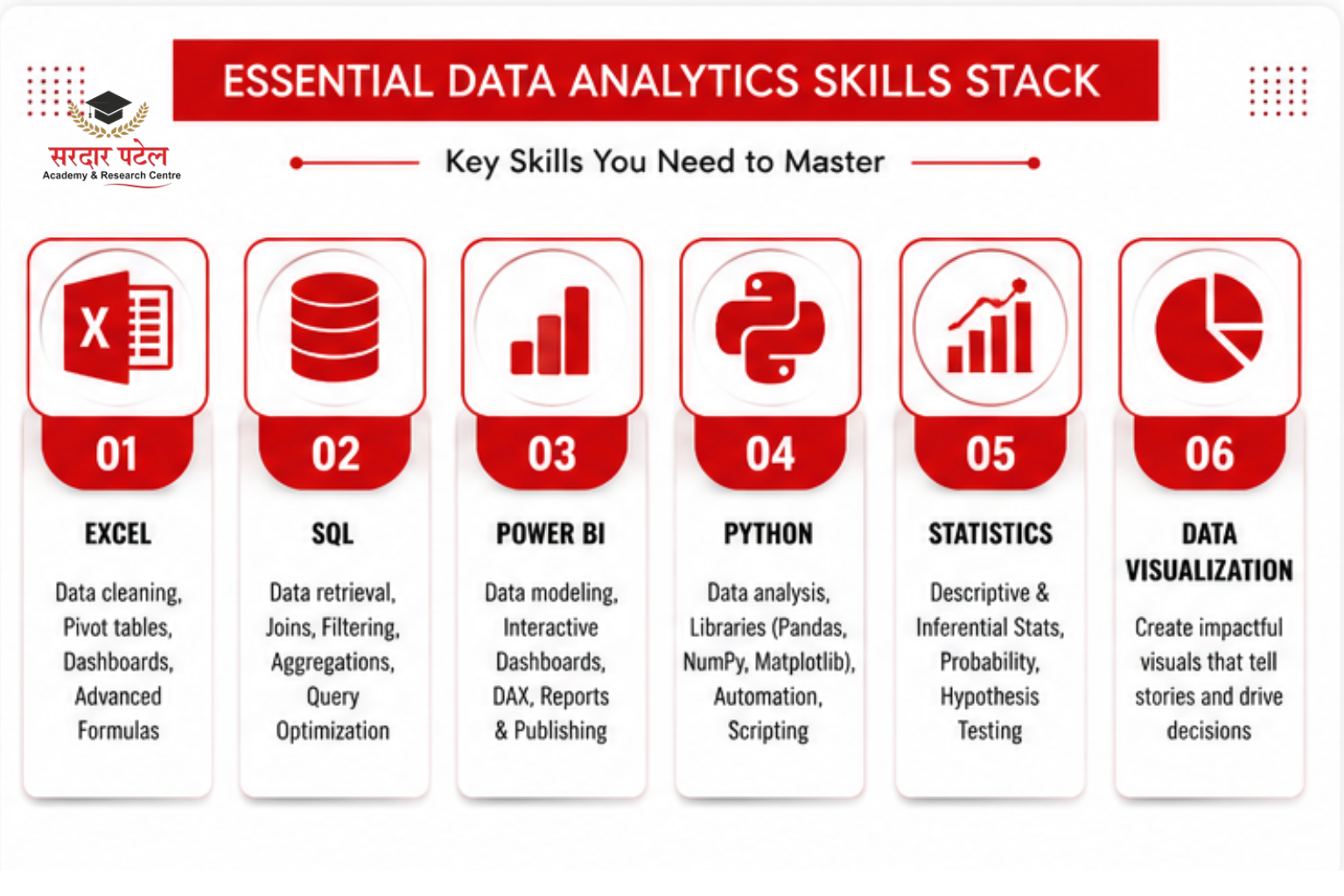
Before enrolling, ensure the program covers the essential tools and technologies used in modern analytics.
1. Microsoft Excel
Excel continues to be a valuable tool for organising, analysing, and deriving insights from data across a wide range of industries. Despite the rise of more advanced tools, most companies — especially small and mid-sized businesses — still use Excel as their primary reporting tool. At Sardar Patel Academy – SPARC, Excel training goes beyond basic spreadsheets; students learn to build dynamic dashboards, automate repetitive tasks with formulas, and present insights in a format that non-technical stakeholders can easily understand.
Topics should include:
• Data Cleaning
• Pivot Tables
• Lookup Functions
• Dashboards
• Data Visualisation
• Advanced Formulas
2. SQL
SQL is essential for working with databases. In virtually every data analyst role, you will need to query databases to extract the information you need for your analysis. SQL is not just a beginner skill — even senior analysts use it daily to pull, filter, and join data from multiple tables. At SPARC, SQL is taught with a focus on practical query-writing so that students can walk into interviews and solve real problems confidently.
Students should learn:
• Data Retrieval
• Filtering
• Joins
• Aggregations
• Query Optimisation
• Database Management Basics
Interview Tip: SQL skills are frequently tested during data analyst interviews. Prioritise this tool early in your learning journey.
3. Power BI
Many organisations rely on Power BI to transform data into meaningful insights and support informed decision-making. Power BI has become one of the most widely used business intelligence tools in India, especially in the BFSI, retail, and IT sectors. Employers often specifically mention Power BI in job descriptions because it allows teams to create self-service dashboards without heavy IT involvement. Sardar Patel Academy – SPARC’s Power BI module ensures students can build and publish professional dashboards by the end of the course.
Training should include:
• Data Modelling
• Dashboard Creation
• Interactive Reports
• DAX Functions
• Business Reporting
4. Python for Data Analytics
Python has become a standard programming language in analytics. What makes Python particularly valuable is that it can handle tasks that Excel or Power BI cannot — such as cleaning large datasets, automating repetitive reporting, and running statistical models. At SPARC, Python is taught specifically for analytics applications, so students without a coding background can start from scratch and build genuine proficiency.
Important topics include:
• Data Manipulation
• Data Cleaning
• Visualization
• Automation
• Statistical Analysis
Popular libraries: Pandas, NumPy, Matplotlib, Seaborn
5. Statistics and Business Analytics
Strong analytical decisions require a solid understanding of statistics. Without statistical knowledge, data analysts risk misinterpreting trends or drawing wrong conclusions from data. SPARC’s statistics module is taught in a business context, meaning students learn how to apply these concepts to real scenarios like customer behaviour analysis, sales forecasting, and performance measurement.
Topics include:
• Probability
• Hypothesis Testing
• Regression Analysis
• Descriptive Statistics
• Predictive Analytics
6. Data Visualisation
Analysing data is important, but effectively communicating the insights is equally essential. A well-designed dashboard or chart can influence business decisions faster than a ten-page report. SPARC trains students to think like storytellers when presenting data — choosing the right chart type, highlighting key trends, and designing visuals that are clear to both technical and non-technical audiences.
Students should learn:
• Dashboard Design
• Visual Storytelling
• Business Reporting
• KPI Tracking
Importance of Practical Training
Many students complete courses but struggle during interviews because they lack practical experience.
A quality training program should provide:
Live Projects
Working on real datasets helps students understand industry challenges. At Sardar Patel Academy – SPARC, students work on projects sourced from actual business scenarios, giving them portfolio items they can discuss confidently in interviews.
Examples include:
• Sales Analysis
• Customer Segmentation
• Marketing Campaign Analysis
• Financial Reporting
• Business Performance Tracking
Case Studies
Industry-based case studies help learners solve real business problems and build critical thinking skills.
Capstone Projects
These projects demonstrate your skills to potential employers and significantly strengthen your resume.
Why Choose an Analytics Course with an Internship in Delhi?
One of the biggest advantages of joining an analytics course with an internship in Delhi is gaining practical exposure before entering the job market.
Internships help students:
• Understand workplace expectations
• Apply classroom knowledge
• Work with industry tools
• Build professional confidence
• Gain real project experience
Employers often prefer candidates who already have internship experience because they require less training after hiring. Sardar Patel Academy – SPARC facilitates internship opportunities for eligible students as part of the overall program, helping them step into the job market with real experience already on their resume.
Related Read: Is an Internship Important in Data Analytics Training? — The answer becomes clear when you see how employers evaluate freshers during hiring.
Career Opportunities After Completing Data Analytics Training
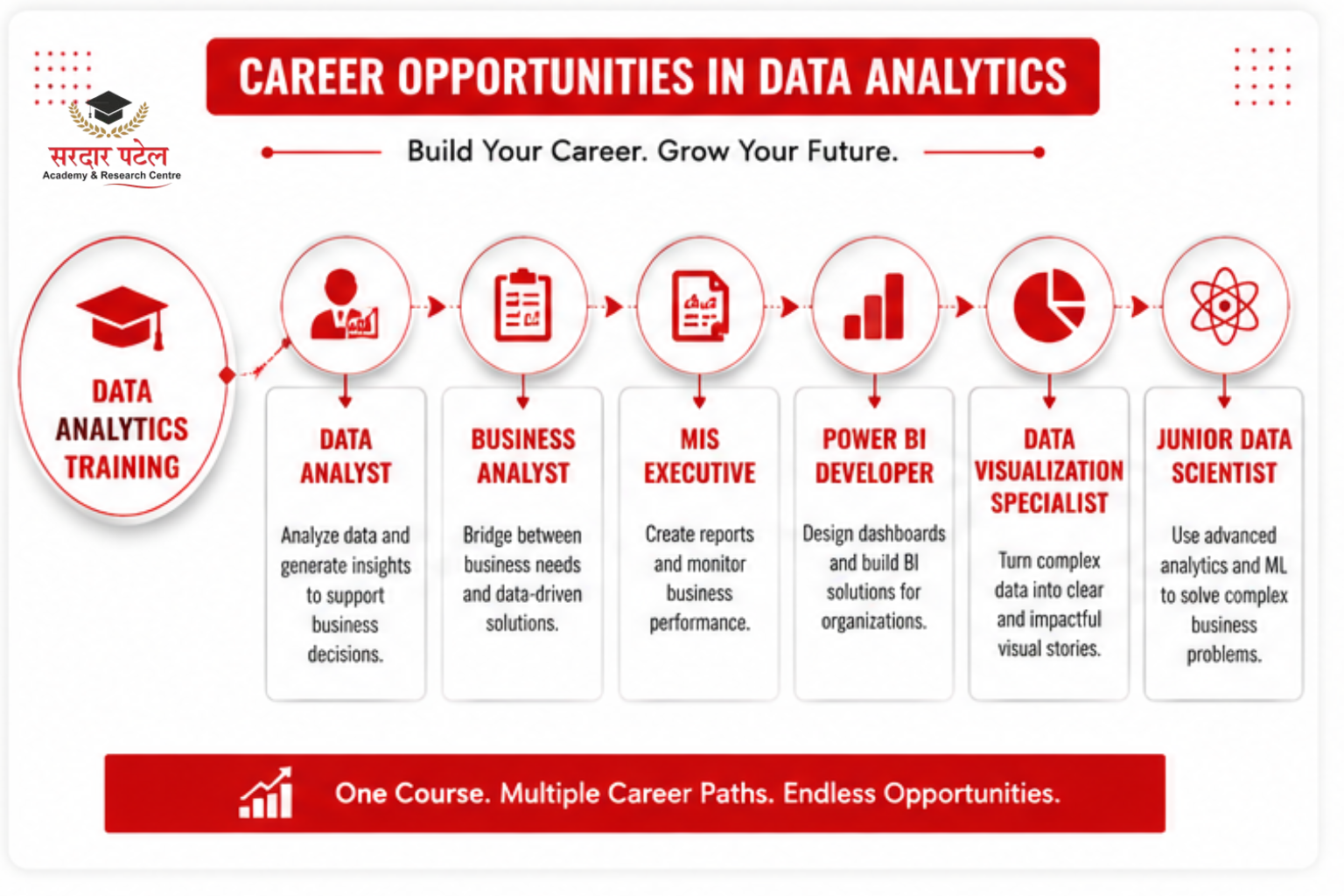
A job-oriented course can open doors to multiple career paths.
Data Analyst
Responsibilities include data collection, analysis, reporting, and dashboard development.
Business Analyst
Business Analyst: Uses data to improve organisational performance and decision-making.
MIS Executive
This role primarily involves managing business data, ensuring its accuracy, and creating reports that support informed decision-making.
Power BI Developer
Power BI Developer: Power BI professionals design dashboards and reports for organisations.
Data Visualisation Specialist
Data Visualisation Specialist: These professionals create interactive reports that simplify complex information.
Junior Data Scientist
Junior Data Scientist: With additional experience and skills, analytics professionals can move toward data science roles.
Average Salary After a Data Analytics Course
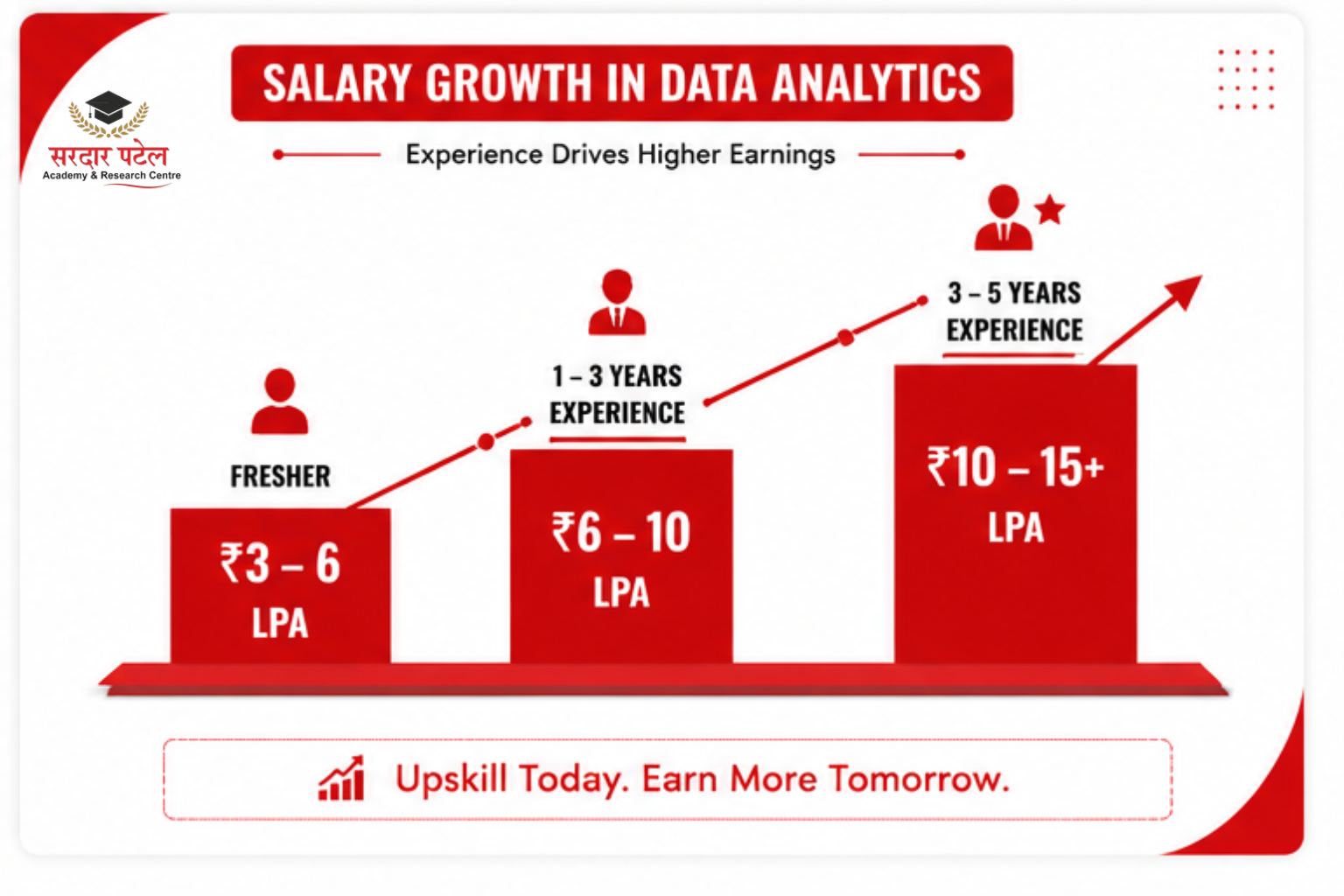
Salary depends on factors such as skill level, certifications, internship experience, location, and company size.
| Experience Level | Average Salary |
| Fresher | Rs. 3 LPA – Rs. 6 LPA |
| 1–3 Years | Rs. 6 LPA – Rs. 10 LPA |
| 3–5 Years | Rs. 10 LPA – Rs. 15 LPA+ |
Source: Naukri.com / AmbitionBox, Q1 2026. Candidates with strong portfolios and practical experience often secure higher salary packages.
Who Should Enrol in a Data Analytics Course?
Data analytics is suitable for individuals from diverse educational backgrounds.
Students
Students can acquire practical, industry-focused skills during their studies, helping them become job-ready before graduation.
Fresh Graduates
Graduates can improve their employability and access better job opportunities with hands-on analytics skills.
Working Professionals
Professionals seeking career growth or a transition into analytics can benefit from specialised training.
Entrepreneurs
Entrepreneurs: Business owners can use analytics to improve decision-making and business performance
.
How to Choose the Best Job-Oriented Data Analytics Course in Delhi
Not all courses deliver the same value. To choose the right course, it is important to carefully assess the following factors.
Industry-Relevant Curriculum
Choose a course covering Excel, SQL, Power BI, Python, Statistics, and Business Analytics. Sardar Patel Academy – SPARC’s curriculum is built around these exact tools, ensuring students are not learning outdated content.
Experienced Trainers
Learning from industry experts helps bridge the gap between theory and practical application. SPARC’s faculty includes professionals with hands-on industry experience, not just academic instructors.
Project-Based Learning
A strong course should include real datasets, industry projects, portfolio development, and internship opportunities. Selecting an analytics course with an internship in Delhi can significantly improve your practical knowledge and employability.
Placement Assistance
Look for institutes offering resume building, interview preparation, mock interviews, and placement support. Sardar Patel Academy – SPARC provides dedicated placement assistance to help students connect with relevant job opportunities in Delhi and NCR.
Related Guide: Data Analytics Classes with Placement Support — Always check whether the institute offers mock interviews and resume building alongside technical training.
Flexible Learning Options
Many institutes offer classroom training, online classes, weekend batches, and fast-track programs. Choose the format that aligns with your schedule and learning preferences.
Benefits of Job-Oriented Data Analytics Training
Faster Career Growth
Practical skills help candidates become productive quickly and stand out during interviews.
High Demand Across Industries
As data-driven decision-making becomes more important, organisations across diverse industries are actively seeking skilled data analytics professionals.
Better Job Opportunities
Industry-oriented training improves employability and helps candidates access higher-quality roles.
Strong Portfolio Development
Projects and case studies strengthen your profile and give you concrete examples to discuss in interviews.
Career Switching Opportunities
Career Switching Opportunities: Many professionals successfully transition from non-technical backgrounds into analytics roles. Sardar Patel Academy – SPARC has seen students from commerce, arts, and humanities backgrounds successfully build careers in data analytics after completing the program.
Future Scope of Data Analytics
The future of data analytics continues to expand with technologies such as:
• Artificial Intelligence
• Machine Learning
• Big Data
• Cloud Computing
• Business Intelligence
Organisations increasingly depend on data-driven decision-making, making analytics skills highly valuable for years to come. Professionals who continuously upgrade their skills can expect strong career growth and long-term job security.
Final Thoughts
Choosing a job-oriented data analytics course in Delhi can be one of the smartest career decisions in today’s data-driven world. The right training program equips you with practical skills, industry knowledge, project experience, and career support needed to secure rewarding opportunities.
When selecting a course, prioritise hands-on learning, real-world projects, placement support, and internship opportunities. An analytics course with an internship in Delhi can provide the practical exposure that employers value most.
Sardar Patel Academy – SPARC stands out in Delhi’s training landscape for its focus on practical skill-building, an industry-aligned curriculum, and dedicated placement support. Whether you are a student, graduate, or working professional, investing in quality analytics training at SPARC can help you build a successful and future-ready career.
Compare Options: Best Data Analytics Course in Delhi with Placement — Find the right program that combines technical depth with strong career support.
Start Job-Ready Training Today
Build practical analytics skills, work on real projects, gain industry exposure, and prepare for high-growth career opportunities with a comprehensive Job-Oriented Data Analytics Course in Delhi at Sardar Patel Academy – SPARC.
✔ Training from experienced industry trainers
✔ Real-world projects for your portfolio
✔ Resume and LinkedIn support
✔ Mock interviews and career guidance
✔ Placement assistance with hiring partners
Phone: +91 93129-66129
Email: admissions@sparc.org.in
FAQs
A job-oriented data analytics course focuses on practical skills, live projects, internship opportunities, and placement support to prepare students for industry roles.
Students, graduates, working professionals, and entrepreneurs can enrol in a data analytics program.
Basic programming knowledge is helpful, but many beginner-friendly courses teach Python from scratch. At Sardar Patel Academy – SPARC, Python is taught from the basics, so students with no prior coding experience can comfortably learn and apply it.
Course duration at Sardar Patel Academy – SPARC varies by program. Short-term courses can be completed in 3 to 4 months, while more comprehensive programs that include internship components may run for 6 months or longer. Weekend and fast-track batches are also available for working professionals.
Internships provide real-world experience, strengthen resumes, improve confidence, and increase job opportunities. Sardar Patel Academy – SPARC facilitates internship opportunities as part of its program, giving students a significant advantage in the job market.
The program covers Microsoft Excel, SQL, Power BI, Python (with libraries like Pandas, NumPy, Matplotlib, and Seaborn), and Statistics. These are the core tools that employers actively look for in data analyst candidates.
Fresh graduates who complete a data analytics program typically earn between Rs. 3 LPA and Rs. 6 LPA, depending on their skill level, portfolio strength, and the company they join. (Source: Naukri.com / AmbitionBox, Q1 2026)
Yes. Sardar Patel Academy – SPARC’s program is designed to accommodate students from non-technical backgrounds, including commerce, arts, and humanities. The curriculum starts from the fundamentals and gradually builds toward advanced topics, ensuring every student can follow along regardless of their prior background.
Yes. Sardar Patel Academy – SPARC provides dedicated placement assistance that includes resume building, interview preparation, mock interview sessions, and connections with relevant hiring companies in Delhi and NCR.