+91 9312966129
 sparc.enquiry01@gmail.com



Zero-Click Search in 2027: What Digital Marketers Need to Know
Understand zero click search in 2027, its impact on SEO, AI Overviews and practical strategies to improve search visibility, brand awareness and traffic.
Table of Contents
- What Is Zero Click Search?
- Where Answer-First Results Appear
- Why This Shift Matters Going Into 2027
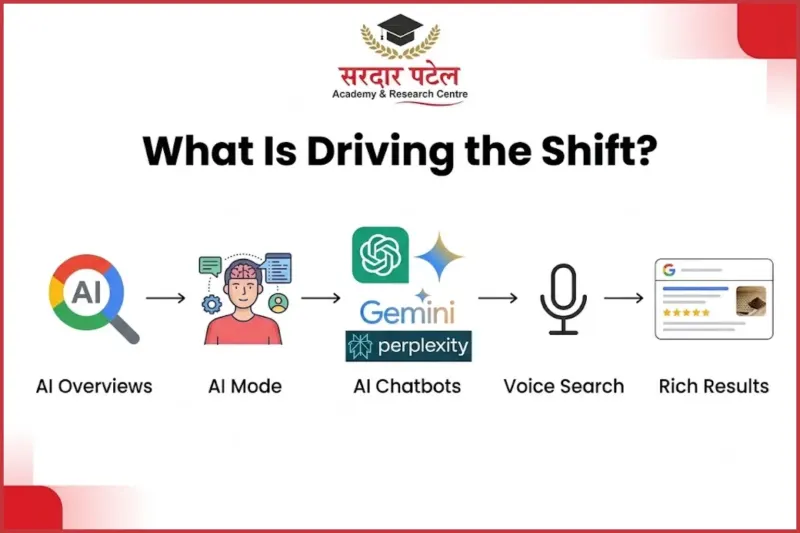
- What Is Driving the Shift
- AI Overviews and AI Mode
- ChatGPT, Gemini and Perplexity
- Voice Assistants and Rich Results
- What It Means for Indian Search Behaviour
- Is It Really Bad News for Marketers?
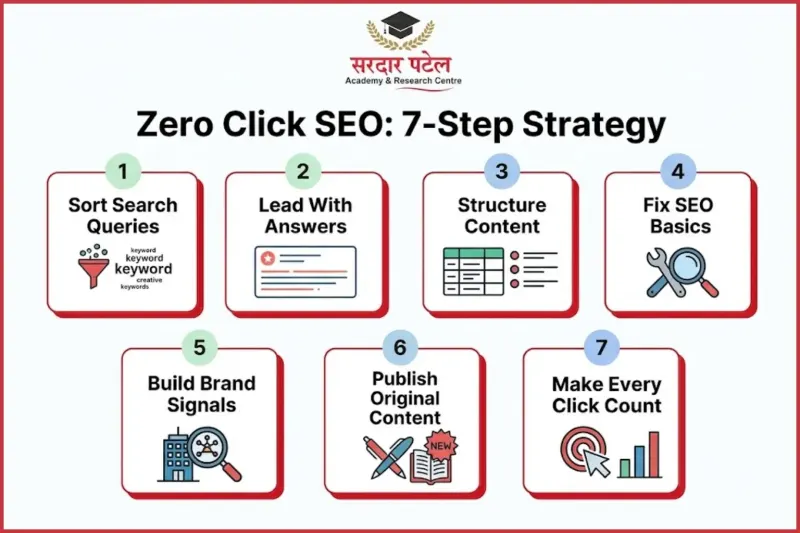
- A Step-by-Step Plan to Stay Visible
- Step 1: Sort your queries by how much a click is worth.
- Step 2: Lead with the answer.
- Step 3: Structure content so machines can parse it.
- Step 4: Get the technical and on-page basics right.
- Step 5: Strengthen brand and entity signals
- Step 6: Publish what a summary cannot replace.
- Step 7: Make every click count.
- How to Measure Success When Clicks Drop
- Common Mistakes to Avoid
- Why Students Should Learn This Now
- Conclusion
Type a question into Google today, and there is a good chance you will get your answer without opening a single website. A definition, a conversion rate, a short AI summary, a map with phone numbers: the results page often does the job by itself. That behaviour is called zero-click search, and as we head into 2027, it is changing what "ranking well" actually means.
If you are completely new to the field, start with our beginner guide to SEO and then come back. This guide assumes you know what a ranking is and tackles the harder question: how do you stay visible when fewer people click?
What Is Zero Click Search?
A zero-click search happens when a person searches, reads what the results page shows, and then either leaves or types a fresh query without clicking any result. Search Engine Land's coverage of the 2024 SparkToro study defines it in exactly these terms.
Notice that this is not always a failure on the searcher's side. Many questions are small: the time in London, the meaning of a word, today's exchange rate. The search engine answered, so there was nothing left to click.
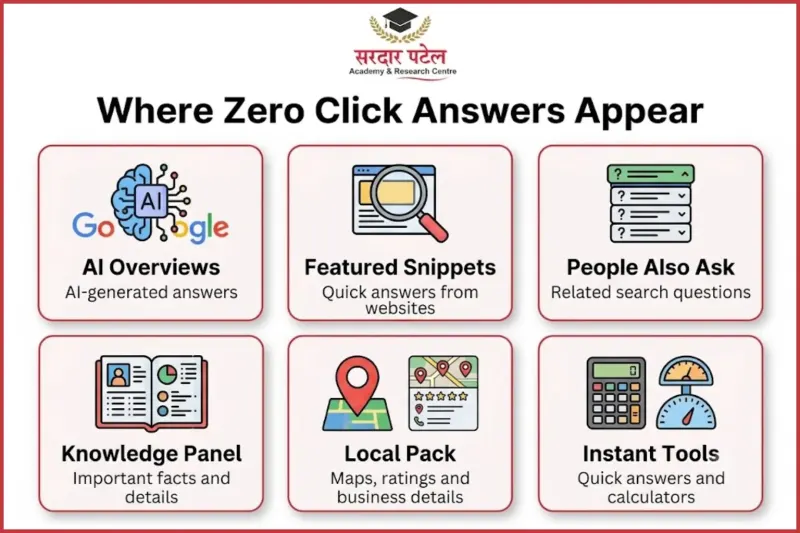
Where Answer-First Results Appear
| Result format |
What the searcher gets |
Opportunity for marketers |
| AI-generated summary |
A short synthesised answer with a few cited sources |
Become one of the cited sources |
| Featured snippet |
A highlighted excerpt from one page |
Write clear, direct answers |
| People Also Ask |
Expandable related questions |
Cover follow-up questions in your content |
| Knowledge panel |
Facts about a brand, person or place |
Keep entity details consistent |
| Local pack |
Map, ratings, call button |
Maintain an accurate Google Business Profile |
| Instant tools |
Converters, weather, scores |
Rarely winnable; target deeper queries |
Key Terms: No Click, AEO and GEO
You will see the phrase no-click search used as a casual synonym; both describe the user behaviour. Zero-click SEO describes what marketers do about it: shaping content so a brand benefits even when the visit never happens. Answer engine optimisation (AEO) and generative engine optimisation (GEO) overlap heavily with it, and our AEO vs. SEO comparison covers where they differ.
Why This Shift Matters Going Into 2027
Three studies are worth knowing. Read them as signals of direction rather than exact scoreboards, because each uses a different method.
| Source |
What it found |
Caution |
| SparkToro and Datos, 2024 |
58.5% of US and 59.7% of EU Google searches ended without a click; only about 360 of every 1,000 US searches sent a click to the open web |
Based on clickstream panel data |
| SparkToro, early 2026 |
68% of US Google searches from January to April 2026 ended without a click |
Different data panel than 2024, so the jump is partly a measurement change |
Pew Research Centre's 2025 study found users clicked a regular result in 8% of visits when an AI summary appeared, versus 15% when it did not, and links inside the summary itself drew only about 1%. Our AI search trends report covers the full breakdown. Being cited helps visibility, but it does not guarantee traffic.
Because the 2024 and 2026 SparkToro figures come from different data panels, they cannot be compared like for like. That is why these statistics are best used as a direction of travel, not a precise percentage. Another caveat: these studies cover the US and EU. We are not citing an India-specific figure here, so check your own Search Console data before concluding about Indian audiences.
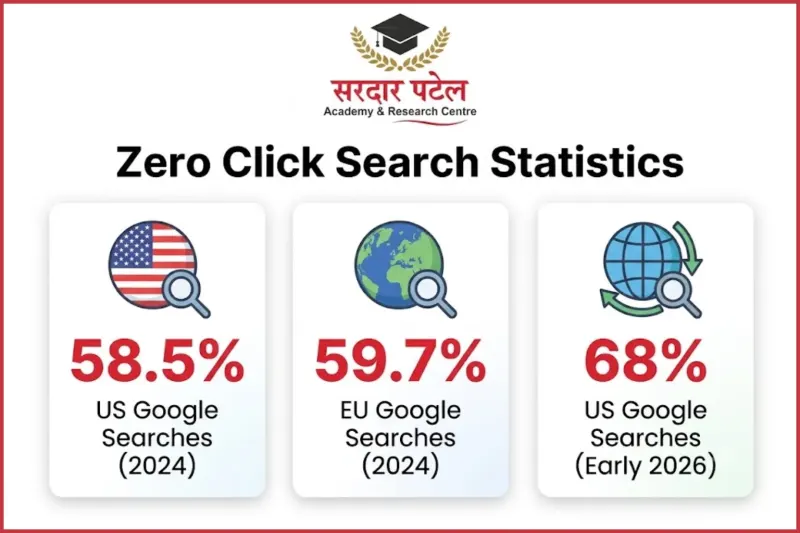
The safe takeaway is simple. Across several methods, more searches now resolve on the results page than in earlier SparkToro studies, and AI features are widely suspected to be accelerating that.
What Is Driving the Shift
AI Overviews and AI Mode
SparkToro named AI Overviews as a likely contributor to the 2026 increase, as reported by Search Engine Land, though the study did not measure how much of the rise they explain. It also found that AI Mode played a small role in that window, with just 0.34% of searches moving into it.
Google, for its part, says clicks from pages with AI Overviews tend to be higher quality, meaning visitors stay longer. Google has not shared detailed data to support this, so treat that as a claim rather than a proven result.
ChatGPT, Gemini and Perplexity
Answer engines add a second layer. People ask a question in a chat interface, receive a composed answer, and may never visit the source. To understand how these tools differ, read our comparison of ChatGPT, Google AI and Perplexity.
Voice Assistants and Rich Results
Spoken answers are the purest form of no-click search: the assistant reads out one response and moves on. Rich results such as star ratings, product details and event listings work in a similar way, giving the key facts before any click.
What It Means for Indian Search Behaviour
I could not find a public study that measures zero-click behaviour in India, so treat this section as practical reasoning rather than data. Two patterns are worth planning for.
First, local intent. A query such as "digital marketing course in GTB Nagar" is likely to trigger a map result with ratings, timings and a call button. A student can shortlist an institute without ever opening its website, so your business listing, reviews and contact details work as part of your content.
Second, language mixing. Many people search in Hindi, English or a blend of the two. Spoken queries add another layer, because an assistant usually reads back a single answer. Our piece on voice search SEO in India explains how to prepare for it.
Is It Really Bad News for Marketers?
Partly. These searches do remove traffic for simple, factual queries. If your site earned visits mainly by defining basic terms, expect a decline.
But it also creates openings:
- Brand exposure without a visit. Being named in an answer builds familiarity.
- Higher-intent clicks. People who do click often need more than a summary.
- Complex queries stay valuable. Comparisons, tutorials, tools and opinions still require a full page.
Consider a hypothetical coaching institute. A snippet answering "what is the syllabus for exam X" may cut visits to that page. Yet if the institute's name appears in the answer, students may later search for it directly. The visit may simply arrive later as a branded search, and the brand gains recall.
Search features change quickly, so keep up with the latest Google SEO updates rather than relying on last year's playbook.
A Step-by-Step Plan to Stay Visible
Google's own guidance on AI features and your website says established SEO best practices still apply. That is reassuring: you do not need a separate strategy, but you do need to sharpen the existing one.
Step 1: Sort your queries by how much a click is worth.
Answer-first results hit some topics far harder than others, so separate quick-answer queries from queries where users need depth. Our guide to AI-driven keyword research explains how to do this with modern tools.
Step 2: Lead with the answer.
Open each section with two or three sentences that fully answer the question. Then expand with context, examples and evidence. This format suits both snippets and AI summaries. For example, a section titled "What is zero click search?" could open with: "A zero click search is a search that ends on the results page without a click." The next paragraphs then add the data, examples and next steps.
Step 3: Structure content so machines can parse it.
Use descriptive headings, short paragraphs, tables and lists. Learn the principles in writing content AI search engines understand.of
Step 4: Get the technical and on-page basics right.
Google's guidance points to crawlability, internal links, page experience and text-based content. Structured data can also help search systems understand your page, though it does not guarantee inclusion in any AI feature.
Step 5: Strengthen brand and entity signals
Keep your organisation name, descriptions, author details and local listings consistent everywhere. For local businesses, an accurate Google Business Profile matters as much as the website.
Step 6: Publish what a summary cannot replace.
Original research, case studies, templates, calculators and first-hand experience give people a reason to visit.
Step 7: Make every click count.
When a visitor arrives, offer an obvious next step: a related guide, a download, a newsletter or a demo. Fewer clicks mean each one deserves more attention.
If you would like to practise these steps on real projects, the Digital Marketing Course with AI at Sardar Patel Academy & Research Centre (SPARC) covers SEO, social media marketing, Google Ads, AI tools, content marketing and analytics. Its page lists a 7-month duration and 50+ projects. You can review the full Digital Marketing Course with AI details before deciding.
How to Measure Success When Clicks Drop
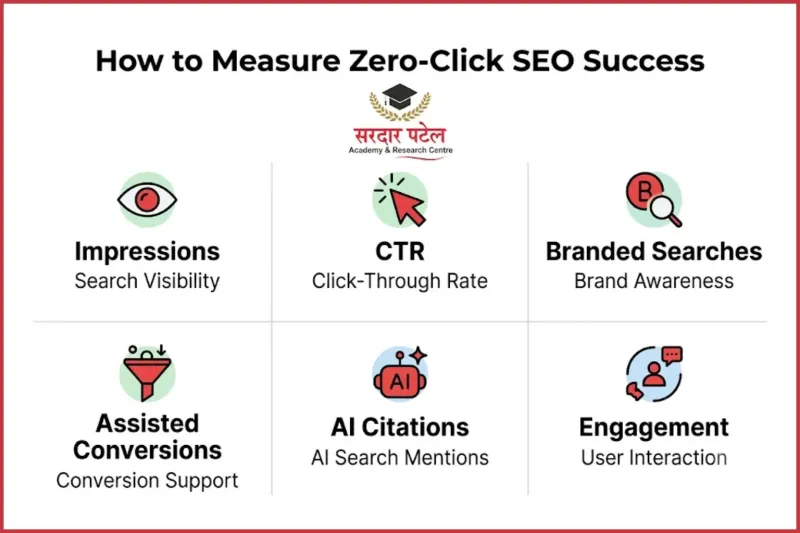
When more searches end on the results page, traffic alone no longer tells the whole story. Google has said that sites shown in AI features are counted within overall search traffic in Search Console, and it has since begun rolling out AI-specific performance reports and a control for site owners. Combine several signals instead.
| Metric |
Where to check |
What it tells you |
| Impressions |
Search Console |
Whether you are being shown, even without clicks |
| Click-through rate (CTR) |
Search Console |
Whether features like AI summaries are reducing clicks on key pages |
| Branded searches |
Search Console, Google Trends |
Whether visibility is building recall |
For AI-specific reporting, see the Generative AI report section in our Google AI Mode SEO guide.
Common Mistakes to Avoid
- Chasing every snippet. Some queries will never send traffic; focus where a click still has value.
- Writing thin answers. A one-line answer gives readers no reason to trust or visit you.
- Ignoring brands. If nobody remembers your name, being cited achieves little.
- Quoting statistics without context. Panel differences change the numbers; always name the source and method.
- Treating this shift as only a traffic problem. It is also a branding and measurement problem.
- Abandoning fundamentals. Technical health and helpful content still decide who gets selected. If you are unsure where to begin, run through our on-page SEO checklist.
Why Students Should Learn This Now
Digital marketing teams are increasingly asked to prove value when dashboards show fewer visits. People who understand how these searches work, along with AI search measurement, can explain these shifts to employers and clients. SPARC has been running skill-based courses in Delhi since 2003, with its flagship campus at GTB Nagar, and you can learn more about the institute on the Sardar Patel Academy & Research Centre website.
Conclusion
Zero-click search is not a passing glitch; it is a lasting feature of how people use search engines, and AI summaries are likely to keep it growing. Marketers who adapt will stop measuring success only by visits and start measuring visibility, recall and the quality of each click.
Begin with a small step: pick five pages, rewrite their openings to answer questions directly, and track impressions for a month. When you are ready for structured, hands-on learning, explore the Digital Marketing Course with AI at Sardar Patel Academy & Research Centre. Call +91 93129-66129, visit us at Kingsway Camp near GTB Nagar Metro Gate 4, or reach the team through the contact page.
FAQs
It describes a search that ends on the results page, with no click on any listing. The user may have found the answer, or may have refined the query instead.
Not necessarily. It reduces visits for simple queries but can raise brand awareness and leave complex, high-intent queries intact.
Studies suggest a majority of Google searches in the US and EU end without a click, though figures vary by method. SparkToro reported 58.5% for the US and 59.7% for the EU in 2024, and 68% for US searches in early 2026 using a different data panel.
It is the practice of optimising content to earn visibility, trust and brand recall from answer-style results, not just clicks.
They appear to contribute. Pew found fewer clicks on regular links when an AI summary showed, and SparkToro flagged them as a likely factor without measuring their exact share.
The goals overlap heavily. Zero-click SEO focuses on earning value from results that need no click, while AEO and GEO focus on being the source that answer engines use. The practical work is largely shared.
Keep local listings accurate, answer customer questions clearly on your site, build a recognisable brand and track impressions along with clicks.