+91 9312966129
 sparc.enquiry01@gmail.com


SQL Developer Career Opportunities
SQL Developer salary in India ranges from Rs. 4L to 30L+. Discover required skills, top job roles, fresher opportunities in Delhi NCR, and a career growth path for 2026.
Table of Contents
- Featured Snippet: Is SQL Developer a Good Career?
- What Is an SQL Developer?
- SQL Developer Career Opportunities in 2026
- Why Companies Continue Hiring SQL Developers
- Why SQL Skills Are Still in High Demand
- SQL Is Used Everywhere
- SQL as a Gateway Skill
- Skills Required to Become an SQL Developer
- SQL Query Writing
- Joins and Table Relationships
- Database Design
- Stored Procedures, Functions, and Triggers
- Performance Optimization
- Complementary Skills That Boost Salary
- 5. Roles and Responsibilities of an SQL Developer
- SQL Jobs for Freshers in Delhi and Other Cities
- Top Hiring Cities for SQL Professionals
- Entry-Level SQL Roles Freshers Can Apply For
- SQL Developer Salary in India
- Career Growth Path for SQL Developers
- Industries Hiring SQL Professionals
- Banking and Finance
- Healthcare
- E-Commerce and Retail
- Information Technology
- How to Become an SQL Developer
- Future Scope of SQL Development
- Conclusion
- Start Your SQL Career with SPARC
Featured Snippet: Is SQL Developer a Good Career?
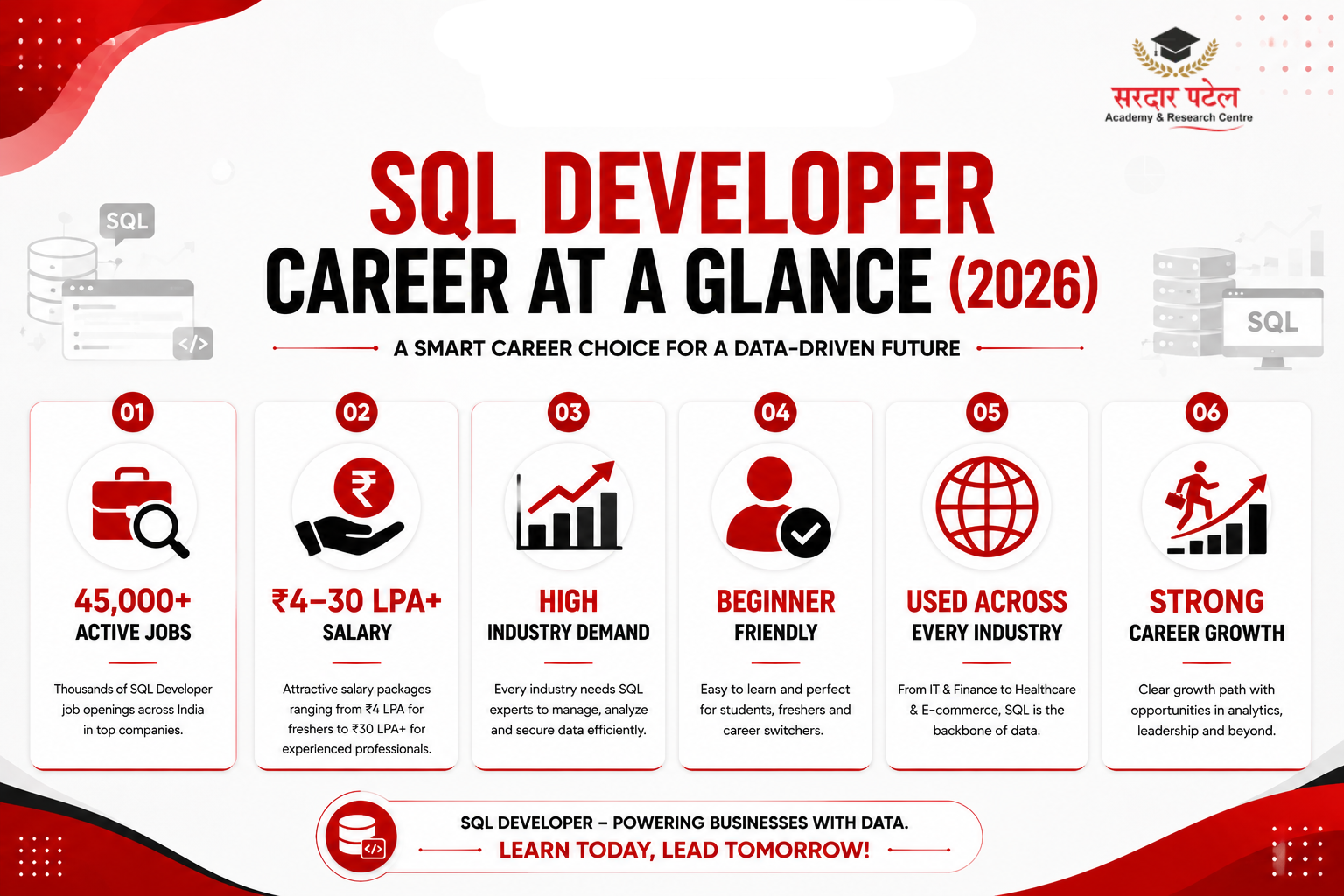
Yes. SQL Developer is one of the most stable tech careers in India. Every organisation — from banks and hospitals to e-commerce platforms and IT companies — depends on databases. This means demand for SQL professionals remains consistently high across industries, with salaries ranging from Rs. 4 LPA for freshers to Rs. 30 LPA+ for senior professionals Data Analytics Basics for Beginners.
Data powers almost every business decision today. Whether it is an e-commerce company tracking sales, a bank managing transactions, or a hospital storing patient records, data sits at the centre of operations. But data is only useful when professionals know how to organise, retrieve, and analyse it — and this is exactly where SQL Developers play a critical role.
According to NASSCOM Technology Industry Insights, demand for data and database professionals continues to grow across industries.
Structured Query Language (SQL) remains one of the most widely used technologies in the world. According to Stack Overflow’s Developer Survey 2024, SQL consistently ranks among the top 3 most-used languages globally. Organisations rely on SQL databases to manage massive amounts of information, making SQL professionals valuable across every major industry.
Whether you are a student, fresher, working professional, or someone planning a career switch, SQL offers a strong foundation for entering the fields of software development, data analytics, business intelligence, and database administration. This guide covers everything you need to know about building a career in SQL development in India in 2026.
What Is an SQL Developer?
An SQL Developer is a professional who works with relational databases using Structured Query Language (SQL). Their primary job is to create, manage, optimise, and retrieve data from databases so that businesses can make informed decisions, run their applications, and generate accurate reports.
SQL Developers are essential members of software development, analytics, and business intelligence teams. They work across industries, including IT, banking, healthcare, e-commerce, and retail. Popular database platforms SQL developers work with include:
- MySQL — the most popular open-source database, widely used in web applications
- Microsoft SQL Server — standard in enterprise and corporate environments
- PostgreSQL — an advanced open-source database preferred for complex analytics
- Oracle Database — used in large-scale banking and financial systems
- MariaDB — a lightweight alternative to MySQL, growing in cloud environments
What Is Data Analytics?
SQL Developer Career Opportunities in 2026
The demand for SQL professionals in India continues to grow rapidly. A search on Naukri.com in June 2026 shows over 45,000 active job listings requiring SQL skills across India, spanning roles in data analytics, business intelligence, software development, and database administration.
Modern SQL professionals are not limited to traditional database management. Today’s SQL career opportunities extend into:
- Data Analytics — extracting insights from business data to drive decisions
- Business Intelligence — building dashboards and reports using tools like Power BI
- Software Development — writing backend queries for applications
- Database Administration (DBA) — managing, securing, and optimising databases, Oracle SQL Documentation
- Data Engineering — building data pipelines and warehouses
- Cloud Computing — managing databases on AWS, Azure, and Google Cloud
Why Companies Continue Hiring SQL Developers
Organisations across India need SQL experts to manage growing volumes of business data. From generating daily MIS reports to supporting customer-facing platforms, SQL developers keep business operations running smoothly. As digital transformation accelerates, the need for professionals who can handle structured data efficiently will only increase. Microsoft Learn – SQL Training
Why SQL Skills Are Still in High Demand
Technology changes rapidly, but SQL has remained relevant for over four decades. The reason is simple: nearly every business that stores data uses a relational database, and SQL is the universal language for communicating with them.
SQL Is Used Everywhere
From small startups to Fortune 500 companies, SQL powers critical systems including banking transaction platforms, hospital management software, e-commerce inventory systems, ERP and CRM platforms, and mobile application backends. Without SQL professionals, accessing and managing this data efficiently becomes impossible.
SQL as a Gateway Skill
One of SQL’s biggest advantages as a career choice is how it opens doors to multiple high-paying roles. Professionals who start with SQL commonly transition into Data Analyst, Business Analyst, BI Developer, Database Administrator, Data Engineer, and Power BI Developer roles — often with significant salary jumps at each stage.
Skills Required to Become an SQL Developer
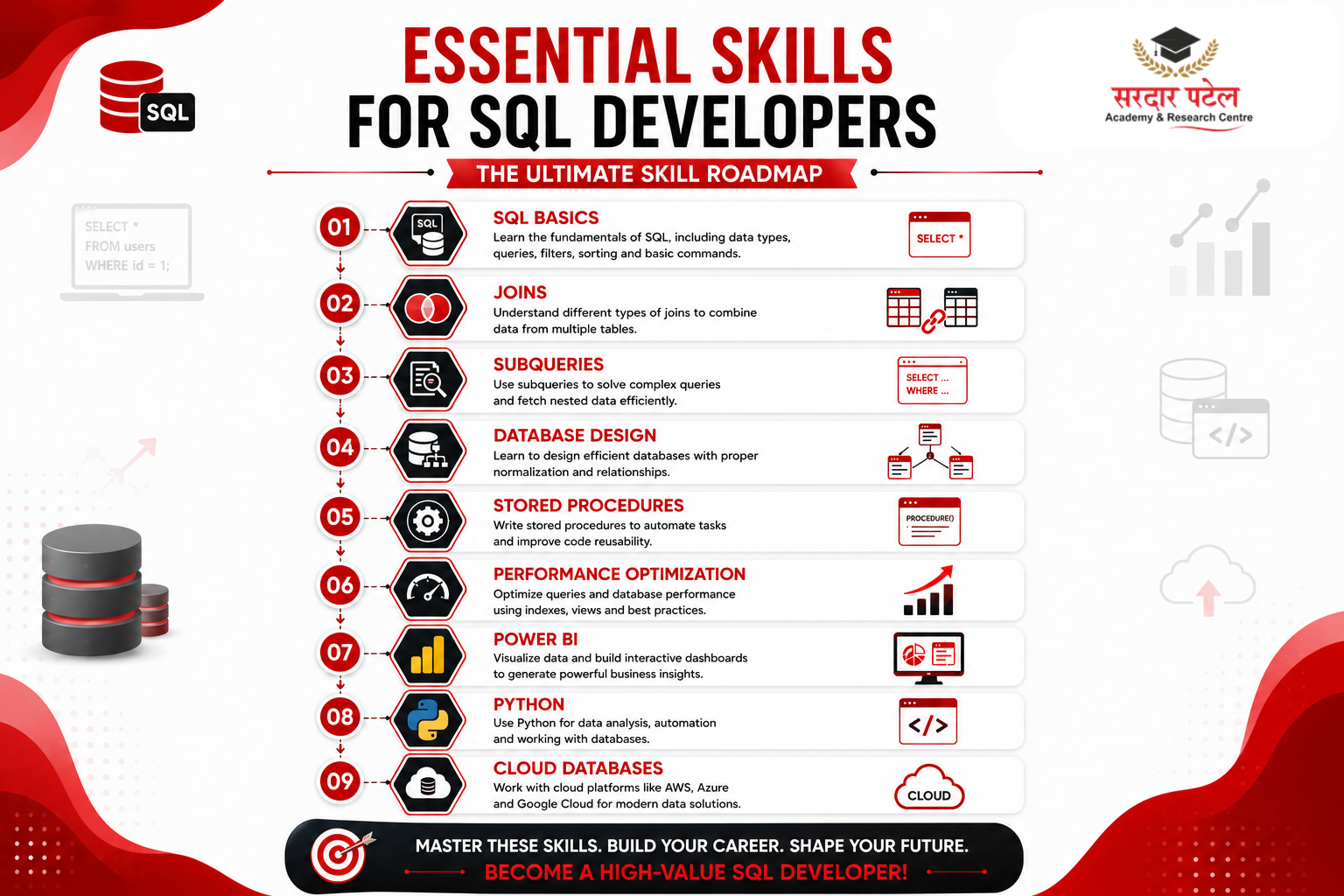
Becoming a successful SQL developer requires both technical knowledge and problem-solving ability. Here are the core skills employers look for:
SQL Query Writing
The foundation of every SQL role is the ability to write accurate, efficient queries. This includes SELECT statements, WHERE filters, ORDER BY sorting, GROUP BY aggregation, HAVING conditions, and DISTINCT filtering. Freshers are expected to write basic queries; senior developers must write optimised, complex queries handling millions of rows.
Joins and Table Relationships
Most real-world databases contain multiple related tables. SQL developers must understand INNER JOIN, LEFT JOIN, RIGHT JOIN, FULL JOIN, and SELF JOIN to retrieve data accurately from multiple sources. This is one of the most commonly tested skills in SQL interviews.
Database Design
Good database design directly impacts application performance. SQL developers should understand Primary Keys, Foreign Keys, Normalisation (1NF, 2NF, 3NF), Indexing strategies, and Constraints. Poor design leads to data inconsistencies and slow queries — problems that are expensive to fix later.
Stored Procedures, Functions, and Triggers
Advanced SQL developers automate repetitive tasks using Stored Procedures, User-Defined Functions, Triggers, and Views. These skills are commonly required in mid-level and senior SQL roles and significantly improve efficiency.
Performance Optimization
As databases grow, query performance becomes critical. SQL developers must know how to analyse Execution Plans, apply Indexing Strategies, rewrite inefficient queries, and use Performance Tuning techniques. This skill set is what separates junior developers from senior ones.
Complementary Skills That Boost Salary
Professionals who combine SQL with Power BI, Python, Excel advanced functions, cloud platforms (AWS RDS, Azure SQL), or data visualization tools consistently earn 30-50% higher salaries than those with SQL skills alone. Data Analytics Tools You Must Know
Roles and Responsibilities of an SQL Developer
An SQL Developer’s day-to-day work spans database development, data retrieval, performance monitoring, and application support. Core responsibilities include:
- Designing and creating database tables, schemas, and relationships based on business requirements
- Writing complex SQL queries to extract, transform, and load data for reports and analytics
- Building and maintaining stored procedures, functions, triggers, and views
- Monitoring database performance and resolving bottlenecks or errors
- Managing backups, recovery procedures, and database security
- Collaborating with software development teams to ensure applications interact correctly with databases
- Preparing MIS reports, dashboards, and data summaries for management decision-making
SQL Jobs for Freshers in Delhi and Other Cities
The demand for SQL jobs among freshers in Delhi-NCR remains strong due to the region’s large concentration of IT companies, analytics firms, and shared service centres. Cities like Gurgaon and Noida are particularly active hiring markets for entry-level database roles.
Top Hiring Cities for SQL Professionals
- Delhi NCR (Gurgaon, Noida) — large IT parks and MNC service centres
- Bengaluru — India’s tech capital, with the highest demand for data professionals
- Hyderabad — growing analytics and IT hub
- Pune — strong presence of IT and manufacturing companies
- Chennai and Mumbai — financial services and enterprise IT
Entry-Level SQL Roles Freshers Can Apply For
- SQL Developer (Junior)
- Data Analyst Trainee
- MIS Executive
- Reporting Analyst
- Business Intelligence Associate
- Database Support Executive
Most companies hiring freshers look for strong SQL fundamentals, the ability to write basic to intermediate queries, and ideally one or two project examples. Formal certifications or a structured training program significantly improves selection chances.
SQL Developer Salary in India
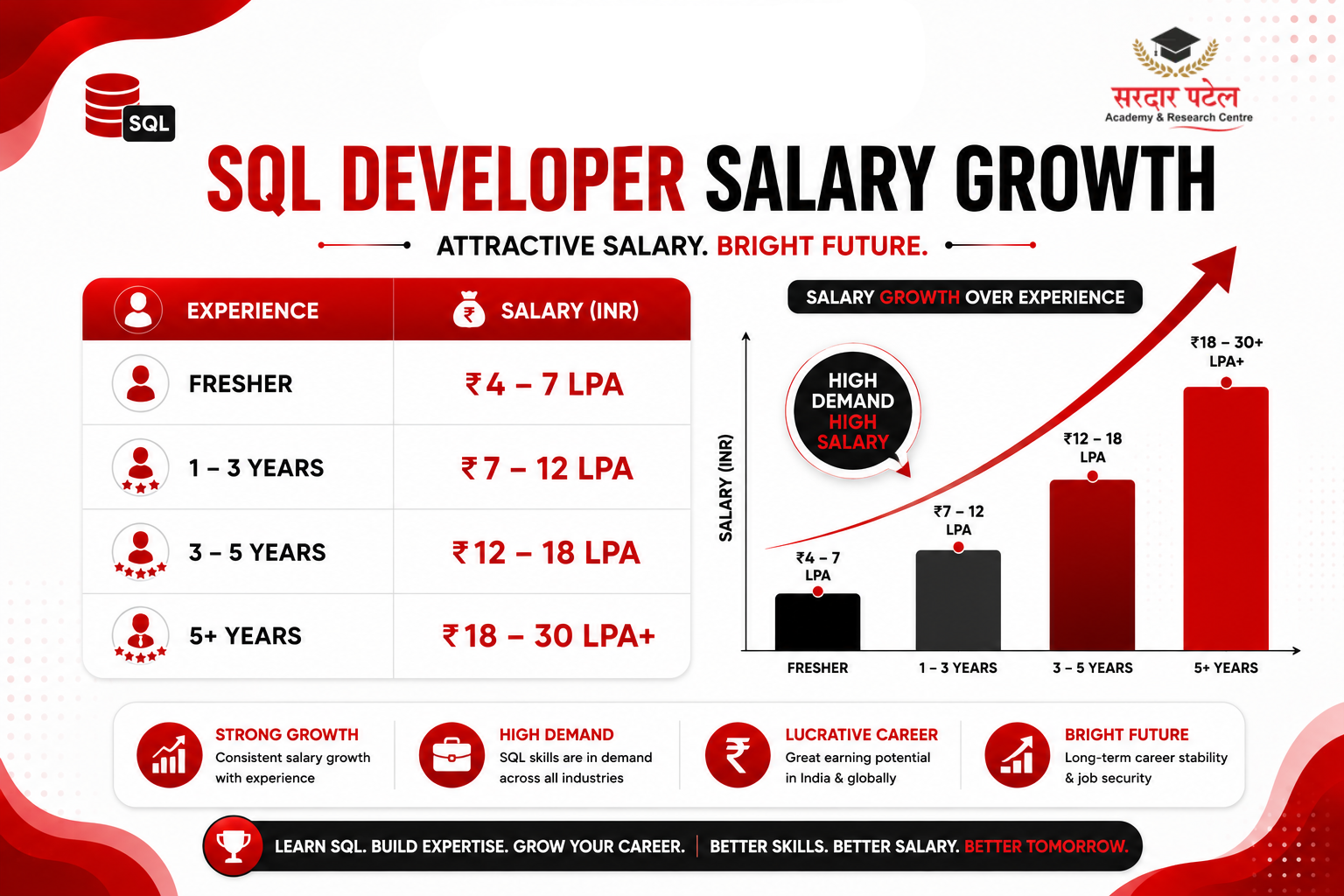
SQL developer salaries in India vary based on experience, skills, certifications, industry, and location. The following data is based on listings from Naukri.com and Glassdoor India as of June 2026:
| Experience Level |
Average Salary |
Top Cities |
Key Skills |
| Fresher (0-1 yr) |
Rs. 4-7 LPA |
Delhi NCR, Bengaluru |
SQL Basics, Excel |
| 1-3 Years |
Rs. 7-12 LPA |
Hyderabad, Pune |
Joins, Stored Proc. |
| 3-5 Years |
Rs. 12-18 LPA |
Mumbai, Chennai |
Power BI, Python |
| 5+ Years |
Rs. 18-30 LPA+ |
All Major Cities |
Cloud, DBA, BI |
Source: Naukri.com, Glassdoor India — June 2026. Ranges reflect base salary; total compensation, including bonuses, may be higher.AmbitionBox SQL Developer Salaries
Data Analytics Career Scope, Skills & Salaries
Professionals who combine SQL with Power BI, Python, or cloud database technologies (AWS RDS, Azure SQL Database) consistently earn at the upper end of these ranges or above.
Career Growth Path for SQL Developers
SQL offers one of the clearest and most rewarding career progression paths in the technology sector. Starting as junior developers, professionals can advance into data architecture and analytics leadership roles within 8-10 years.
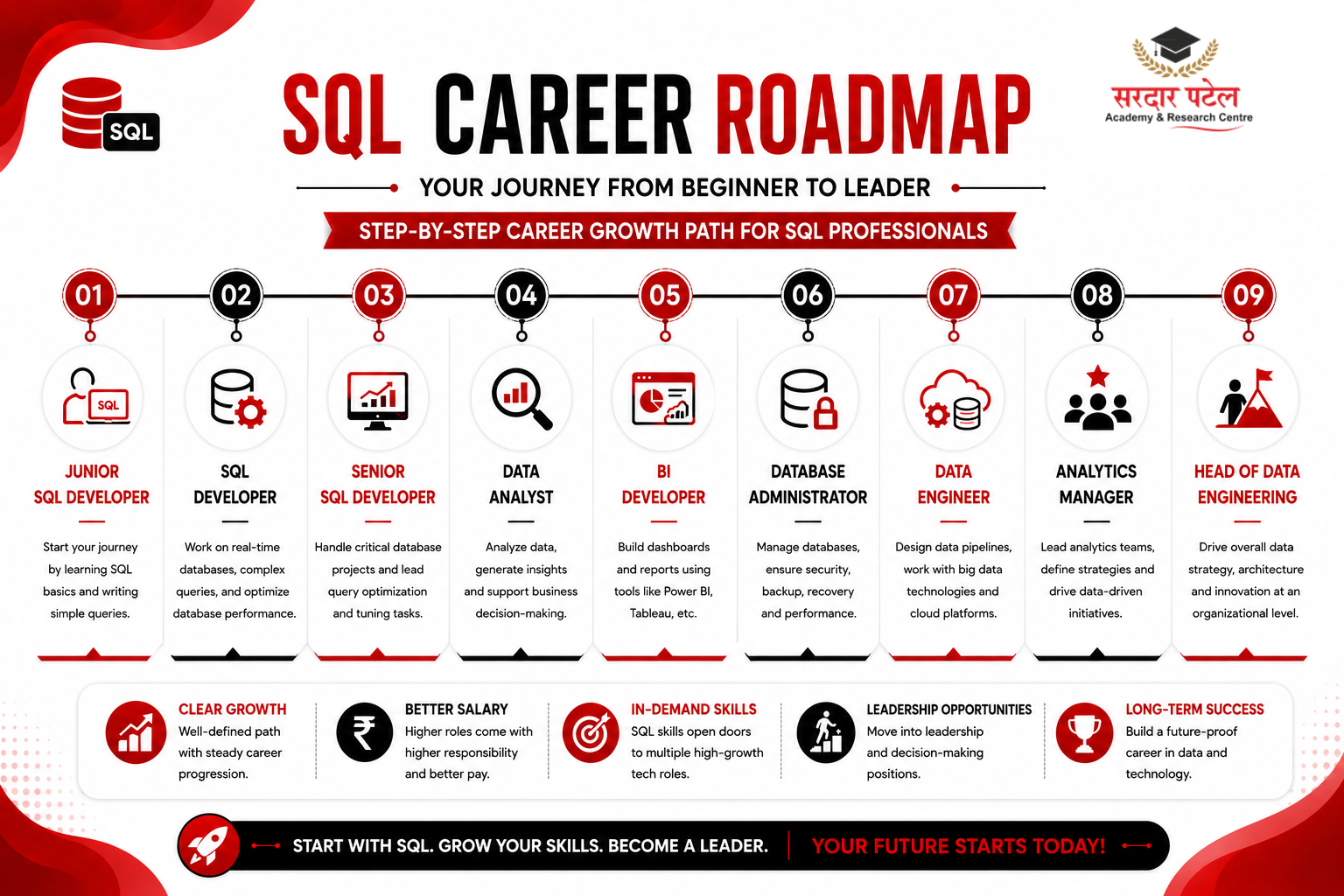
Entry-Level (0-2 Years)
- SQL Developer / Junior Database Developer
- Reporting Analyst
- MIS Executive
Mid-Level (2-5 Years) - Senior SQL Developer
- Data Analyst
- BI Developer (Power BI / Tableau)
Advanced (5-8 Years) - Database Administrator (DBA)
- Data Engineer
- BI Consultant
Leadership (8+ Years) - Data Architect
- Analytics Manager
- Head of Data Engineering
The versatility of SQL means professionals can specialise in analytics, cloud infrastructure, or business intelligence — all of which offer distinct, high-paying career tracks.
Industries Hiring SQL Professionals
SQL skills are valuable across virtually every major industry in India. Here is how different sectors use SQL professionals:
Banking and Finance
Banks and financial institutions use SQL for transaction processing, risk analysis, regulatory reporting, fraud detection, and customer data management. This sector offers some of the highest SQL salaries due to the complexity and volume of data involved.
Healthcare
Hospitals and healthcare companies use SQL to manage patient records, generate clinical reports, track billing and insurance claims, and support health analytics platforms. With healthcare digitisation accelerating post-COVID, demand in this sector is growing.
E-Commerce and Retail
E-commerce platforms rely on SQL for customer analytics, sales tracking, inventory management, recommendation engine data, and supply chain reporting. Companies like Flipkart, Amazon India, and Myntra actively hire SQL professionals.
Information Technology
IT companies use SQL developers for backend application support, data migration projects, software testing, and internal reporting systems. This remains the largest single employer of SQL professionals in India.
How to Become an SQL Developer
Following a structured learning path significantly increases your chances of landing a good SQL role quickly. Here is a recommended step-by-step approach:
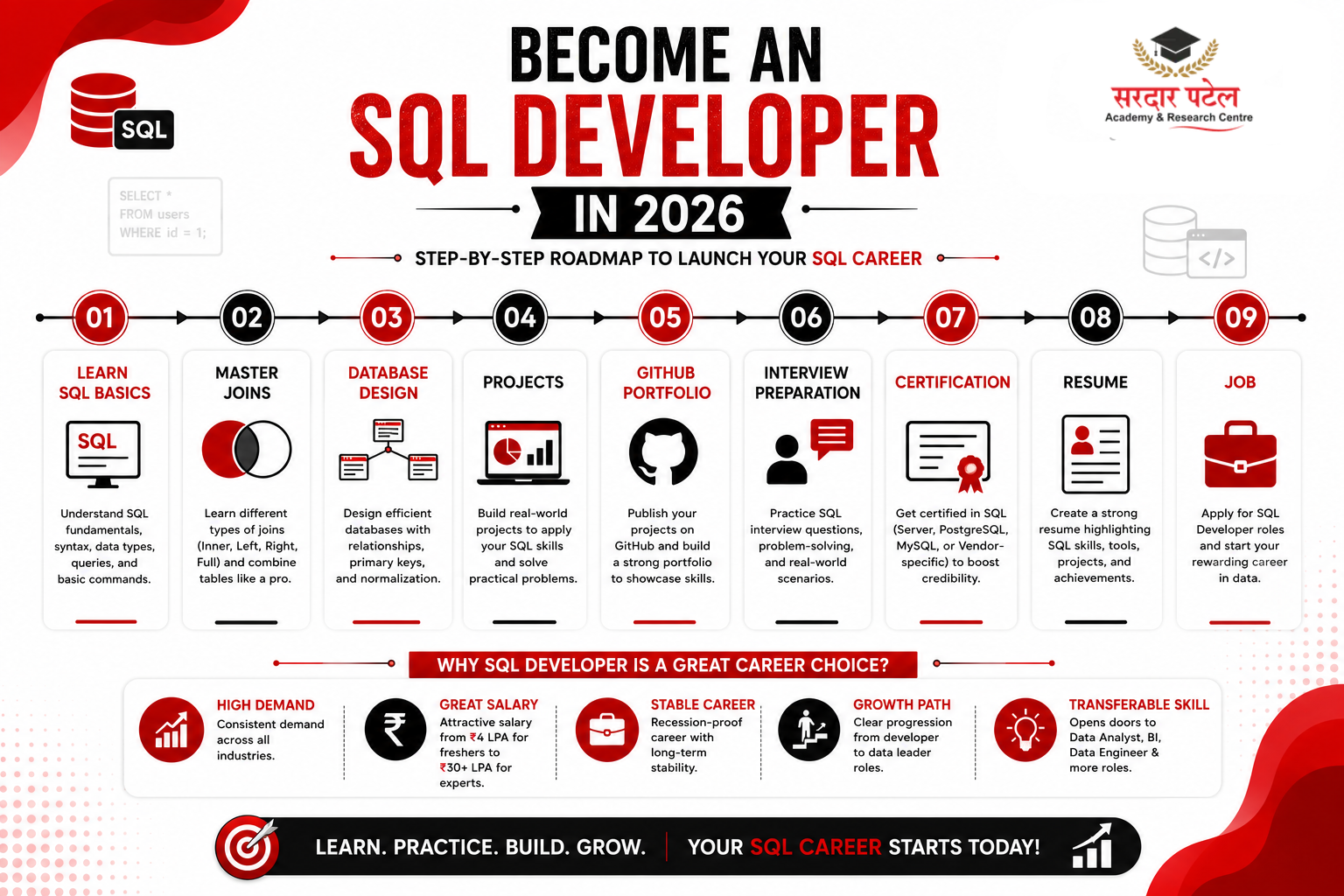
Step 1: Learn SQL Fundamentals
Begin with the basics — SELECT, WHERE, ORDER BY, GROUP BY, HAVING, and aggregate functions like COUNT, SUM, AVG. Practice writing queries on a real database tool like MySQL Workbench or DB Browser for SQLite.
If you're starting from scratch, our SQL Basics Tutorial for Students covers the essential concepts, syntax, and practice examples needed to build a strong foundation.
Step 2: Master Joins and Subqueries
Once the basics are comfortable, focus on joining multiple tables and writing subqueries. These are the most commonly tested topics in SQL interviews and are used daily in professional work.
Step 3: Learn Database Design
Understand how to design normalised databases with proper Primary Keys, Foreign Keys, and relationships. Build a small project like a Library or Hospital database from scratch.
Complete Data Analytics Learning Guide
Step 4: Work on Real Projects
Project experience is what differentiates candidates in interviews. Build an Inventory Management System, a Sales Reporting Database, or an Employee Performance Tracker. Use real datasets from Kaggle or government open data portals.
Step 5: Build a Portfolio and Prepare for Interviews
Upload your SQL scripts and project documentation to GitHub. Practice SQL query challenges on platforms like LeetCode, HackerRank, and SQLZoo. Prepare for scenario-based interview questions on database design and query optimisation.
You can also practice our Internship vs Full Time Data Analytics Job to improve your confidence before technical interviews.
Future Scope of SQL Development
SQL’s future remains strong despite the rise of NoSQL databases, big data tools, and AI-driven analytics. The reason is that structured, relational data is not going away — if anything, the explosion of data from digital transactions is increasing the need for professionals who can manage it reliably.
Key trends driving demand for SQL professionals in the coming years include:
- Cloud database growth — AWS RDS, Azure SQL, and Google Cloud SQL are expanding rapidly
- Business intelligence adoption — every mid-size company now wants dashboards and reports
- Data engineering — building pipelines that feed analytics platforms requires strong SQL skills
- AI and machine learning — training data preparation still heavily relies on SQL
- Digital transformation — as more businesses go digital, database needs multiply
Professionals who combine SQL with cloud skills, Python, and BI tools will be particularly well-positioned for the high-growth roles in the next 5-10 years. To stay updated with emerging technologies and industry demand, explore our guide on Future of Business Intelligence Careers
Conclusion
SQL development offers one of the most stable, well-paying, and versatile career paths in India’s technology sector. With over 45,000+ active job listings, strong salary growth from entry to senior levels, and clear pathways into data analytics, business intelligence, and cloud database roles, SQL remains a future-proof skill in 2026 and beyond.
Data Analytics Course Eligibility and Career Opportunities
The growing number of SQL jobs for freshers in Delhi, Bengaluru, Hyderabad, and other major cities reflects the continued and expanding demand for database professionals. Whether you are entering the job market for the first time or looking to add a high-value technical skill to your profile, SQL is an excellent starting point.
Ready to launch your career in SQL and data analytics? Visit SPARC to explore our industry-focused training programs, upcoming batches, and placement support.
Start Your SQL Career with SPARC
At SPARC, our Data Analytics Course includes SQL, Excel, Power BI, Tableau, Python, live projects, and placement assistance to prepare you for database and analytics careers.
What You Will Learn:
- SQL Fundamentals and Advanced Queries
- Database Design and Normalisation
- Joins, Functions, Stored Procedures, and Triggers
- Reporting and Data Analysis with Real Industry Projects
- Interview Preparation and Portfolio Development
Career Support Includes:
- Resume Building and LinkedIn Optimisation
- Mock Interviews and Placement Assistance
FAQs
Yes. SQL remains one of the most in-demand database technologies globally. In India, active SQL job listings on major portals exceed 45,000+ as of mid-2026, spanning industries from IT and banking to healthcare and retail. The career offers strong salary growth, multiple specialization paths, and long-term stability.
Absolutely. Many organizations actively hire freshers for SQL Developer, Data Analyst, and Reporting Analyst roles. The key is demonstrating strong SQL fundamentals and practical project experience. Structured training programs with hands-on projects significantly improve hiring chances.
Freshers with good SQL skills typically earn between Rs. 4-7 LPA depending on skills, company size, and location. Delhi NCR and Bengaluru tend to offer higher fresher packages. Adding complementary skills like Power BI or Python can push starting salaries toward the upper range.
No. SQL is widely considered one of the most beginner-friendly technical skills because of its English-like syntax. Most learners can write basic queries within a week of starting. Advanced topics like optimization and stored procedures take longer but are learned through practice on real projects.
Basic programming knowledge is helpful but not required. SQL can be learned independently by complete beginners. However, combining SQL with Python scripting is valuable for data engineering and analytics roles.
Banking and finance, IT services, healthcare, e-commerce, retail, manufacturing, telecom, and consulting companies all actively hire SQL professionals. Finance and IT sectors offer the highest salaries.
Power BI and Tableau for data visualization, Python for data analysis and automation, Advanced Excel for reporting, cloud database platforms (AWS RDS, Azure SQL), and data warehousing concepts are all highly valuable skills to combine with SQL.