+91 9312966129
 sparc.enquiry01@gmail.com



AI Content Quality Checklist for Digital Marketers
Use this AI Content Quality Checklist to verify facts, improve originality, check SEO, and review AI-generated content before publishing.

Table of Contents
- What Is an AI Content Quality Checklist?
- What Google Says About AI-Assisted Content
- The 10-Point AI Content Checklis
- Strategy checks
- Accuracy checks
- Voice and originality checks
- SEO and usability checks
- AI Content Quality Checklist at a Glance
- Worked Example: Fixing a Weak AI Paragraph
- SEO Content Checklist for AI-Assisted Pages
- Common Mistakes to Avoid
- A Simple Review Workflow
- After You Publish
- Skills Worth Building
- Conclusion
Publishing AI-generated content is easy, but publishing content that people actually trust takes more than a few well-written prompts. What if your article contains outdated information, repetitive ideas or advice that adds nothing new to the reader? Even when an AI-generated draft looks polished and well-structured, it may still lack originality, factual accuracy or the human touch needed to connect with your audience. These small mistakes can affect your content's credibility, user experience and overall search performance.
That's where an AI content quality checklist becomes essential. It gives you a practical way to evaluate your content, identify hidden weaknesses and make meaningful improvements before publishing. From checking factual accuracy and originality to improving readability, relevance and search intent, every step plays an important role in creating valuable content. In this guide, we'll explore 10 important checks to help you turn AI-generated drafts into high-quality, reader-focused content that builds trust, delivers real value and deserves your audience's attention.
What Is an AI Content Quality Checklist?
An AI content quality checklist is a fixed list of review questions that every AI-assisted draft must pass before it goes live. It sits between "generated" and "published."
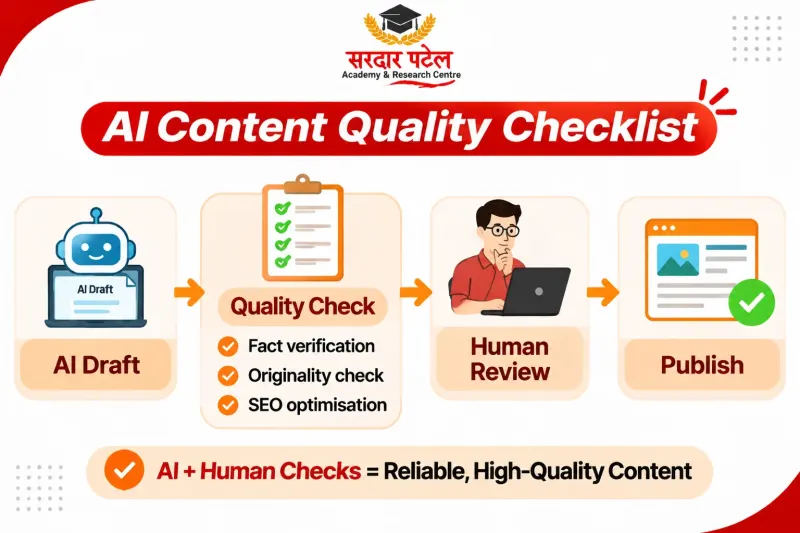
AI drafts fail in predictable ways. They state wrong facts with confidence, give advice so vague it fits any business, repeat phrases, rely on outdated details and settle into a flat tone. A reliable AI content quality checklist turns each of those weaknesses into a check any editor can run, so quality doesn't depend on who happens to be reviewing that day.
It also protects your wider strategy. Content only builds trust when readers can rely on it, which is the idea behind what content marketing is and why it matters.
What Google Says About AI-Assisted Content
Google does not ban AI-written pages. Its guidance on generative AI content says these tools can help with research and with structuring original work, as long as the result meets Search Essentials and the spam policies.
That page was updated on 1 October 2026. It now says it is critical to manually fact-check and review AI-generated content before publishing, because generative models predict likely wording rather than retrieve facts. The other line Google draws is scale: its March 2024 spam update targets mass-produced pages mainly to chase rankings.
The takeaway: how a page was produced matters less than whether it helps the reader.
The 10-Point AI Content Checklist
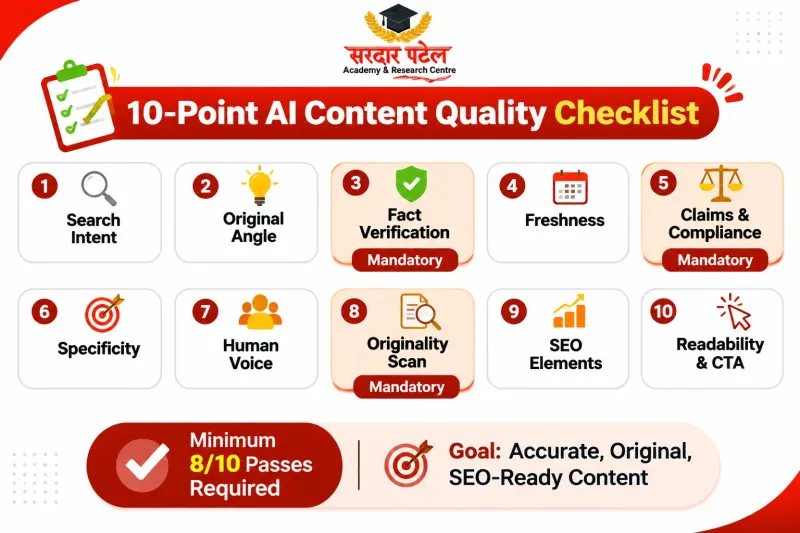
Work through the checks in order and score yourself as you go. A draft needs at least 8 of 10 passes, and checks 3, 5 and 8 are mandatory, whatever the total. Treat this AI content quality checklist as a gate, not a suggestion. The summary table follows the checks.
Strategy checks
1. Confirm the search intent.
Search your target query and note the format of the top five results (guide, list, tool, comparison) and the questions they all answer. Your draft should cover those questions and add something they miss. If it answers a different question, fix the angle before touching the wording.
2. Add an angle AI can't supply.
A model summarises what already exists. Your edge is original input: campaign data, a client scenario, a screenshot, a lesson from a failed test. Google's own people-first content guidance asks whether a page offers original information and real expertise, which is a useful test here.
Accuracy checks
3. Verify every fact, number and name.
Treat statistics, dates, tool features and quotes as unverified until matched to a source. Prefer primary sources (official documentation, original studies, company announcements) over summaries, and summaries over commentary. Open every link the AI gives you, because references can look real and still be wrong. If you can't find support, delete the line. Google now says the same thing about manual review, as this report on the October update shows.
4. Check freshness.
Platform features change quickly. Confirm tool names, menus, limits and dates against recent material, such as our guide on How AI Is Changing Google Ads in 2026.
5. Review claims and compliance.
Remove promises you can't back up, such as "guaranteed rankings." For health, finance or legal topics, get a qualified reviewer.
Voice and originality checks
6. Rewrite the generic parts.
Replace stock phrases such as "in today's fast-paced digital world," "game-changer" and "it is important to note that" with specifics: who, which tool, what result.
7. Edit for a human voice.
Read the draft aloud, vary sentence length and cut repeated transitions until it sounds like your brand.
8. Run a plagiarism and duplication scan.
Use a dependable checker and also compare the draft against your own existing pages to avoid internal overlap. A tool's score is a guide, not a guarantee, so follow it with manual judgment.
SEO and usability checks
9. Apply your SEO content checklist.
Title, meta description, headings, internal links, image alt text and structured data all need a human pass. Beginners can start with our On Page SEO Checklist for Beginners.
10. Check readability and the next step.
Use short paragraphs, descriptive subheadings, tables where they help and one clear call to action.
AI Content Quality Checklist at a Glance
| # |
Check |
You pass when… |
| 1 | Search intent |
The draft answers the query's real question |
| 2 | Original angle |
At least one first-hand example or data point is included |
| 3 | Fact verification |
Every claim maps to a reliable source |
| 4 | Freshness |
Tool features and dates are current |
| 5 | Claims and compliance |
No unsupported promises remain |
| 6 | Specificity |
Stock phrases are replaced with concrete detail |
| 7 | Human voice |
The text reads naturally aloud |
| 8 | Originality scan |
No unintended overlap with other pages |
| 9 | SEO elements |
Metadata, headings, links and alt text are reviewed |
| 10 | Readability and CTA |
The page is scannable and has one clear next step |
Worked Example: Fixing a Weak AI Paragraph
Here is an illustrative before-and-after (a hypothetical example, not client data) showing the checklist at work.
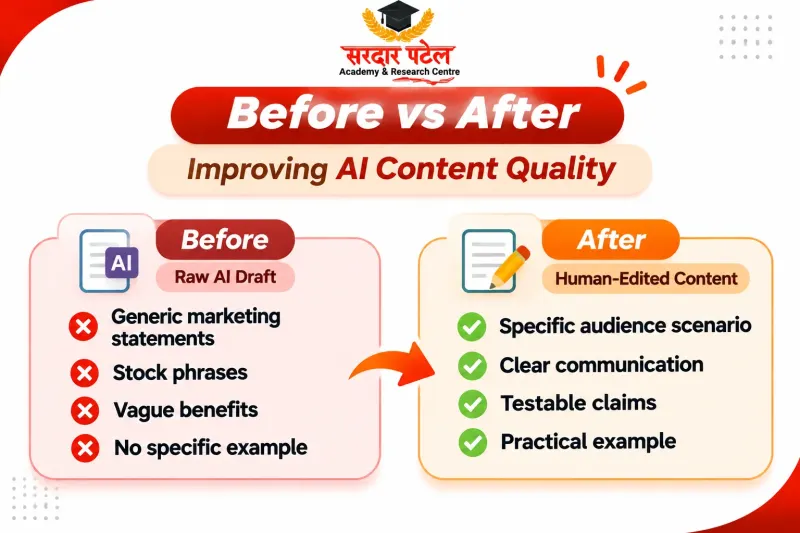
| Before (raw AI draft): "Email marketing is a powerful tool that can help businesses grow. In today's fast-paced digital world, subject lines are very important for success." After (edited): "A subject line gets about one glance in a crowded inbox to earn the open. If you're announcing a free demo class, 'Free demo class this Saturday' tells the reader what it is and when. Split-test it against a curiosity-style line on part of your list and keep the winner." |
SEO Content Checklist for AI-Assisted Pages
A good SEO content checklist doesn't replace quality. It makes sure quality can be found. AI drafts often slip on the same technical details, so give them a dedicated pass:
| Element |
What to verify |
Typical AI slip |
| Title tag |
Main topic included, reads naturally, fits display length |
Bland or oversized titles |
| Meta description |
Accurate summary that invites a click |
Repeats the intro |
| Headings |
Logical H1–H3 hierarchy that mirrors intent |
Vague headings like "Key Insights" |
| Internal links |
Relevant, descriptive anchor text |
Links dropped in random spots |
| External links |
Authoritative, specific pages, not homepages |
Invented or dead URLs |
| Images |
Descriptive alt text, compressed files |
Missing or generic alt text |
| Keywords |
Natural use with related terms such as E-E-A-T and topical relevance |
Stuffing or awkward repetition |
The same review applies to ad headlines and descriptions written with AI. If paid search is part of your work, start with How AI-Powered Google Ads Campaigns Work so you know what the platform automates and what you still approve.
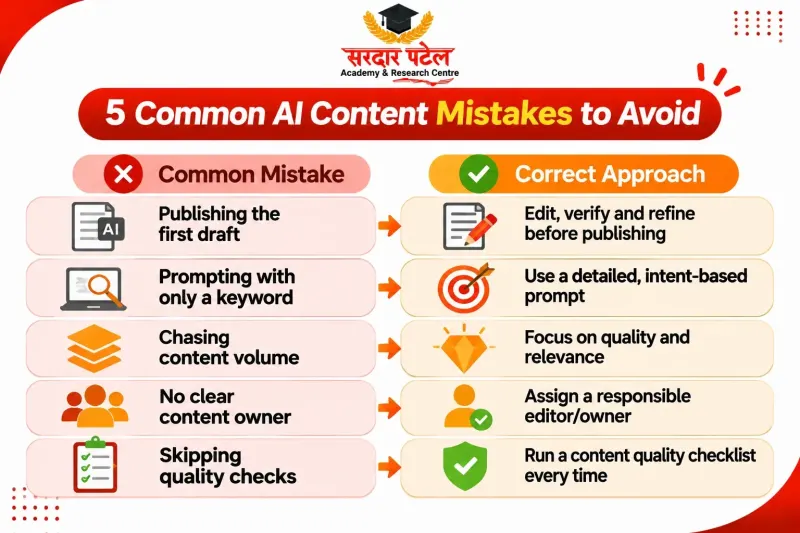
Common Mistakes to Avoid
- Publishing the first draft. It's the fastest route to thin, forgettable content.
- Prompting with only a keyword. Give the tool a brief covering audience, intent, tone and the sources you trust.
- Chasing volume. Publishing dozens of pages without added value is what Google's 2024 low-quality content update set out to reduce.
- No clear owner. Assign a named editor to approve each piece. If you automate parts of the routine, first understand the difference between an AI agent and marketing automation.
- Skipping the checklist when a deadline looms. That is exactly when errors slip through.
A Simple Review Workflow
- Write a brief: audience, intent, angle and the sources you trust.
- Generate an outline and a first draft, then add your own examples, test results and opinions. If you're still choosing tools, see AI tools every digital marketing student should know.
- Fact-check every claim and link, then run the draft through the checklist and fix what fails.
- Have a second person do the final read. Final approval should stay human.
After You Publish
Quality control doesn't end at the publish button. Check impressions, clicks and click-through rate in Google Search Console, plus time on page and scroll depth in your analytics tool. Review the page again after a few weeks and update anything that has aged. Then feed what you learn back into your checklist, for example by adding a new red-flag phrase or a source you now trust.
If you also run AI-driven search campaigns, read Google AI Max for Search Campaigns: What Marketers Should Know so your landing page content matches how those campaigns find searchers.
Skills Worth Building
Knowing how to apply an AI content quality checklist is a practical, employable skill, because it shows you can use AI tools without lowering editorial standards. Our student employability whitepaper, Skills Companies Want, looks at what employers look for.
If you'd like structured training, the SPARC digital marketing course runs for 7 months and covers SEO, social media marketing, Google Ads, AI tools, content marketing and analytics, with 50+ projects. Before you enrol anywhere, run through the Digital Marketing Course Checklist Before You Enrol.
Conclusion
AI can speed up content creation, but quality still depends on human judgment. An AI content quality checklist helps you maintain that quality by ensuring your content is accurate, original, relevant and aligned with search intent. From fact-checking to improving readability and adding genuine value, these simple checks can make a meaningful difference in what you publish.
If you're looking to build these skills further, learning how AI fits into real-world digital marketing can be a great next step. Explore Sardar Patel Academy's 7-month Digital Marketing Course with AI, featuring 50+ practical projects, to gain hands-on experience and strengthen your digital marketing skills.
FAQs
An AI content quality checklist is a step-by-step review list that checks AI-assisted drafts for accuracy, originality, usefulness, voice and SEO before publication.
Google's guidance focuses on value, not production method. Content created mainly to manipulate rankings can violate its spam policies, but helpful AI-assisted content is not banned. Check Google's current Search Central documentation for the latest wording.
Add first-hand examples, vary sentence rhythm, remove stock phrases and read the draft aloud. Replace generic statements with specific details from your own experience.
Google's earlier guidance suggested being transparent where readers would reasonably wonder how content was made, and advised against listing AI as the author. Follow your industry's norms and any client or platform rules.
No. They measure similarity to indexed text, not accuracy or usefulness. Pair them with fact-checking and editorial review.
Review it whenever search guidance or your tools change, and at least every few months. Add new checks when you notice the same error appearing repeatedly.