+91 9312966129
 sparc.enquiry01@gmail.com

Accounting Career Options After 12th Arts
Explore accounting career options after 12th arts: Tally and diploma courses, skills, entry-level jobs and a step-by-step path. Learn in Delhi.
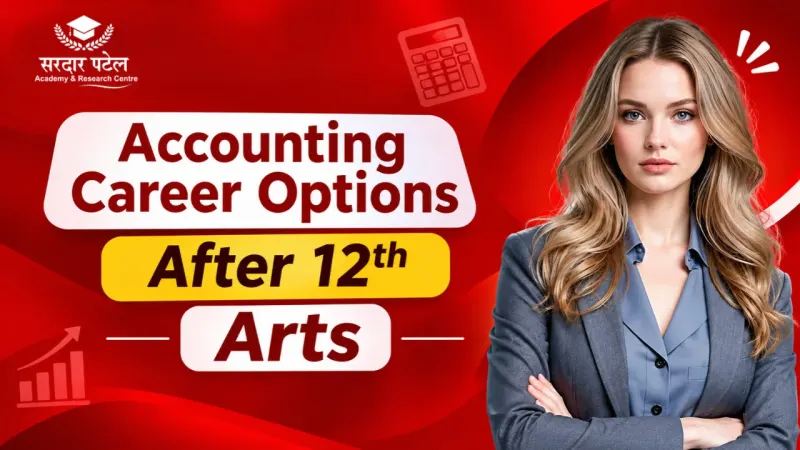
Table of Contents
- Can Arts Students Really Build a Career in Accounting?
- Accounting Courses After 12th Arts Worth Considering
- 1. Certificate and Diploma Courses in Accounting
- 2. Tally Course After 12th Arts
- 3. B.Com or BBA (If You're Open to a Degree Route)
- 4. Foundation-Level Courses (CA Foundation / CMA Foundation)
- Comparing the Options at a Glance
- Accounting Skills for Beginners: What You Actually Need to Learn
- Core accounting concepts
- Software skills
- Compliance basics
- Soft skills that matter more than people expect
- Accounting Jobs You Can Realistically Target
- Building Your Accounting Career Path Step by Step
- Learning Accounting in Delhi: Where SPARC Fits In
- Common Mistakes to Avoid
- Final Thoughts: Your Next Step
If you've just finished 12th Arts and you're wondering whether accounting is even an option for you, here's the short answer: yes, it absolutely is. A lot of students assume accounting is reserved for Commerce graduates, but that's not really true anymore. Employers today care far more about whether you can actually handle books, GST filings, and accounting software than which stream you studied in school.
This guide walks you through the real accounting career options after 12th arts, the courses worth considering, the skills you'll actually need on the job, the kind of roles you can expect to land, and how to build a career path from here without wasting a year figuring things out.
Can Arts Students Really Build a Career in Accounting?
Yes, and this is worth saying clearly, because a lot of arts students talk themselves out of it before they even try. Accounting, at its core, is a practical, learnable skill. It's not abstract theory; it's rules, formats, and software that you practise until they become second nature.
What actually matters for most entry-level and mid-level accounting roles:
- Comfort with numbers and basic arithmetic (not advanced maths)
- Attention to detail and patience with repetitive work
- Willingness to learn tools like Tally, Excel, and GST software
- Understanding of business documents like invoices, receipts, and bank statements
None of these require a Commerce background specifically. They require training, and that training is exactly what dedicated accounting courses after 12th arts are designed to give you.
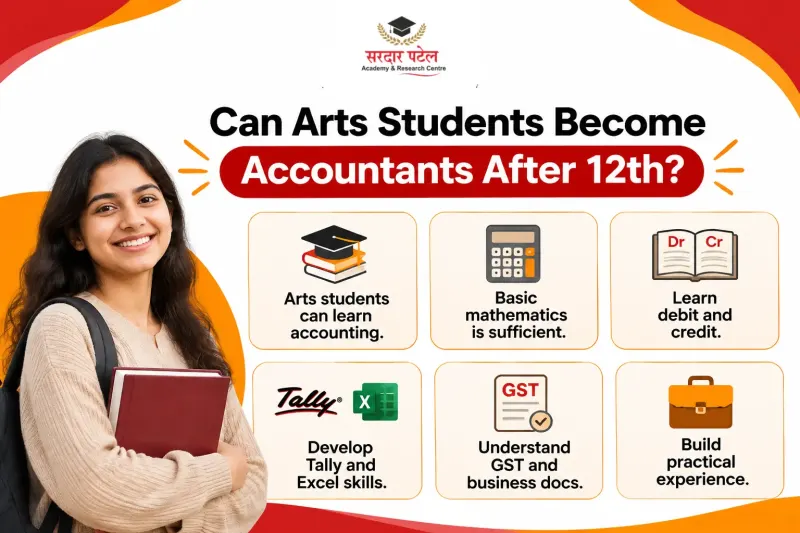
That said, it's fair to be honest about the trade-offs too. Arts students may need to put in slightly more effort early on to get comfortable with commercial terminology, things like debit/credit logic or basic taxation concepts that Commerce students pick up in school. This isn't a big hurdle, but it does mean a good foundational course matters more for you than it might for someone from a Commerce background.
If you'd like a broader, step-by-step view of the whole journey, our guide on how to start a career in accounting after 12th covers the complete roadmap.
Accounting Courses After 12th Arts Worth Considering
There isn't one single "correct" path here; the right course depends on your budget, timeline, and whether you want a degree alongside practical skills or just job-ready training as fast as possible.
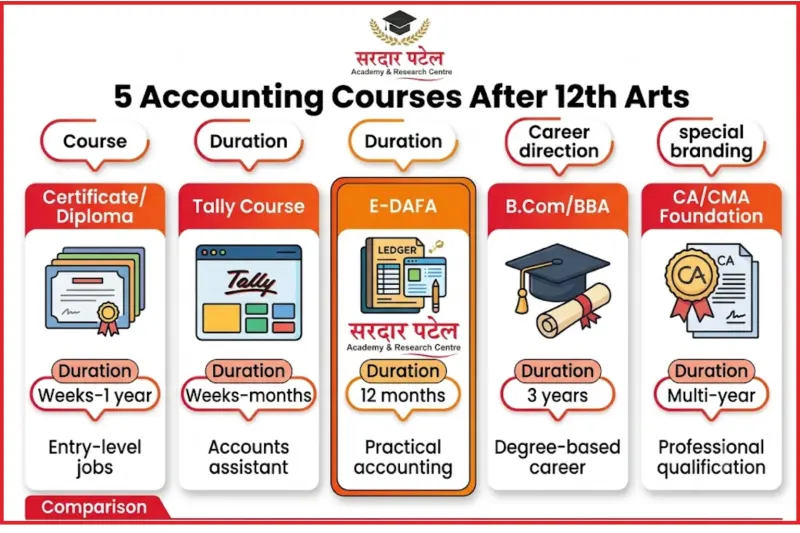
1. Certificate and Diploma Courses in Accounting
These are usually the fastest routes into the workforce. A good diploma course typically covers:
- Fundamentals of bookkeeping and accounting principles
- Tally Prime
- GST basics and return filing
- Payroll and TDS fundamentals
- MS Excel for accounting tasks
Programme length varies widely, from a few weeks for short software courses to around a year for a full diploma, so check the duration before you enrol.
2. Tally Course After 12th Arts
Tally is one of the most commonly asked-for skills in accounts-related job listings, which is why it comes up so often when people ask about accounting jobs after 12th. A focused Tally course typically covers voucher entry and ledger management, inventory, GST invoicing, bank reconciliation, and basic financial reports such as the P&L and balance sheet. It's short, affordable, and maps directly to what employers ask for in accounts assistant and data entry roles. If you want hands-on practice, SPARC's Tally Prime & Busy course is a short-term option.
3. B.Com or BBA (If You're Open to a Degree Route)
Many universities allow arts students to pursue a B.Com or BBA. Some accept students from any stream, while others may ask for a bridge course or additional eligibility criteria. If you're not in a rush and want the credibility of a degree alongside your practical training, this is worth exploring. Admission requirements differ from one university to another, so check the admission page of the specific college you're interested in before you apply.
4. Foundation-Level Courses (CA Foundation / CMA Foundation)
Arts students can generally register for the CA Foundation and CMA Foundation after 12th, but these are rigorous, multi-year commitments, better suited to students who are serious about becoming a chartered accountant or cost accountant eventually, rather than those looking for a quick entry into the job market. Eligibility rules can change, so confirm the latest requirements on the official ICAI website before you plan around it.
Comparing the Options at a Glance
| Course Type |
Duration |
Best For |
Typical job readiness (general view) |
| Certificate/Diploma in Accounting |
A few weeks to 1 year |
Fast entry into the workforce |
High |
| Tally course after 12th Arts |
A few weeks to a few months |
Practical, software-focused skills |
High |
| Practical diploma (e.g., SPARC's E-Accounting Course, E-DAFA) |
12 months |
Complete, job-oriented training: Tally Prime, Busy, GST, TDS, Income Tax e-filing, Advanced Excel |
High |
| B.Com / BBA |
3 years |
Those wanting a formal degree |
Medium (needs added practical training) |
| CA / CMA Foundation |
Long-term (multi-year path) |
Students aiming for CA/CMA qualification |
Low initially, very high long-term |
A common and practical approach many students take: start with a short accounting or Tally course to build job-ready skills quickly, and pursue a degree in parallel if you want the additional qualification down the line. If you're comparing options, you can also read our list of the best accounting courses after 12th, which is a useful comparison point even if you're coming from the arts stream.
Accounting Skills for Beginners: What You Actually Need to Learn
If you're starting from zero, it helps to know exactly what to focus on instead of trying to learn everything at once. Here's a realistic breakdown of what employers commonly look for:
Core accounting concepts
- Understanding debit and credit
- Basics of journal entries and ledgers
- Reading a trial balance
- Understanding the difference between assets, liabilities, income, and expenses
Software skills
- Tally Prime, which appears in many entry-level accounting job listings
- MS Excel formulas like SUM, VLOOKUP, and basic pivot tables go a long way
- Familiarity with GST portals and e-invoicing systems
Compliance basics
- GST return filing process (even at a conceptual level)
- TDS deduction basics
- Payroll processing fundamentals
Soft skills that matter more than people expect
- Accuracy and attention to detail: a single misplaced decimal can cause real problems
- Time management, especially around filing deadlines
- Basic communication skills for coordinating with vendors, clients, or senior accountants
You don't need to master all of this before applying for jobs. Most accounting roles for freshers involve on-the-job learning, but walking in with Tally and Excel basics already gives you a real edge. For a deeper look, read what skills you need to become a professional accountant.
Accounting Jobs You Can Realistically Target
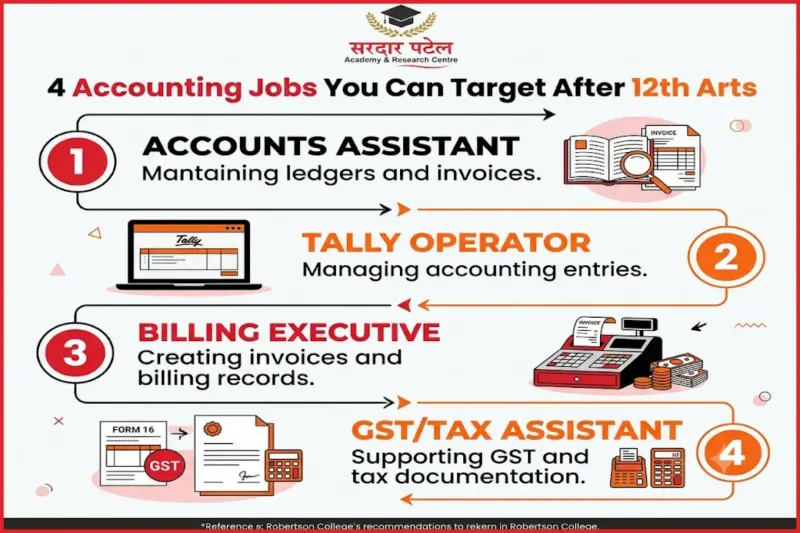
Once you've completed a course, these are some of the roles commonly open to freshers with practical training:
- Accounts Assistant: data entry, invoice processing, and basic ledger maintenance
- Tally Operator: managing books through Tally software
- Billing Executive: generating invoices and managing billing records
- GST/Tax Assistant: supporting senior staff with GST filings and documentation
Small and medium businesses, including many in Delhi NCR, hire for these roles because they need someone who can manage day-to-day books without a full-time chartered accountant on payroll. Salary depends on location, company size, and your skills, so check current job listings in your area before setting expectations. For the full list of roles, see our guide to accounting jobs for freshers.
Building Your Accounting Career Path Step by Step
Here's a practical way to think about your accounting career after arts, rather than trying to plan every year:
- Start with a foundational course. A certificate/diploma programme or a focused Tally course gives you the fastest, most direct route to job-readiness.
- Practice on real or simulated data. Theory alone won't cut it; spend time actually entering transactions, generating reports, and reconciling accounts.
- Apply for entry-level roles while continuing to learn. Don't wait for "complete mastery". Most learning happens on the job.
- Add GST and payroll specialisation over time. These are the skills that move you from a basic data-entry role into something closer to an accounts executive position.
- Consider a degree (B.Com/BBA) alongside work if it fits your goals. This isn't mandatory, but it can open doors to slightly higher-responsibility roles later.
- Evaluate the CA/CMA Foundation only once you're sure. These are long, demanding paths, worth it if accounting is genuinely where you see your future. You can check the latest CMA details on the ICMAI website.
Learning Accounting in Delhi: Where SPARC Fits In
If you're in Delhi NCR and want practical, software-based training, Sardar Patel Academy & Research Centre (SPARC) runs its accounting programmes from its GTB Nagar campus, near GTB Nagar Metro Station Gate No. 4. Its E-Accounting Course (E-DAFA) is a 12-month programme designed for learners with no prior technical or commerce background.
The course starts with computer basics and MS Office, then moves into accounting fundamentals, Tally Prime, Busy, GST, TDS, Income Tax e-filing, and Advanced Excel, with practical assignments throughout. Students also get placement assistance, including resume guidance and mock interviews, and flexible batch timings are available for working professionals. Fee and instalment details are shared directly by the counselling team.
Common Mistakes to Avoid
- Waiting for the "perfect" course instead of starting with a solid, practical one and building from there.
- Skipping software practice. Knowing accounting theory without Tally or Excel practice makes it harder to clear interviews.
- Ignoring GST basics. Even a surface-level understanding makes a real difference in interviews, since GST compliance touches almost every accounting role today. The official GST portal is a good place to see how filing works.
- Assuming a degree is not mandatory. Many roles prioritise practical skills over academic background, especially at the entry level.
Final Thoughts: Your Next Step
Choosing an accounting career after 12th arts doesn't require a commerce background. It requires the right training and a willingness to get hands-on with tools like Tally and GST filing. Whether you go with a short diploma, a focused Tally course, or eventually a degree alongside your skills, the path is genuinely open to you.
The most practical next step is simple: pick a course that teaches real, job-ready skills rather than just theory, and start practising as early as possible. If you're exploring where to begin, you can explore SPARC's E-Accounting Course (E-DAFA) to build job-ready accounting skills, or get in touch with the SPARC team to talk through which course fits your goals best.
Sardar Patel Academy & Research Centre (SPARC)
Call: +91 93129 66129
Address: 2514, Ground Floor & First Floor, Hudson Lane, Kingsway Camp (Opposite Laxmi Dairy), near GTB Nagar Metro Station Gate No. 4, Delhi 110009
FAQs
Yes. Accounting is a skill-based field, and arts students can enter it through certificate courses, diploma programmes, Tally training, or by pursuing B.Com/BBA where eligible. What matters most to employers is practical competency, not your 12th stream.
A Tally course is often enough to qualify for entry-level roles like Tally Operator, Accounts Assistant, or Billing Executive, especially when paired with basic GST knowledge. For more advanced roles, additional qualifications or experience typically help.
No. Foundational accounting courses are designed to teach commercial concepts from scratch, assuming no prior commerce background. It may take a bit more initial effort, but it's entirely learnable.
This depends on the course you choose. Short certificate or Tally-focused programmes can take a few weeks to a few months, a full diploma such as a 12-month programme takes about a year, and a degree route (B.Com/BBA) takes around three years.
A diploma or certificate course focuses on practical, job-ready skills over a shorter duration, while a degree offers broader academic coverage over a longer period. Many students choose to start with a diploma or Tally course and add a degree later if needed.
Arts students can generally register for the CA Foundation and CMA Foundation after 12th. These are longer, more rigorous paths best suited to students committed to a long-term career in professional accounting. Always confirm current eligibility with ICAI and ICMAI before applying.
Start with the basics of debit/credit and ledgers, then move into Tally and Excel, followed by GST fundamentals. Building these in that order tends to make the learning curve smoother.
Yes. SPARC's E-Accounting Course (E-DAFA) is a 12-month programme built for non-technical learners, so no prior commerce or computer background is assumed. It covers Tally Prime, Busy, GST, TDS, Income Tax e-filing, and Advanced Excel with practical assignments, and placement assistance is part of the programme.