+91 9312966129
 sparc.enquiry01@gmail.com



AI Content vs Human Content: What Works Better for SEO?
AI content vs human content: see what Google says, what ranking data shows, and a hybrid workflow to publish SEO pages that rank and earn reader trust.
Table of Contents
- What Counts as AI Content and Human Content?
- What Google Actually Says About AI-Generated Content
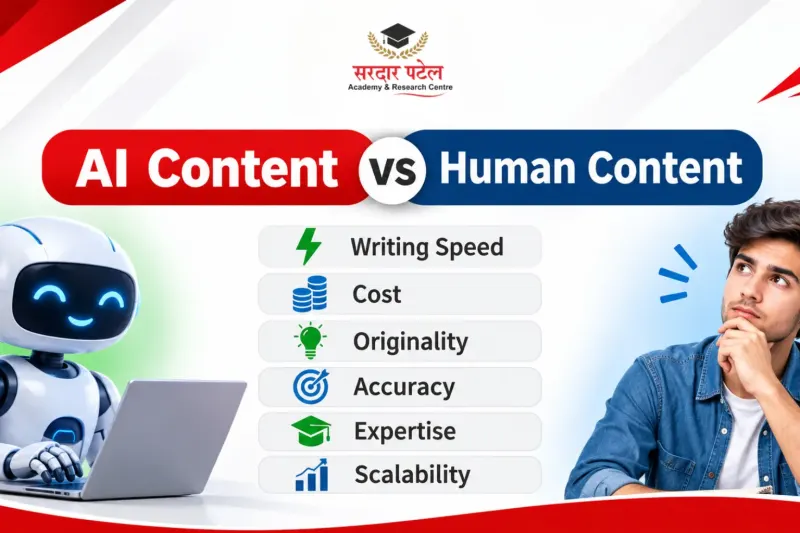
- AI Content vs Human Content: A Side-by-Side Comparison
- What the Ranking Data Shows
- How to read these numbers carefully
- Which Approach Fits Which Content?
- Where AI Helps and Where Humans Still Win
- Good uses of AI in an SEO workflow
- Work that still belongs to people
- AI SEO Beyond the Blue Links
- Cost, Speed and the Indian Context
- A Hybrid Workflow That Works
- Start with intent, then scaffold with AI
- Add what only you know
- Fact-check and edit for voice
- Add something original and name the author
- Run a 30-Day Test on Your Own Site
- Common Mistakes to Avoid
- What This Means for SEO Careers
- Conclusion
Open any marketing forum today, and you will find the same argument going in circles. Should a business publish what a language model drafts in a few minutes, or pay a writer to spend days on one article? The debate is no longer a thought experiment, because it now shapes budgets, hiring plans and publishing calendars.
The practical answer sits between the two camps. This guide compares AI content vs human content on the factors that affect search performance: quality, accuracy, originality, cost, speed and trust. You will see what Google says in its own documentation, what recent ranking data suggests, and a workflow you can start using this week. If you are still getting to grips with the wider discipline, What Is Content Marketing and Why It Matters is a useful warm-up.
What Counts as AI Content and Human Content?
AI-generated content is text produced mainly by a language model from a prompt, with little rewriting afterwards. Human content is written by a person who researches the topic, shapes the structure and drafts the piece using their own knowledge and judgement.
Most real pages sit somewhere in between. A writer might ask a tool for an outline, draft the body alone, then run a grammar check. Another team might generate a full draft and have an editor rebuild half of it. So the sharper question is not “who typed the words?” but “how much human thinking went into them?”
 What Google Actually Says About AI-Generated Content
Google has stayed consistent on one point: it cares about the value of a page, not the tool behind it. Its guidance on using generative AI content says the technology can help when researching a topic and adding structure to original content, but the result must still meet Search Essentials and the spam policies. Producing many pages with no added value for users can break the scaled content abuse policy.
The guidance also became stricter on accuracy. On 1 October 2026, Google updated that page to explain that generative models predict likely word sequences rather than retrieve facts, so output can contain errors. It now describes manual fact-checking and review before publishing as critical, as Search Engine Roundtable reported.
Google’s quality guidance also leans on a framework called E-E-A-T: experience, expertise, authoritativeness and trustworthiness. Quality raters use it to judge pages, and those ratings help Google test its systems rather than rank individual pages directly. For writers, it works as a practical checklist. Does the author have real experience with the topic? Can the claims be trusted? Is it clear who stands behind the page?
Google’s own guide to generative AI search makes the same point: optimising for AI features is still SEO.
AI Content vs Human Content: A Side-by-Side Comparison
Here is how the two compare when you look at the work itself rather than the hype.
| Factor |
AI-generated content |
Human content |
Speed |
First drafts in minutes |
Slower, often hours or days |
| Cost per draft |
Low | Higher |
| Factual reliability |
Needs careful checking for errors |
Depends on the writer’s research habits |
| Original insight |
Recombines patterns it has seen |
Can include first-hand experience, interviews and opinion |
| Voice and brand fit |
Generic unless heavily guided |
Distinct and consistent when the writer knows the brand |
| Scalability |
High |
Limited by team size |
| Trust signals |
Weak on its own |
Strong when the author has real expertise |
| Main risk |
Thin, repetitive pages at scale |
Inconsistent quality and slower output |
Neither column wins outright. The real decision is about which weaknesses your team can afford. A site with ten expert authors and a slow calendar has different needs from a small team maintaining a large help centre.
What the Ranking Data Shows
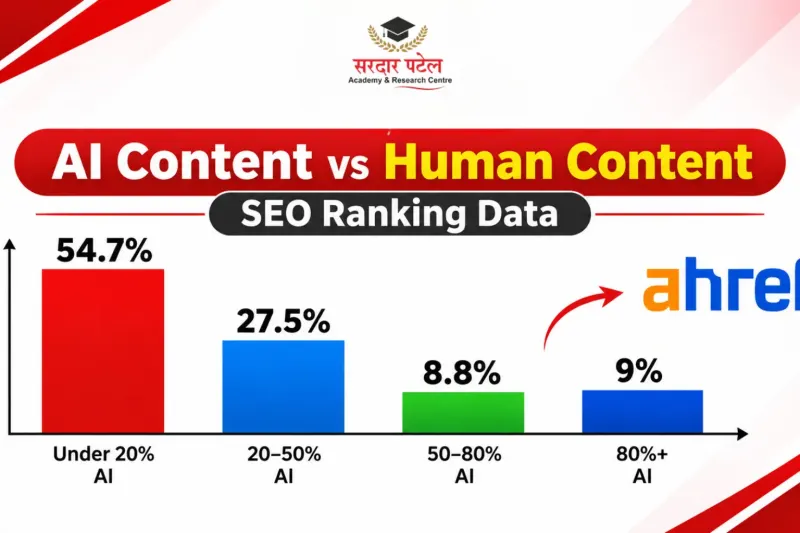
The strongest public evidence on AI content vs human content comes from an Ahrefs study published in July 2026. It examined pages from the top 10 results for 100,000 Google searches (about 150,000 pages were long enough to analyse) and estimated how much of each page was AI-written. Among pages in positions one to three, the split looked like this:
| Estimated AI level on the page |
Share of top-three results |
| Under 20% |
54.7% |
| 20–50% |
27.5% |
| 50–80% |
8.8% |
| 80% or more |
9.0% (including 5.3% at 100%) |
Two things stand out. First, human-led pages hold most of the top spots. Second, fully AI pages do appear there, so a blanket penalty is not what the data shows. Ahrefs also reported that pages with low or moderate AI levels earned two to three times the organic impressions of pages with high or very high levels.
How to read these numbers carefully
These are correlations. A page may rank lower because it is generic, not because a detector flagged it. Coverage from Search Engine Journal points out that heavily flagged pages still rank across the top 10.
Detector tools, including the one Ahrefs used, estimate how machine-like a text looks. Their scores are probabilistic, so a high score is a prompt to review the page, not proof of a problem. What matters is usefulness to the reader. is usefulness to the reader.
Which Approach Fits Which Content?
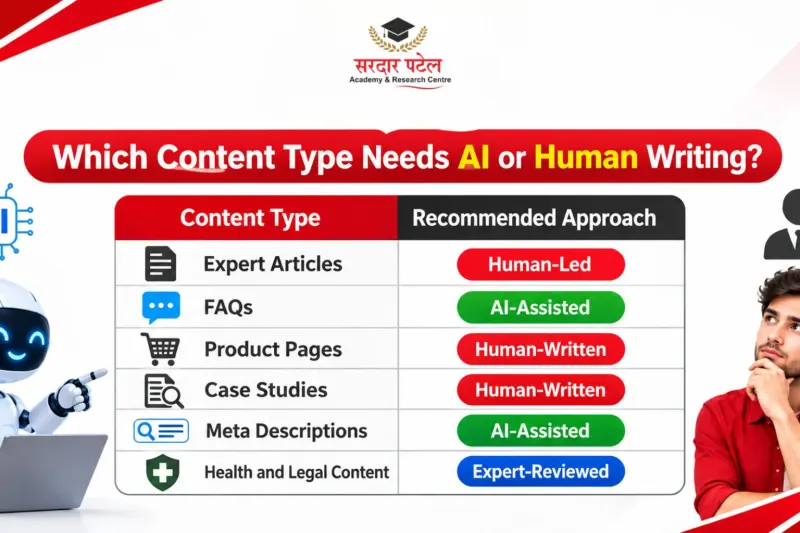
The right mix of AI content vs human content depends on the page. This table is our practical recommendation, not a Google rule.
| Content type |
Best approach |
Reason |
| Expert articles and opinion pieces |
Human-led, AI for research |
Readers come for first-hand experience |
| Service, course and product pages |
Human-written, AI for variations |
Facts, fees and claims must be exact |
| Health, money, legal and career advice |
Human-written, expert-reviewed |
Mistakes can cause real harm |
| Glossary entries and FAQs |
AI-assisted, editor-checked |
Structured and repeatable |
| Meta descriptions and headline tests |
AI-assisted |
Low risk and quick to iterate |
| Ad copy variations |
AI-assisted, human-approved |
Volume testing suits automation |
| Case studies, interviews and original research |
Human |
Proof cannot be generated |
| Hundreds of near-identical pages |
Avoid unedited AI |
Falls under scaled content abuse |
Ad copy is where many teams start experimenting, and How AI-Powered Google Ads Campaigns Work explains the paid-search side of that story.
Where AI Helps and Where Humans Still Win
The healthiest way to approach the question is by task, not by ideology.
Good uses of AI in an SEO workflow
- Brainstorming angles, subtopics and reader questions from a seed keyword
- Grouping and summarising long keyword lists (our guide to AI keyword research goes deeper)
- Building a first-pass outline and testing alternative headline or meta description wording
Work that still belongs to people
- First-hand experience such as test results, classroom observations or client outcomes
- Opinions, trade-offs and recommendations that carry accountability
- Interviews, quotes and original data
- Sensitive subjects like health, money, legal and career advice, plus the final accuracy check before anything goes live
Consider a college describing its training outcomes. A model can write a polished paragraph on why employability matters, but only the institution knows its own student results, employer feedback and curriculum choices. That is why a resource like our employability whitepaper carries weight that generic text cannot copy. Human content wins wherever the proof lives outside a model’s training data.
AI SEO Beyond the Blue Links
AI Overviews and chat assistants now summarise answers and cite sources, which changes what “ranking” means. Ahrefs found that 76% of AI Overview citations come from pages already in Google’s top 10, so classic SEO still feeds Google’s AI answers.
Other assistants behave differently: in a 2025 analysis of 15,000 prompts, only about 12% of links cited by ChatGPT, Gemini and Copilot appeared in Google’s top 10 for the same prompt. Either way, assistants tend to cite clear, well-sourced pages that answer a question directly, and those qualities come from careful editing, not volume. Our AI search trends roundup tracks how this is shifting. our guide AI Agent vs Marketing Automation: What's the Difference?
Cost, Speed and the Indian Context
AI drafts are cheap, but a publishable page is not, so the cost gap is smaller than it looks. The real cost of a page includes the editor’s time, the fact-check, any expert review and the updates that follow. Those steps do not disappear when AI writes the first draft. They simply move from writing to checking.
For Indian businesses and training institutes, the gap is often local detail. Fees in rupees, eligibility rules, certificate recognition, city and campus names, and the way students and parents actually search, often mixing Hindi and English, are exactly the facts a generic draft gets wrong or leaves out. Those details also make a page useful to a local reader, so they deserve a human pass every time.
The same economics apply to paid search, where AI can multiply ad variations but a marketer still has to approve them. How AI Is Changing Google Ads in 2026 is a useful follow-up if you manage ad accounts.
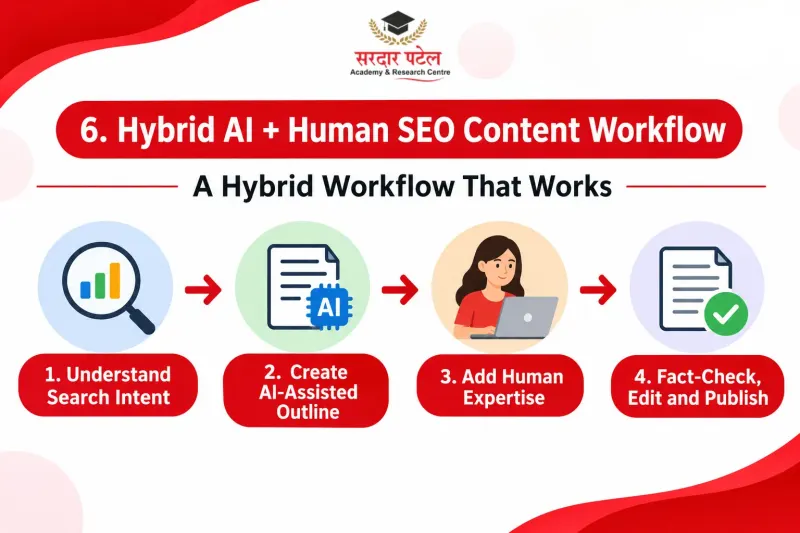
A Hybrid Workflow That Works
The best-performing teams rarely pick a side. They divide the work so each part goes to whoever does it better. Here are the four steps that matter most; our AI content strategy guide covers the wider planning.
Start with intent, then scaffold with AI
Look at what searchers actually want from the query, decide the angle, and only then ask a tool for related questions, possible headings and gaps. Treat the output as raw material.
Add what only you know
Write down your own examples, numbers, mistakes and opinions, then write the introduction, the recommendation and every expertise-led section yourself.
Fact-check and edit for voice
Verify statistics and names against primary sources, keep the links, and cut filler. Check this guide: AI content quality checklist covers the full review.
Add something original and name the author
A table, a screenshot, a short case or a quote makes the page harder to substitute, and clear authorship tells readers who stands behind it.
Run a 30-Day Test on Your Own Site
Public studies of AI content vs. human content show patterns. Your own data shows what works for your audience. A simple test:
- Pick six topics of similar difficulty and search demand.
- Publish three as AI-led drafts with a basic edit and a full fact-check, and three as human-led pages with AI support and original examples.
- Track impressions, clicks and average position in Google Search Console for 30 to 60 days.
- Compare the groups, but stay cautious. Six pages is a small sample, so use the results to shape your next test rather than to declare a winner.
Common Mistakes to Avoid
- Publishing raw drafts. Unedited output tends to be generic and may contain errors, which is why Google’s October 2026 update calls manual review critical.
- Scaling thin pages. Producing hundreds of near-identical pages is exactly what the scaled content abuse policy targets.
- Treating it as a purity test. The goal is a useful page, not a certificate of how it was typed.
- Trusting detector scores as verdicts. Detectors estimate. They do not tell you how Google will rank a page.
- Chasing keyword counts. Covering the reader’s questions beats repeating a phrase to hit a number.
What This Means for SEO Careers
Writers who can edit, verify and add original insight offer something tools struggle to supply. The lesson is simple: tools are common, judgement is not. Read more on SEO careers in the age of ChatGPT.
Conclusion
The AI content vs human content question has no single winner, only better and worse ways of combining them. AI speeds up research, structure and repetitive tasks. People supply experience, accountability and the original thinking that make a page worth citing. Whichever way you weigh AI content vs human content, the pages that last are checked, edited and genuinely useful.
Start small: pick one article, apply the workflow above and compare results after a few months. If you would like guided practice, explore SPARC’s Digital Marketing Course with AI, a seven-month programme covering SEO, content marketing and AI tools through hands-on projects.
FAQs
Not simply for being AI-generated. Google’s guidance targets content produced mainly to manipulate rankings, and scaled pages that add no value, whatever the production method.
Yes. Ahrefs found fully AI pages among the top three results, but they were a small share (5.3%), while most top results were largely human-written.
Neither wins alone. Human-led work holds most top positions in the data above, while AI-assisted work performs acceptably when it is checked, edited and genuinely useful.
No. A rushed or shallow human article can underperform. Human content tends to win where experience, opinion and original evidence matter.
Google’s earlier guidance said disclosure is helpful when readers might reasonably wonder how a piece was made, and that naming AI as the author is probably not the best approach. Check any rules specific to your industry as well.
There is no official percentage. A practical test: would the page still be useful if a reader knew nothing about how it was made, and does it contain at least one thing, such as an example, a data point or a judgement, that a person contributed?